Search Header Logo
The Brainery Intro Chemistry Class

The Brainery Intro Chemistry Class

Assessment

Presentation

Science

9th - 12th Grade

Hard

Solutions, Suspensions, Separation Techniques

Standards-aligned

Created by

Sharon Tan

FREE Resource

26 Slides • 59 Questions

1

media

Secondary Three Chemistry

media

2

Open Ended

What is Chemistry?

3

media

Think that it is all about reactions and mixing of chemicals?

What is Chemistry?

4

5

web page not embeddable

You can open this webpage in a new tab.

​https://www.seab.gov.sg/docs/default-source/national-examinations/syllabus/olevel/2024syllabus/5078_y24_sy.pdf

6

Building on Lower Secondary Science

C8 Atomic Structure: Protons, Electrons, Neutrons
Mass number, Atomic/Proton Number

C11 Chemical Changes: Acids, Bases/Alkalis

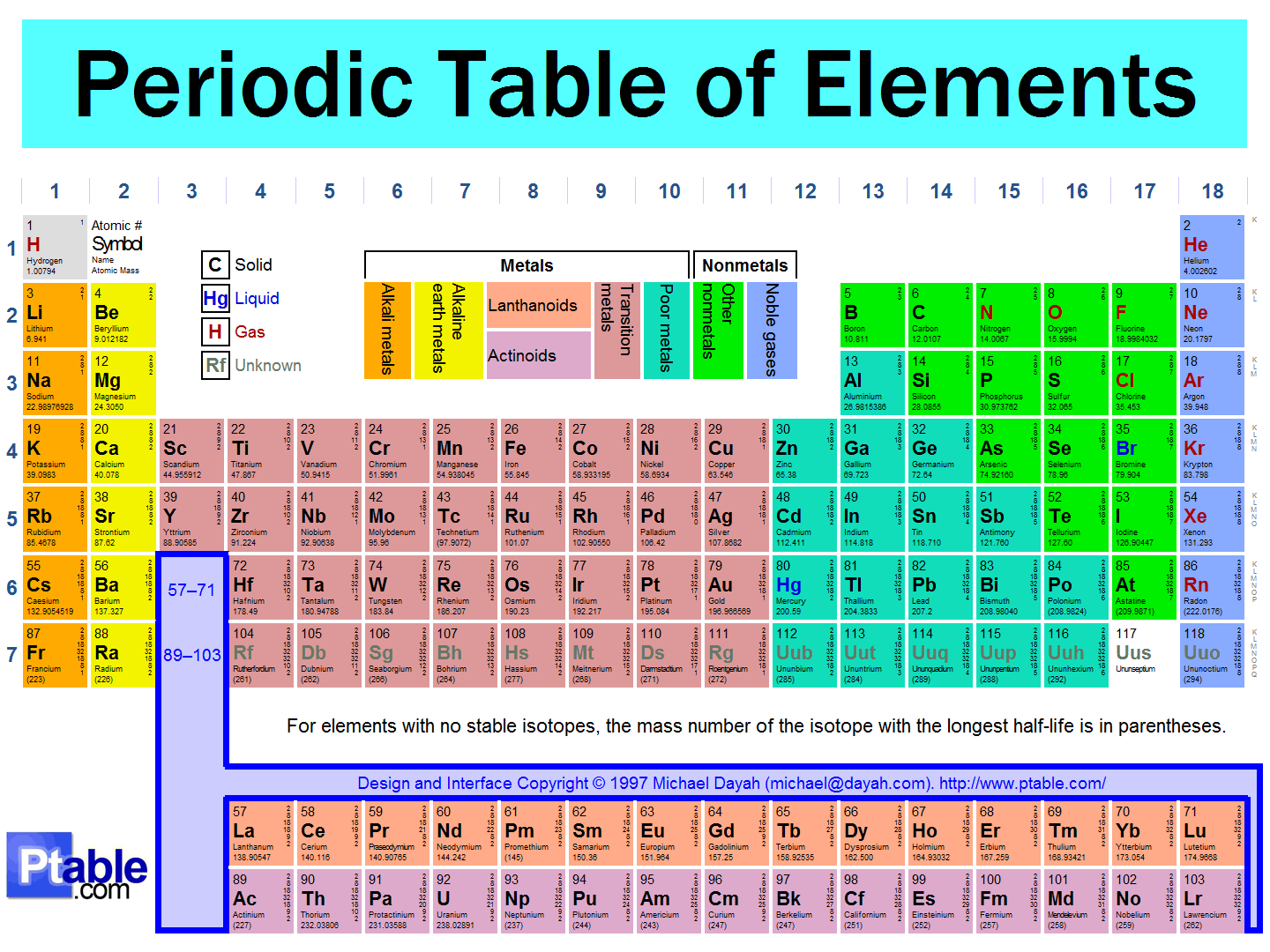
C3 Chemical Composition: Elements, Mixtures, Compounds, Periodic Table

C4 Separation Techniques: Filtration, Evaporation, Chromatography, Distillation

C7 Particulate Nature of Matter: Particles of Solid, Liquid, Gas

media

7

media

8

media

9

media

10

media

11

media

number is a double digit, we subtract 10.

12

Multiple Choice

The vertical (up and down) columns in the Periodic Table are called

1

groups

2

towers

3

periods

4

atomic numbers

13

Multiple Choice

Elements in a .................. have similar chemical properties.

1

period

2

group

3

row

14

media

15

media

16

Multiple Choice

Which group of the periodic table is composed of inert (not reactive) gases?

answer choices

1

alkali metals

2

alkaline earth metals

3

halogens

4

noble gases

17

media

18

media

19

media

20

Multiple Choice

Question image
The horizontal row on the periodic table is called a
1
group
2
family
3
period
4
atomic number

21

Multiple Choice

Question image
What does the 1.00794 stand for?
1
Hydrogen
2
atomic number
3
atomic mass
4
atomic explosion

22

media

23

Reorder

A mixture contains sulfur powder, iron filings and solid table salt. Order the steps to show the correct sequence to separate the mixture

Use a magnet to remove the iron filings.

Add some water to dissolve the table salt.

Stir with a glass rod.

Filter the mixture.

Heat the filtrate to evaporate the water.

1
2
3
4
5

24

Multiple Choice

Contains only one kind of atom.
1
Element
2
Compund
3
Mixture

25

Multiple Choice

Contains two or more atoms combined
1
Elements
2
Compounds
3
Mixtures

26

Multiple Choice

Which of the following is an element?
1
Sugar
2
Salt
3
Water
4
Oxygen

27

Multiple Choice

Question image
A pure substance...
1
is an element or a compound
2
is an element or a mixture
3
is a compound or a mixture
4
is a mixture

28

Match

Match the following

pure element

pure compound

mixture of elements

mixture of compounds

mixture of elements and compounds

29

Multiple Choice

Question image
What is the picture displayed?
1
atom
2
element
3
molecule
4
compound

30

media
media
media
media

31

Multiple Choice

Question image

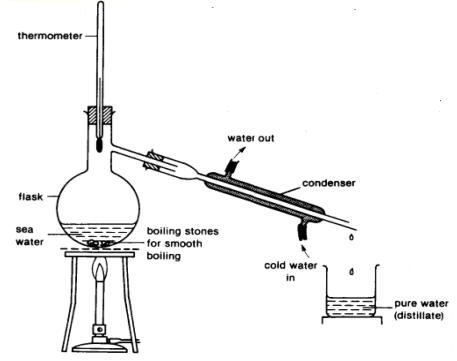
What is the name of this separation technique?

1

Simple distillation

2

Fractional distillation

3

Boiling

4

Evaporation

32

Multiple Choice

Which of the following statements tells us that a sample of liquid is pure water?

1

It is colourless.

2

It leaves no residue when filtered.

3

It boils at 100oC.

4

It is odourless.

33

Multiple Choice

Which separation technique is used to obtain pure water from seawater?

1

Simple distillation

2

Filtration

3

Chromatography

4

Evaporation

34

Multiple Choice

Question image

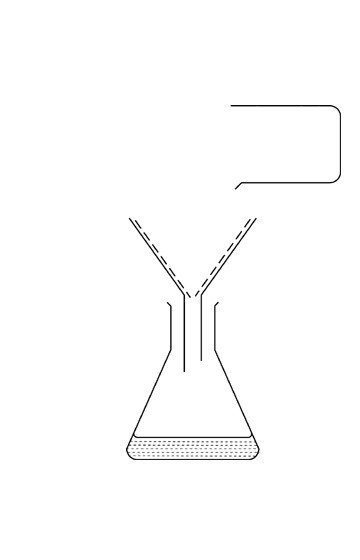
What is the name of this separation technique?

1

distillation

2

filtration

3

evaporation

4

chromatography

35

Multiple Choice

What is the physical property on which fractional distillation depends?

1

different boiling points

2

different melting points

3

different solubilities

4

different densities

36

Multiple Choice

For paper chromatography to work,

1

the dyes must have different boiling points.

2

the dyes must have different solubilities in the solvent.

3

the starting line on the chromatogram must be drawn using pen.

4

The starting line must be below the level of the solvent.

37

Multiple Choice

Which separation technique is used to obtain pure oxygen from liquid air?

1

Simple distillation

2

Filtration

3

Chromatography

4

Fractional distillation

38

Multiple Choice

Which separation technique is used to obtain salt from seawater?

1

Simple distillation

2

Filtration

3

Chromatography

4

Evaporation

39

Multiple Choice

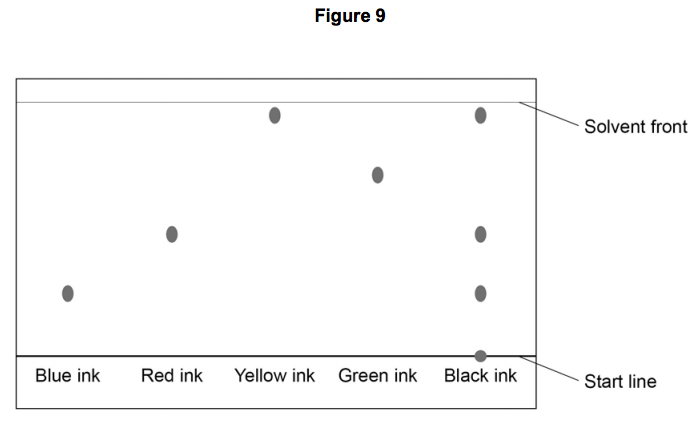
Question image

Which ink is most soluble?

1

Blue

2

Red

3

Yellow

4

Green

40

Multiple Choice

Question image

Which ink is a mixture?

1

Blue

2

Red

3

Yellow

4

Black

41

Multiple Choice

Question image

Referring to the chromatogram, black ink contains

1

Blue, red and yellow ink only

2

Blue, red, yellow and green ink

3

Blue and yellow ink

4

Black ink only

42

Multiple Choice

During filtration, the solid that is trapped in the filter paper is called ..A.. and the liquid that has passed through the filter paper is called ..B..

1

A: residue B: filtrate

2

A: residue B: filterate

3

A: filtrate B: residue

4

A: filterate B: residue

43

media

44

media

45

Multiple Choice

Which statement best describes the fact that gases can be compressed?

1

The particles in a gas do not have a fixed volume.

2

The particles in a gas are very far apart.

3

The particles in a gas have no force of attraction (bonds) between them.

4

The particles in a gas are constantly moving very rapidly.

46

Multiple Choice

Which statement best describes the fact that a liquid cannot be compressed?

1

The particles in a liquid are all close and touching.

2

The particles in a liquid are constantly moving.

3

The particles in a liquid have weak attractive forces between them.

4

The particles in a liquid can change position.

47

Multiple Select

Diffusion occurs in which states of matter?

1

Solids

2

Liquids

3

Gases

48

Multiple Choice

Question image

The three states of matter are represented by diagrams X, Y and Z. Which change occurs during condensation?

1

X to Y

2

X to Z

3

Y to X

4

Z to X

49

Multiple Choice

Particles of all matter are in constant random motion.
1
True
2
False

50

Multiple Choice

These particles are held together by very strong forces of attraction

1

Solid

2

Liquid

3

Gas

4

Plasma

51

Multiple Choice

The particles of solids ________________

1

vibrate about their fixed postions

2

are able to slide over each other

3

move about freely at high speeds and in random direction

4

do not move

52

Multiple Choice

The particles of liquids ________________

1

vibrate about their fixed postions

2

are able to slide over each other

3

move about freely at high speeds and in random direction

4

do not move

53

Multiple Choice

The particles of gases ________________

1

vibrate about their fixed postions

2

are able to slide over each other

3

move about freely at high speeds and in random direction

4

do not move

54

Multiple Select

Which statements describe the arrangement of particles in solids?

1

particles are moving in all directions

2

Particles are arranged in an orderly manner

3

particles can slide over one another.

4

particles vibrate about their positions

55

Multiple Select

Question image

The diagram represent the arrangement of particles in ____________.

1

gas

2

liquid

3

solid

56

Multiple Select

Question image

The diagram represent the arrangement of particles in ____________.

1

gas

2

liquid

3

solid

57

Multiple Select

Question image

The diagram represent the arrangement of particles in ____________.

1

gas

2

liquid

3

solid

58

media
media

59

Multiple Choice

What is atomic number?

1

Number of protons in an atom

2

Number of neutrons in an atom

3

Mass of an atom

4

Charge on an atom

60

Multiple Choice

Which subatomic particles are found in the nucleus of an atom?
1
Protons and Electrons
2
Protons and Neutrons
3
Neutrons and Electrons
4
Protons, Neutrons and Electrons

61

Multiple Choice

Question image

What is the charge formed on the particle shown?

1

1+

2

0

3

1-

4

2+

62

Multiple Choice

The total number of protons and neutrons in an atom is called the...

1

Atomic number

2

Proton number

3

Nucleon number

4

Weight number

63

Multiple Choice

Atoms of the same element must always have the same number of _________
1
electrons
2
neutrons
3
isotopes
4
protons

64

Multiple Choice

The __________ of an atom is the sum of the protons and neutrons in the nucleus of that atom.

1

nucleon number

2

atomic number

3

atomic weuight

4

isotope weight

65

Multiple Choice

Which particle is negatively charged?
1
proton
2
atom
3
neutron
4
electron

66

Multiple Choice

For an atom to be electrically neutral, it must contain the same number of _____

1

protons and neutrons

2

neutrons and electrons

3

protons and electrons

4

nucleons and electrons

67

Multiple Choice

An atom of an element has the electronic configuration 2,8,5. Which group and period is the element placed in the Periodic Table?

1

Group 13, Period 3

2

Group 13, Period 5

3

Group 15, Period 3

4

Group 15, Period 5

68

media
media
media

Hydrogen Gas Test
Bring a lighted splint near the gas.
Flame extinguished with a 'pop' sound.

Hydrochloric acid
Nitric acid
Sulfuric acid

Sodium hydroxide
Potassium hydroxide

aqueous ammonia

69

media

​Neutralisation

70

media
media

​Test for CO2
Bubble gas into limewater.
White precipitate formed.

71

Multiple Choice

A neutralisation reaction is a reaction between 
1
Acid and a Base 
2
Acid and water 
3
Base and water 
4
None of the above 

72

Multiple Choice

An acid reacts with metal to produce 
1
Carbon dioxide 
2
Hydrogen gas
3
Hydrogen gas and water 
4
Salt and hydrogen gas 

73

Multiple Choice

A neutralisation reaction produces 
1
An acid 
2
A neutral substance 
3
Only water 
4
Salt and water 

74

Multiple Choice

An acid reacts with a metal carbonate to produce 
1
Salt, water and hydrogen gas
2
Salt, water and carbon dioxide
3
Limewater
4
Salt and water 

75

Multiple Choice

What type of reaction is the following:

HCl + Zn --> ZnCl2 + H2

1

Neutralisation

2

Acid and a metal

3

Acid and a carbonate

4

Physical reaction

76

Multiple Choice

Complete the following reaction:
Sulfuric acid + sodium carbonate
--> 

1
Carbon dioxide + water 
2
calcium carbonate + water + carbon dioxide 
3

Sodium sulfate + water + carbon dioxide 

4
Sodium chloride + water + carbon dioxide 

77

Multiple Choice

Complete the following reaction:
Hydrochloric acid + magnesium hydroxide --> 
1
Magnesium chloride + water 
2
Magnesium + water
3
Magnesium chloride + hydrogen gas 
4
Magnesium chloride + water + carbon dioxide 

78

Multiple Choice

What are properties of acids?
1

Bitter, slippery, pH above 7

2

Sour, reacts with metals, pH below 7

3

Sour, reacts with metals, pH above 7

4

Bitter, pH of 7, does not react with metals

79

Multiple Choice

Which of the following is the chemical formula of an acid?

1

NaOH

2

HCl

3

H2O

4

Ca(OH)2

80

Multiple Choice

Which of the following is the chemical formula of a base/alkali?

1

CaSO4

2

H2SO4

3

Ba(OH)2

4

KCl

81

Multiple Choice

What is the test for carbon dioxide produced from a reaction?

1

the burning splint test

2

the glowing splint test

3

bubbling the gas through limewater

82

Multiple Choice

Which gas gives out a 'pop' sound when a lighted splint is placed in it?

1

hydrogen

2

oxygen

3

carbon dioxide

4

nitrogen

83

New!

Chemical formula and equations!
Chemical bonding!
Preparing salts!
Mole calculations!
Redox reactions!
Metal reactivity series!

Period Table Group Properties!
Energetics!
Rate of reactions!
Electrochemistry!
Organic chemistry!

and more depth on sec 2 topics!

84

media

85

media
media

Secondary Three Chemistry

media

Show answer

Auto Play

Slide 1 / 85

SLIDE