
Lesson 2 - Forces

Presentation
•
Science
•
7th Grade
•
Practice Problem
•
Hard

Jayden Campbell
Used 2+ times
FREE Resource
30 Slides • 3 Questions
1
2
Measuring Forces
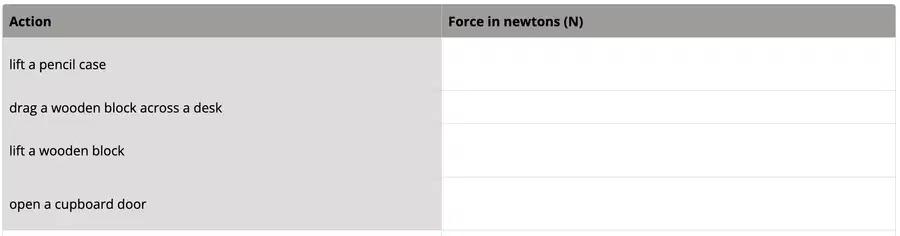
Forces are measured in newtons. The symbol for newtons is a capital "N". For example, 5 newtons is written as 5 N.
The newton is named after Sir Isaac Newton. He discovered the laws that apply to forces in the 1680s.
When you hold an apple, the force of gravity it applies down on your hand is about one newton. A one litre carton of milk presses down with a force of around 10 N.
Forces are measured using an instrument called a spring balance.
3
Activity
4
Balanced Forces
If there is a change in how something moves or changes shape, then we know that a force has acted on it. But, this does not mean that there is a change in motion or shape every time a force is applied.
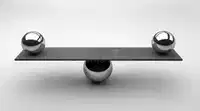
For example, a book resting on a table does not move. It may appear that there are no forces acting on it. However, there is a downward pull on the book by gravity. There is also an upwards push on the book by the table.

5
Balanced Forces
These two forces are equal in size and cancel each other out.
When forces act on an object in opposite directions and are the same size they are known as balanced forces. Balanced forces cancel each other out and have no effect on the object's motion or shape.
6
Simulation Activity
We can investigate this question by using the interactive.
Follow these steps to get started:
Start the interactive below by selecting 'Net force'
Drag the figures onto the rope. Set up the figures to be the same as in the image to the right by selecting one small blue figure and one small red figure
Press 'Go!' when you are ready to run the interactive
Press the orange reset button in the right hand corner to start again
7
Try something different
Now, use the interactive to change the figures. This time you must have at least two figures on one side, however, the result must be balanced.
8
Balanced forces
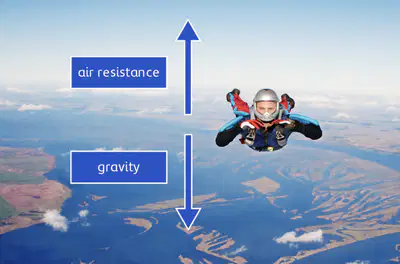
Balanced forces don't always mean that the object has stopped moving. If an object is travelling at a constant speed without changing direction the forces acting on it are balanced. An example can be seen when skydiving.
9
Balanced forces
As a skydiver jumps, they quickly fall downwards due to the pull of gravity. The upward push of air works to slow the skydiver down. As they increase in speed, the amount of air resistance increases. Eventually, the amount of air resistance becomes equal to the force of gravity. The forces become balanced. The skydiver will continue to fall downwards, however, it will be at a constant speed.
10
Multiple Select
Balanced forces act on objects that are....
Not moving
Moving at a constant speed
Slowing down
Speeding up
11
Multiple Choice
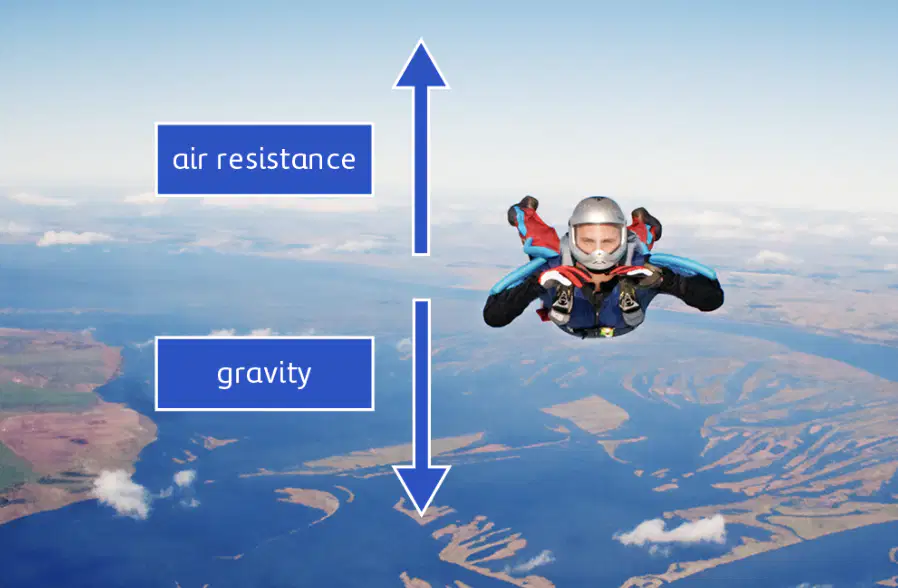
Look at the image of the skydiver. When air resistance and gravity are equal, the skydiver will...
Stop falling
Speed up
Slow down
Continue to fall at a constant speed
12
Unbalanced Forces
When the forces acting on an object are different sizes then this will result in a change in the shape or motion of an object. Forces that can change the motion or shape of an object are known as unbalanced forces.
For example, we can see unbalanced forces in action when looking at a moving golf ball. The applied force from the golf club, not shown in the video, causes the golf ball to move to the left. However, the force of friction is much larger and acts in the opposite direction to slow it down. As friction is greater in size, it eventually causes the ball to stop moving.
13
Simulation Activity
Investigate by using the interactive again.
Start the interactive by selecting 'Net force'.
Drag two small blue figures and one small red figure onto the rope.
Press 'Go!' when you are ready to run the interactive.
Press the orange reset button in the right hand corner to start again.
14
Net Forces
The overall force acting on an object is known as the net force. The net force states the overall newtons of force, as well as the direction that the overall force is travelling in.
You can calculate the net force when the forces are equal and opposite, or balanced. You can also calculate it when one force is greater than another, or unbalanced. How to calculate the net force depends on whether the forces are acting in opposite directions or in the same direction.
15
When to subtract forces
When forces are acting in opposite directions the smaller force cancels out some of the larger force, but not all. We can calculate the net force by subtracting the smaller force from the larger one.
16
When to subtract forces
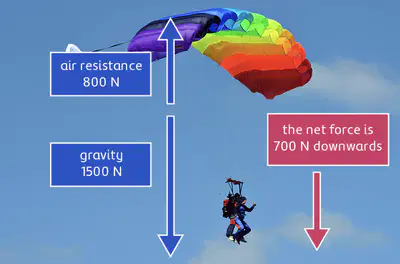
For example, we could calculate the net force of two people in a parachute. The pull of gravity towards the Earth is 1500 N, while the air resistance on the falling parachute is 800 N.
To calculate the net force:
1500 N – 800 N = 700 N
The larger force is downwards, therefore the net force is 700 N down.
17
Multiple Choice
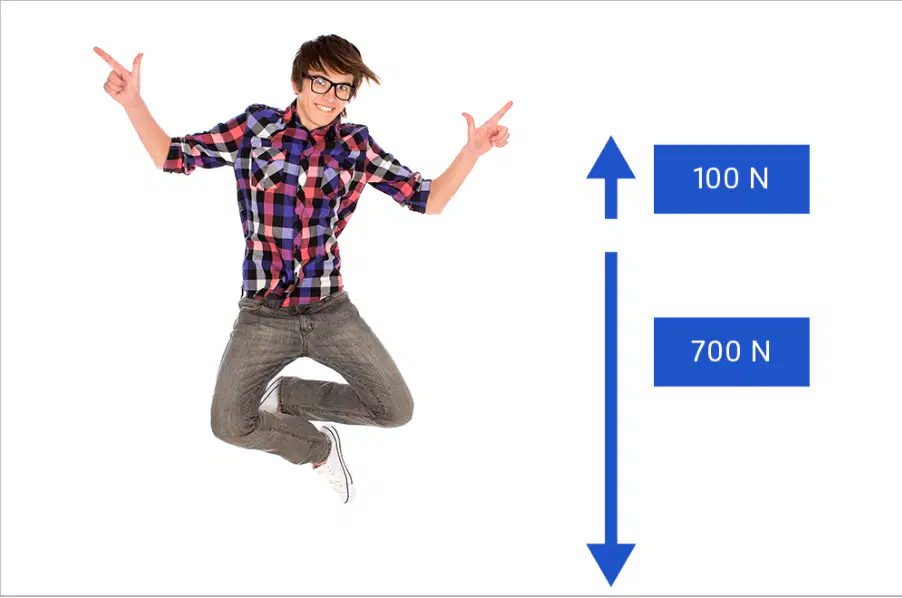
The net force on the young man jumping in the image is...
600 N down
600 N up
800 N up
800 N down
18
Simulation Activity
Follow these steps to get started:
Start the interactive by selecting 'Net force'
Turn on the 'Values' button on the top righthand side, this will allow you to see the size of the forces on each side of the trolley
Drag the figures onto the rope
Press 'Go!' when you are ready to run the interactive
Press the orange reset button in the righthand corner to start again
19
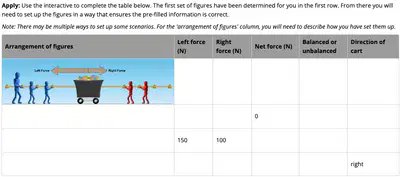
Simulation Activity
See worksheet that is handed out on what to do.
20
When to add forces
Forces do not always act in opposite directions.
If two forces are moving in the same direction, they can add together to create a larger net force.
21
When to add forces
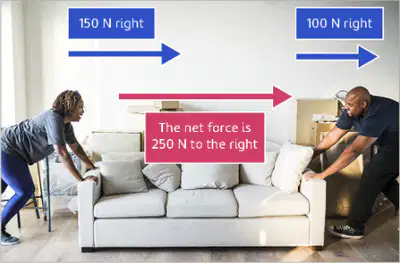
If we looked at the image on the right we can see two people moving a couch to the right. One person is pushing the couch 150 N to the right, while the other person is pulling the couch 100 N to the right.
22
When to add forces
To calculate the net force:
150 N + 100 N = 250 N
As both forces are going to the right, the net force is 250 N to the right.
23
24
25
26
27
Gravitational fields
There is a space surrounding every object where another object will experience the force of gravity. This is known as a gravitational field. Every object with mass has its own gravitational field.
The more massive an object is, the greater the strength of its gravitational field. For example, the Sun is much more massive than the Earth and therefore has a stronger gravitational field than Earth. Humans also have their own gravitational fields. Ours are just much smaller than those of Earth and other planets and stars in the Solar System.
28
Gravitational fields
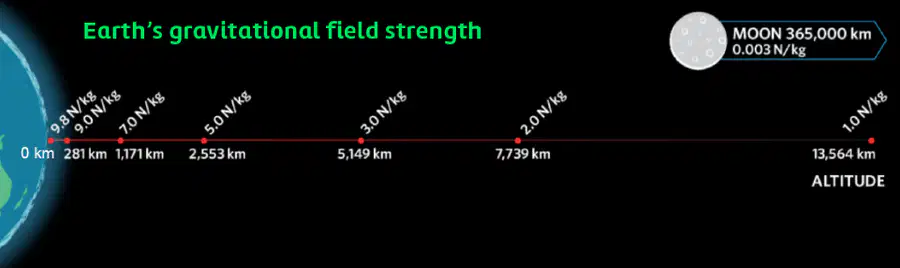
The size of the force of gravity in a gravitational field can change. The size of the force, at a particular location, on a mass of 1 kg is the gravitational field strength. Force is measured in newtons (N), so gravitational field strength is measured in newtons per kilogram (N/kg).
29
Gravitational fields
The diagram below shows the Earth's gravitational field strength as you travel out towards the Moon.
Remember: Objects at any position in the diagram aren't just in Earth's gravitational field. They're also in the gravitational fields of all the objects in the Universe! But almost all of those other objects are so small or far away that they have virtually no effect. The exceptions are the Moon and Sun.
30
Weight vs mass
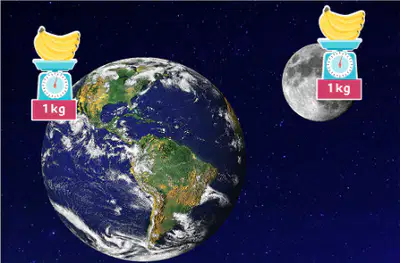
As it says in the video from the start of the lesson, people weigh less on the Moon than on Earth. While your weight would change, your mass would not. These terms are used interchangeably in everyday language, but their scientific meanings are quite different.
31
Weight vs mass
Mass: how much matter an object contains, measured in kilograms.
Weight: the gravitational force on an object, measured in newtons.
The amount of matter in an object doesn't change. If you had 1kg of bananas on the Earth and took it to the Moon, you would still have 1 kg of bananas on the moon. They'd fill you up just as much wherever you ate them!
32
Weight vs mass
But the forces acting on them differ. The gravitational field is stronger on the Earth's surface than on the Moon. Therefore the gravitational force on the bananas – that is, their weight – is different at the two locations.
33
Weight vs mass
We can calculate the weight using the following equation:
weight (N) = mass (kg) x gravitational field strength (N/kg)
or
W = m x g
Example
What is the weight of a 50 kg girl on the Earth's surface?
Mass of girl = 50 kg
Gravitational field strength at Earth's surface = 9.8 N/kg
W = m x g
= 50 kg x 9.8 N/kg
= 490 N
Show answer
Auto Play
Slide 1 / 33
SLIDE
Similar Resources on Wayground

24 questions
Electric Circuits
Presentation
•
7th Grade
28 questions
Reproductive System
Presentation
•
7th Grade
23 questions
Global Winds Part 1
Presentation
•
7th Grade
23 questions
Pangea and. Continental Drift
Presentation
•
7th Grade
26 questions
Photosynthesis and cellular respiration
Presentation
•
7th Grade
26 questions
Cell Division
Presentation
•
7th Grade
25 questions
Local Winds
Presentation
•
7th Grade
28 questions
2.22 Density
Presentation
•
7th Grade
Popular Resources on Wayground
10 questions
How much do you know about our Portrait of an Eagle?

Quiz
•
10th Grade
10 questions
Fast Food Slogans
Quiz
•
6th - 8th Grade
21 questions
Continents and Oceans
Quiz
•
6th Grade
20 questions
Parts of Speech
Quiz
•
5th Grade
16 questions
Subject & Predicate
Quiz
•
5th Grade
25 questions
Multiplication Facts
Quiz
•
5th Grade
12 questions
Map Skills
Quiz
•
3rd Grade
22 questions
Continents and Oceans
Quiz
•
5th Grade
Discover more resources for Science
17 questions
7.6D Aqueous Solutions
Quiz
•
7th Grade
20 questions
Claim, Evidence and Reasoning (CER)
Quiz
•
6th - 8th Grade
18 questions
Counting Atoms
Quiz
•
7th - 8th Grade
10 questions
Exploring Chemical and Physical Changes

Interactive video
•
6th - 10th Grade
20 questions
Food Chains & Food Webs
Quiz
•
5th - 7th Grade
10 questions
Decoding the Periodic Table of Elements
Interactive video
•
6th - 10th Grade
16 questions
Photosynthesis and Cellular Respiration Review
Quiz
•
7th Grade
10 questions
Exploring the Periodic Table
Interactive video
•
6th - 10th Grade