

photosynthesis

Presentation
•
Biology
•
9th Grade
•
Medium

supper teacher
Used 54+ times
FREE Resource
29 Slides • 49 Questions
1

Light
Photosynthesis
Making
Raw materials:
1.Co2
2.H2O
3.light energy
Products
1.Glucose
2.O2
light energy
Chlorophyll
Carbon dioxide+ water………glucose+oxygen
6Co2+6H20………C6H12O6+6O2
Green Plant
Word
Symbolic/Chemical
2
Multiple Choice
Where does photosynthesis occur?
mitochondria
chloroplast
animal cells
ribosomes
3
Multiple Choice
What is the name of the pigment molecule that absorbs light energy and makes plants green?
chloroplast
glucose
mitochondria
chlorophyll
4
Multiple Select
Which of the following are products of photosynthesis? (Select 2)
glucose
light
water
oxygen
5
Multiple Choice
Am autotroph can:
Make its own food
Make its own water
Make its own oxygen
Make its own carbon
6
Multiple Choice
What type of energy conversion occurs in photosynthesis?
Light from the sun to chemical in glucose
Chemical in glucose to chemical in ATP
7
Multiple Choice
True or false: ATP is produced during photosynthesis
True
False
8

9
Multiple Choice
Which of the following are products of photosynthesis?
glucose and oxygen
glucose and water
carbon dioxide and water
ATP and sunlight
10
Multiple Choice
Which of the following is a reactant of photosynthesis?
oxygen
carbon dioxide
ATP
glucose
11

Chloroplast
Co2
Water molecules
Chlorophyll pigment
Sun light
Convert light energy
to chemical
energy…to make
glucose
-
12

Photosynthesis:
Aerobic respiration:
Drawing Paper 6
Dicotyledonous leaf
Flower
Leaves
Stem
Root
6Co2+6H20……..C6H12O6+6O2
C6H12O6+6O2……..6Co2+6H2O+Energy
13

14

1.Co2
2.Water
3.Light energy
Transverse section of Dicotyledonous leaf under
microscope
Many chloroplast
Many chlorophyll
15

Atmosphere
High
concentration
of carbon
dioxide in
atmosphere
Low
concentration of
carbon dioxide
inside the leaf
1.many chloroplast
2.many chlorophyll
3.trap more light energy
4.more photosynthesis
16

Vascular bundle
Water
Xylem
Phloem
Food
1.Sucrose…respiration and
energy/ATP release
2.Amino acids…protein
synthesis and growth
1.Transport water
from root to leaves
2.Support the plant
17

Leaves
Roots
Root hair cells
Xylem
(Osmosis)
18

19

Sun….light energy
Waxy layer….transparent….allow light to pass
to reach chloroplast in palisade mesophyll cells
Chlorophyll in chloroplast
converts light energy into
chemical energy
Transparent….No
chloroplast….to trap light
by chloroplast in palisade
mesophyll cells
Cell X…200…Palisade
CellY…0…Upper epidermis
Cell Z…30….spongy
20

Leaf
Atmosphere
High
concentration
of oxygen
inside the leaf
Low
concentration
of oxygen in
the atmosphere
21

22

23

24
Multiple Choice
25
Multiple Choice
26
Multiple Choice
27
Multiple Choice
28
Multiple Choice
29
Multiple Choice
30
Multiple Choice
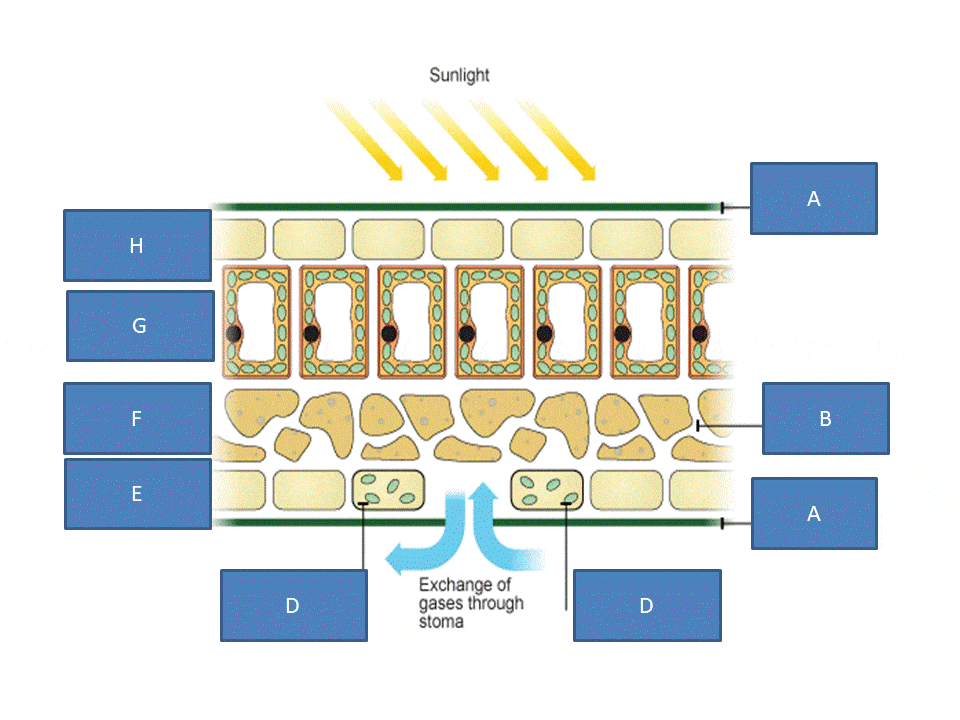
What is the name of the elongated, packed cells (part G) directly under the upper epidermis?
Palisade cells
Guard cell
Spongy layer
Lower epidermis
31
Multiple Choice
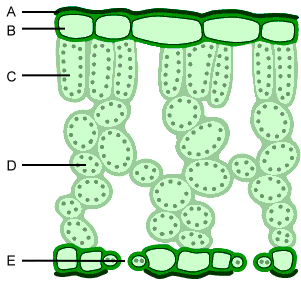
What is letter "A" pointing to?
cuticle
upper epidermis
lower epidermis
palisade mesophyll
32
Multiple Choice

Which number is pointing to the xylem of the leaf?
3
4
5
6
33
Multiple Choice

Which number is pointing to the stomata?
6
7
8
9
34
Multiple Choice
Which part of the leaf consists of xylem and phloem?
vascular bundle
bundle sheath
palisade mesophyll
spongy mesophyll
35
Multiple Choice
Most photosynthesis occurs in this part of the leaf:
upper epidermis
cuticle
palisade mesophyll
spongy mesophyll
36
Multiple Choice
The outermost layer of CELLS of the leaf is the
cuticle
epidermis
spongy mesophyll
bundle sheath
37
Multiple Choice
This layer of cells is where photosynthesis occurs within the leaf; there are air spaces within this layer
spongy mesophyll
palisade mesophyll
chloroplast
upper epidermis
38
Multiple Choice
The cell organelle where photosynthesis occurs in plant cells is the
chloroplast
mitochondrion
vacuole
nucleus
39
Multiple Choice
The vascular tissue which transports sugar (food) in both directions within the leaf is the
xylem
phloem
bundle sheath
chloroplast
40
Multiple Choice
Which two layers of the plant contain chloroplasts?
xylem and phloem
upper and lower epidermis
cuticle and upper epidermis
palisade and spongy mesophyll
41
Multiple Choice
The majority of the stomata of a leaf can usually be found within the
guard cells
upper epidermis
lower epidermis
cuticle
42
Multiple Choice
The stomata are controlled by '________' shaped' guard cells
Kentucky Fried Chicken
Sausage
Banana
Pear
43
Multiple Choice
So from top to bottom, a leaf's structure is
- Palisade cells
- Waxy cuticle and epidermis cells
- Spongy mesophyll
- Epidermis and cuticle, with stomata
- Waxy cuticle and epidermis cells
- Palisade cells
- Spongy mesophyll
- Epidermis and cuticle, with stomata
- Epidermis and cuticle, with stomata
- Waxy cuticle and epidermis cells
- Palisade cells
- Spongy mesophyll
- Waxy cuticle and epidermis cells
- Spongy mesophyll
- Palisade cells
- Epidermis and cuticle, with stomata
44

Absorption of mineral ions will lower the
water potential….creates a water potential
gradient…absorb water by osmosis through
partially permeable membrane….guard cell
become turgid…stomata opens
Stomata opens:
1.High water potential in
the vacuole of guard cells
2.High light intensity
To reduce
water loss
Stomata closes:
1.Low water potential in
the vacuole of guard cells
2.High temperature
3.Low light intensity
45
Multiple Choice

Stomata are made of specialized cells called ______ which surround a tiny pore/opening
stoma
guard cells
dermal cells
diffusion channels
46
Multiple Choice

The main function of stomata is to
capture sunlight
protect leaves from insects
allow gases to move rapidly in/out of leaves
release sugars into the atmosphere
47
Multiple Choice

A stoma is
an opening
a clot
a cell that captures light energy
a water tube
48
Multiple Select
What happens to the guard cells when water is not available within a plant?
The guard cells close.
The guard cells open.
The guard cells become double.
The guard cells increase.
49
Multiple Choice
Guard cells are specialized cells in the surface of the leaf of a green plant.
The main function of these cells is to
change the size of the stomate to regulate water loss
close the stomate to keep dust and dirt out of the leaf
close the stomate to keep dust and dirt out of the leaf
close the stomate to keep dust and dirt out of the leaf
50

Bright light: Photosynthesis>Respiration…More O2…Less Co2
Dark night: Respiration> Photosynthesis…More Co2…Less O2
Dim light: Photosynthesis=Respiration…O2=Co2
PTR
51

Low Co2
High Co2
Co2=O2
C6H12O6+6o2….6Co2+6H20
52

53

Minerals requirement
Nitrate
Magnesium
Phosphate
Root hair cell absorption by
active transport against
concentration gradient using
ATP through specific protein
1.Nitrate…amino acids (CHO+N)…protein…growth…protein
synthesis…enzymes
No nitrate….poor stunted growth…weak stem
2.Magnesium….chlorophyll pigment….trap light energy…
photosynthesis
No magnesium…pale yellow leaves…chlorosis
3.Phosphate…nucleic acid(DNA)…cell division and protein
synthesis
No phosphate…poor growth
54
Multiple Choice
Plants need large amounts of nitrogen, so nitrogen is a_______
micronutrient
meganutrient
macronutrient
omninutrient
55
Multiple Choice
In order to make proteins, plants need to absorb
Magnesium Ions
Nitrate Ions
Sucrose
Carbon Dioxide
56
Multiple Choice
The following ions are necessary for the plants to absorb EXCEPT
Nitrate
Phosphate
Magnesium
Manganese
57
Multiple Choice
This ion is needed for the creation of chlorophyll
Magnesium
Iron
Phosphate
Sulphate
58
Multiple Choice
Which is a definition for photosynthesis?
Releasing energy from nutrients
The breaking down of large insoluble molecules into small soluble molecules
The process by which plants make carbohydrates from raw materials using energy from light
The movement of particles from a high concentration to a low concentration
59

60

61
Fill in the Blanks
State the type of molecules that catalyse the reactions of photosynthesis
62
Multiple Choice
In the middle of the day in winter in Shanghai which factor is most likely to limit the rate of photosynthesis?
Number of guard cells
Light intensity
Water availability
Temperature
63
Multiple Choice
What percentage of the Earth's atmosphere is carbon dioxide?
0.04%
0.4%
4%
40%
64
Multiple Choice

Why does the graph level off?
Carbon dioxide is the limiting factor
The stomata are not fully open
Some factor other than the concentration of carbon dioxide is limiting
The plant needs to be watered
65
Multiple Choice
What factor is likely to limit the rate of photosynthesis very early in the morning in a Shanghai summer?
Concentration of carbon dioxide
Water availability
Light intensity
Temperature
66
Multiple Choice

Which lettered graph represents the affect of light intensity on photosynthetic rate?
A
B
C
D
67
Multiple Choice
68
Multiple Choice
69
Multiple Choice
70
Multiple Choice

Which lettered graph represents the effect of temperature on photosynthetic rate?
A
B
C
D
71
Multiple Choice

72

Light intensity
Rate of photosynthesis
Light intensity is
limiting factor
20 degree/ 0.1%
30 degree/0.5%
30 degree/0.1%
A
B
C
Temperature is
limiting factor
73

Light intensity
Rate of photosynthesis
A
0.01%
0.1%
B
Light intensity is limiting factors..Before A
Above A …Co2 concentration is limiting factor
Below B..Co2 concentration is limiting factor
Above B..Temperature is limiting factor
20 C
20 C
30 C
74

What is the importance of photosynthesis process?
75

Animals and
their human
activities
Plants
76

Global warming
“Enhanced Greenhouse Effect”
Green house gases:
1.Co2
2.Methane
3.CFC
Infrared rays
Ice pole
Ice pole
1.Rise in the earth’s temperature
2.Melting of ice caps
3.Rise in sea level
4.Flooding
5.Destruction of habitat
6.Extinction
7.Loss in biodiversity
77

78

Sun
100 molecule of oxygen
Animals Respiration
Photosynthesis
Plant
90
Light
Photosynthesis
Making
Raw materials:
1.Co2
2.H2O
3.light energy
Products
1.Glucose
2.O2
light energy
Chlorophyll
Carbon dioxide+ water………glucose+oxygen
6Co2+6H20………C6H12O6+6O2
Green Plant
Word
Symbolic/Chemical
Show answer
Auto Play
Slide 1 / 78
SLIDE
Similar Resources on Wayground

70 questions
Macromolecules Lessons
Presentation
•
9th Grade
73 questions
Cold War
Presentation
•
10th Grade
74 questions
4.2 Ionic Bonding Notes
Presentation
•
9th Grade
73 questions
BJC Review gr 9 Day 2 zoom
Presentation
•
9th Grade
72 questions
Honors Early Humans Part 2
Presentation
•
9th Grade
71 questions
IC3 GS5 CF Buổi 1
Presentation
•
9th Grade
77 questions
STAAR Biology EOC Reporting Category 3
Presentation
•
9th Grade
73 questions
QUIZIZZ ULANGKAJI BIOLOGI 9 (T4): NUTRISI
Presentation
•
10th Grade
Popular Resources on Wayground
10 questions
Safety Day 2026 – Student Review

Quiz
•
9th Grade
21 questions
Continents and Oceans
Quiz
•
6th Grade
20 questions
Parts of Speech
Quiz
•
5th Grade
16 questions
Subject & Predicate
Quiz
•
5th Grade
25 questions
Multiplication Facts
Quiz
•
5th Grade
12 questions
Map Skills
Quiz
•
3rd Grade
22 questions
Continents and Oceans
Quiz
•
5th Grade
15 questions
Rounding Decimals
Quiz
•
5th Grade
Discover more resources for Biology
20 questions
Cell Transport
Quiz
•
9th - 12th Grade
25 questions
photosynthesis and cellular respiration
Quiz
•
9th Grade
20 questions
Cell Cycle
Quiz
•
9th Grade
8 questions
DNA vs. RNA
Presentation
•
9th - 12th Grade
14 questions
Ecological Succession: Primary and Secondary
Quiz
•
9th Grade
20 questions
Characteristics of Life
Quiz
•
9th - 10th Grade
12 questions
Cell Cycle
Quiz
•
9th Grade
20 questions
Cell Organelles
Quiz
•
9th Grade