
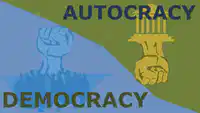
6th GO Chapter 3 Section 1: Autocracy vs. Democracy

Presentation
•
Social Studies
•
6th Grade
•
Practice Problem
•
Medium

Jennifer Pineda
Used 3+ times
FREE Resource
9 Slides • 8 Questions
1

Autocracy
vs.
Democracy
2

Systems of Government
A government is the people and
system that has authority to make laws, enforce laws, and interpret laws when disagreements arise
for a political entity such as a city,
state, or country. A government
also oversees the general welfare
of its citizens.
3
Multiple Choice
Government is ___________.
the president who is the leader of a country.
the citizens that live in a city, state, or country and take part in decisions in their communities.
people having the right to vote for the leaders of their choice.
the people and the system that has the authority to make, interpret, and enforce laws and oversees the welfare of the people.
4

Two Very Different Systems
Most governments are either autocratic or democratic. Factors that distinguish between an
autocracy and a democracy are:
●Who holds the power?
●To what extent can citizens participate?
For example: Are citizens allowed to vote? Can citizens run for political office? Can citizens voice their
ideas and opinions without punishment?
5
Drag and Drop
6

7
Drag and Drop
8
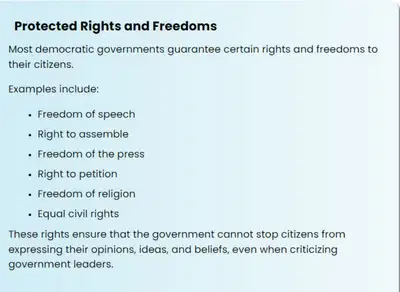
Your Voice Heard in a Democracy
In a democracy, citizens have many ways to express themselves and participate in the government process. That is because a democracy is all about making the voice of the people heard!
Voting is one of the main ways citizens participate in the government of a democracy. Voting allows citizens to assert their power over what the government does and the laws it makes. Free elections, held every few years, ensure that power is passed peacefully from one political leader to another, when citizens vote to do so. Voting is both a right and a responsibility.
Citizens can also participate in the government of a
democracy by running for political office, petitioning
the government, and voicing their opinions in
newspapers, on television, and in other media
sources.
9


Stifled Opinions and Muffled Voices in an Autocracy
Citizen participation is a very different story in an autocracy.
In an autocracy, citizens have little to no role in choosing the government’s leaders. Instead, one ruler (dictator) or single political party holds unlimited power. In general, dictators rule by force and are unwilling to give up power without war or other political violence.
Autocratic governments limit citizens’ rights and freedoms, or deny them entirely. People are not
allowed to express their ideas and opinions freely, especially if they are criticizing the government. In some cases, citizens can be fined, jailed, or even killed for speaking out against the government.
The press also has its freedoms limited by autocratic governments. Newspapers, radio, television, internet, and other media sources are often censored to remove content that the government does not want citizens to hear.
10


Monarchy
In an absolute (true) monarchy, a king,
queen, sultan, or emir inherits power
through his or her family line. This monarch
is all-powerful, and citizens are given little
opportunity to participate in government.
For example: Saudi Arabia is ruled by a
king who exercises complete control.
Citizens have no role in the government
and their freedoms of speech, religion, and press are limited.
11

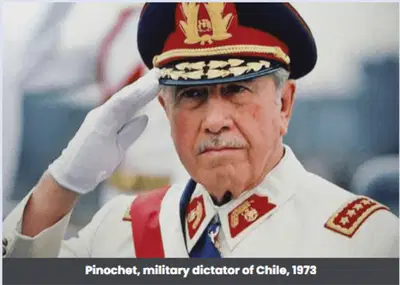
Dictatorship
In a dictatorship, a single leader or
political party controls all aspects of the government, often by use of force. Citizens’ freedoms are not protected, and citizens typically do not have the right to vote.
For example: From 1973 to 1990, the
South American country of Chile was
under the dictator Augusto Pinochet,
who used the military to control Chile’s
government.
12

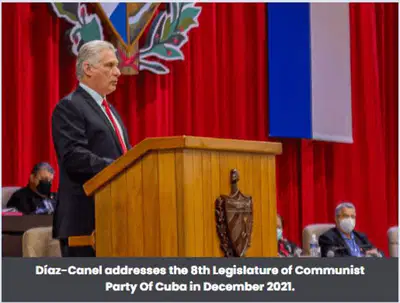
Totalitarian State
A totalitarian state attempts to control all
aspects of the country, including its economy, education, art, and science. This tight control leaves little room for citizen participation.
For example: Cuba is a totalitarian state led by Miguel Díaz-Canel. Diaz-Canel has been
President of Cuba since October 10, 2019 and is considered chief of state and chief of the armed forces. The Cuban government controls all aspects of life in Cuba and offers no opportunities for citizens to participate.
Authorities interfere with privacy and engage in monitoring of its citizens private
communications. The government also has
severe limitations on freedom of speech and
press, restricted freedom of movement, and
limited freedom of religion.
13
Open Ended
How your life would be different if you did not live in a democracy with protected rights and freedoms? What limitations would you experience? How would you feel about these limitations?
14
Multiple Choice
Why is voting an important right in a democracy?
It is how citizens use the power.
It is how governments are funded.
It is how laws are passed.
It is how war is decided.
15
Multiple Choice
Select the statement that describes democracy.
Citizens are not allowed to criticize the government.
One leader (or party) holds all power, usually by force.
Citizens’ rights and freedoms are limited, or entirely denied.
Changes in government often come through political violence.
Voting is the most important responsibility of citizens.
16
Multiple Choice
Select the statement that describes autocracy.
Citizens play a key role in choosing government leaders.
Citizens are allowed to express their opinions freely.
Peaceful elections are held every few years.
The people, or their elected representatives, hold the power.
Citizens play little to no role in choosing government leaders.
17
Multiple Choice
Which statement is false?
Freedom of speech and the press allow citizens to get and share information so they can make better decisions about government.
Autocratic governments allow freedom of speech but not freedom of the press.
Some governments will not allow one’s freedom of speech or press so that they can block ideas and opinions not supported by the government.
Autocracy
vs.
Democracy
Show answer
Auto Play
Slide 1 / 17
SLIDE
Similar Resources on Wayground

12 questions
Africa Religions & Ethnic Groups
Presentation
•
7th Grade
12 questions
Mummification
Presentation
•
6th Grade
12 questions
Three Chinese Philosophies
Presentation
•
6th Grade
13 questions
Four Empires- Politics in Mesopotamia
Presentation
•
6th Grade
14 questions
Brazil: Location, Climate, and Natural Resources
Presentation
•
6th Grade
15 questions
Ancient Egypt and Isrealite's
Presentation
•
6th Grade
12 questions
Governments of Europe
Presentation
•
6th Grade
14 questions
The Maya
Presentation
•
6th Grade
Popular Resources on Wayground
11 questions
Hallway & Bathroom Expectations

Quiz
•
6th - 8th Grade
10 questions
HCS SCI 03 Summer School Assessment 2
Quiz
•
3rd Grade
11 questions
Home Scope
Quiz
•
7th - 8th Grade
12 questions
2026 TAP Technology in the Classroom
Presentation
•
Professional Development
15 questions
HCS SCI 05 Summer School Assessment 2 Review
Quiz
•
5th Grade
15 questions
HCS SCI 04 Summer School Review 2
Quiz
•
4th Grade
59 questions
Geometry Unit 3 Review
Quiz
•
9th - 12th Grade
14 questions
FAST ELA READING SMAPLE TEST MATERIALS

Passage
•
3rd Grade