

It's up for Debate

Presentation
•
English
•
12th Grade
•
Practice Problem
•
Hard

Langston Sinclair
Used 1+ times
FREE Resource
64 Slides • 0 Questions
1


© Presto Plans
2

3




• Why do you think debating is
an important skill to learn and
practice?
Do Now
• Do you think it’s more
important to win a debate or
learn from the experience?
• What skills do you think are
required to be good at the art
of debating?
© Presto Plans
SS: I think debating is an important skill…
SS:I think the skills
required….I think it’s..
4

5



2. Write it down on your
white board.
1. What is a debate?
Think about it first.
6



A debate is a formal discussion or
argument between two or more
individuals (or teams) presenting
opposing viewpoints on a specific
topic. The goal of a debate is to
persuade the audience to support
one side of the issue over the other.
Although there are several debate
formats, they all generally adhere
to a similar structure that allows
both sides to present arguments
and rebuttals.
WHAT IS A DEBATE?
© Presto Plans
Analyze this
excerpt.
7



Have you ever heard the word
rebuttal before? Yes or no!
8




Debates serve an important function in
society. Firstly, they help us to expand our
knowledge on important topics by
encouraging us to consider a wide range
of viewpoints. This helps us to examine
our own opinions critically!
PURPOSE OF DEBATES
Secondly, debates help us gain a
better understanding of perspectives
that are different from our own. This
can help us have more compassion
and understanding for those we
disagree with—which can help move
the conversation forward (without
merely having an unproductive
shouting match)!
© Presto Plans
Make an
inference about
the excerpt on
your white
board.
Next turn
& talk.
9

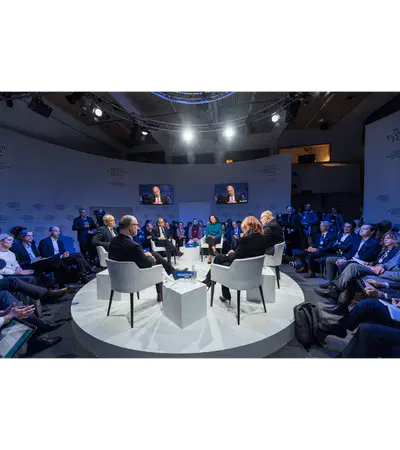


Given their formal nature, debates
often come with a variety of rules,
practices, and guidelines that should
be followed. The most important rule
of all, however, is to always be
respectfulduring the debate.
DEBATE ETIQUETTE
Since debates thrive on the
exchange of opposing viewpoints, it
is easy to imagine how we might
have an emotional response to an
argument or claim. To ensure the
effectiveness of debates, we must
not allow ourselves to disrespect the
opposition in any way. Doing so
tarnishes the integrity of debates.
© Presto Plans
Make a gist!
No more than 9 to 10 words.
10




Before you begin a debate, you must
settle on a topic. Debate topics can
span a wide range of subjects, from
current events and politics to social
issues, science, technology, and
more! An important thing to note
about debate topics is that they
should always be written in the form of
a statement (not a question). They
should also be specific—and
something that people sometimes
disagree with. This makes debates
more interesting and relevant.
DEBATE TOPICS
© Presto Plans
Write down a strong
debatable topic!!
11


Let’s take a look at the difference
between strong and weak topics:
STRONG VS. WEAK TOPIC
Violent video games should be banned.
This topic is strong because it is
specific (violent video games) and
makes a point that some will disagree
with (they should be banned).
Video games have all sorts of benefits.
This topic is weak. It does not make a
specific point that people would
necessarily argue against, nor is it a
necessarily contentious statement. Surely,
video games have some benefits!
© Presto Plans
12




Identify which of the following is the
strong topic and which is the weak one.
IT’S YOUR TURN!
2.
Students should not have access to cell
phones in school.
1.
Cell phones have many practical uses.
Which is stronger: example 1 or 2?
1or 2
© Presto Plans
13




Every debate has two sides:
affirmative or negative.
AFFIRMATIVE / NEGATIVE
Affirmative (which means
agreeing with) refers to the
side that agrees with the
topic. They will argue the
statement is correct.
Negative refers to the side
that disagrees with the
topic. They will argue the
statement is wrong.
© Presto Plans
14

DOL: Answer the multiple-choice questions
by writing the answer on your response card.
1.The goal of a debate is to_____ the audience to support one side of the issue over the other.
A.Structure
B.Present
C.Rebuttal
D.persuade
2.
Debates serve an important function in ______
A.America
B.Community
C.Society
D.Courts
3.
Secondly, debates help us gain a better __________ of perspective that are different from our own
A.Knowledge
B.Understanding
C.Skills
D.Trust
4.
Every debate has two sides:
__________ or ____________
A.
affirmative or positive
B.
rebuttal or argument
C.
affirmative or negative
D.
positive or negative
5. What is the most Important rule during debate?
15


Here are some other debate terms
you will want to know before
beginning a debate.
DEBATE TERMS
Constructive: This is a phase of the
debate where you present your main
arguments and build the foundation
you will draw upon later.
Rebuttal: A rebuttalis when one
side gives evidence that disproves
an argument made by the other
side of the debate.
© Presto Plans
16


WEEK 2 DEBATE !!
17

18



Do Now:
Choose a side to argue about
the affirmative or negative.
Advertising on social media is
harmful.
Write 3 to 4 sentences on
your response card.
SS: I choose the affirmative, concerning advertising…..
19

LO:
20


Quick Response! Time!
Which argument side did you choose?
The Affirmative or negative side.
Write it on your white board.
21



Thesis Statement: This is the main
argument or position the
speaker has on a debate topic.
Dropped Argument: A
dropped argument is an
argument in a debate that the
opposition fails to respond to.
Conceded Arguments: These
are points or claims that one
side acknowledges or
accepts as valid without
offering a counterargument.
DEBATE TERMS
© Presto Plans
Annotate the key
points on your
response card
22


Debate Process
Why do you need a Thesis Statement for
debate? Explain why? On your white boards.
23


Debate Process
Why would someone drop an argument during a
debate? Explain why? On your white board.
2 to 3 sentences.
24




Turn & Talk
What is a Conceded argument?
Talk to your shoulder partner about it.
Next
Explain? Write it down on your whiteboard.
25

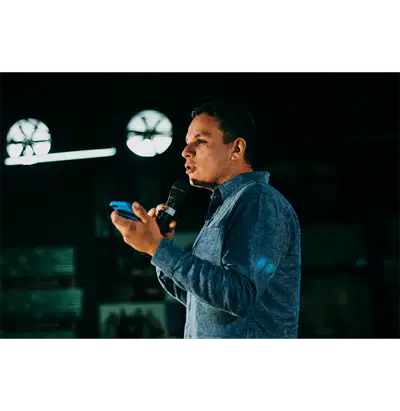
Ethos, pathos, and logos are
rhetorical devices commonly used in
persuasive writing or speech. These
persuasive techniques help convince
an audience to adopt your
viewpoint by making appeals to their
emotions, ethics, and logic.
READ AND ANNOTATE
© Presto Plans
These rhetorical devices are often
used by politicians, activists, leaders,
advertisers—or anyone who needs to
convince an audience of something.
We can use these devices to
improve our debate skills!
26

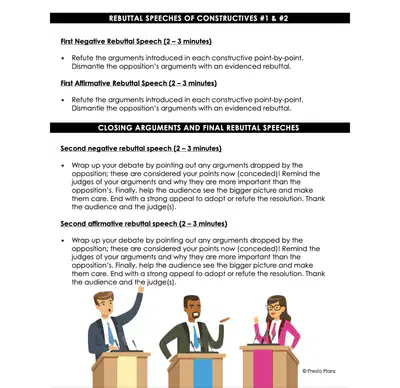
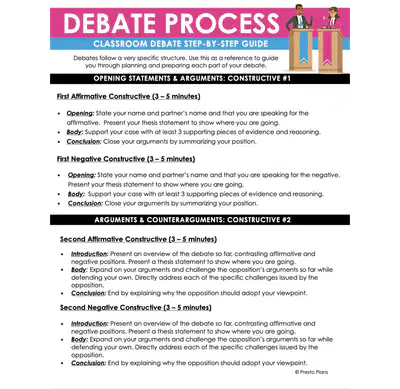
DEBATE STRUCTURE
• 1st Affirmative Constructive
• 1st Negative Constructive
• 2nd Affirmative Constructive
• 2nd Negative Constructive
• 1st Affirmative Rebuttal Speech
• 1st Negative Rebuttal Speech
• 2nd Affirmative Rebuttal Speech
• 2nd Negative Rebuttal Speech
Let’s take a closer look at each step!
© Presto Plans
Although there are many different
debate formats, here is the basic
structure that we will follow.
27

28

Debate Process
29


1. The debate process
A. Is a process you can think of in the moment
B. follows a very specific, thoughtful structure that
is sequential.
C. Is a process that requires minimal work or
research
D. Is an easy process that anyone can complete.
2. Ethos, pathos, and logic are:
a. Rhetorical devices used to appeal to the
emotions of the audience
b. Not an essential part of the debate writing
process
c. Used only rarely to help support arguments
d. Used by unskilled debaters in their arguments
3.Every debate has two sides which are:
a.Counter-arguments and arguments that exist within
the debate
b. Claim, and evidence which explain each person’s side in the
debate
c.Affirmative and Negative, which explain the
argument for and the opposite side of the debate
d.Thesis statement and dropped argument which
explain both sides of the issue
4.When writing your argument, the argument consists of at least:
-
a.One part; the argument and explanation as to why
b.Two parts, the beginning and the ending of the claim
c.Three parts, the opening, body and conclusion
d.Four parts, the opening, body, conclusion,
and counterclaim for the argument
5. Why should you write a counterargument for your debate topic, even if you are arguing
the affirmative side? Explain your answer.
30



DO NOW:
31

32
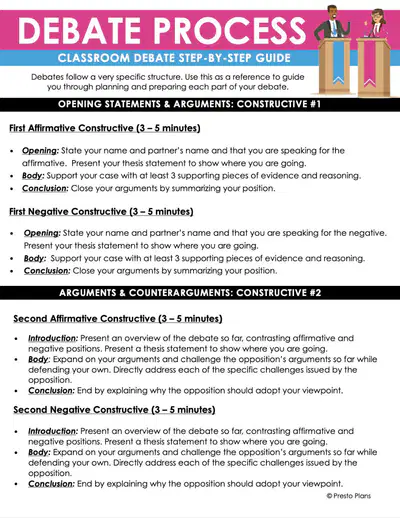
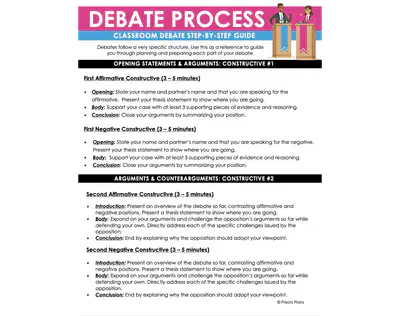
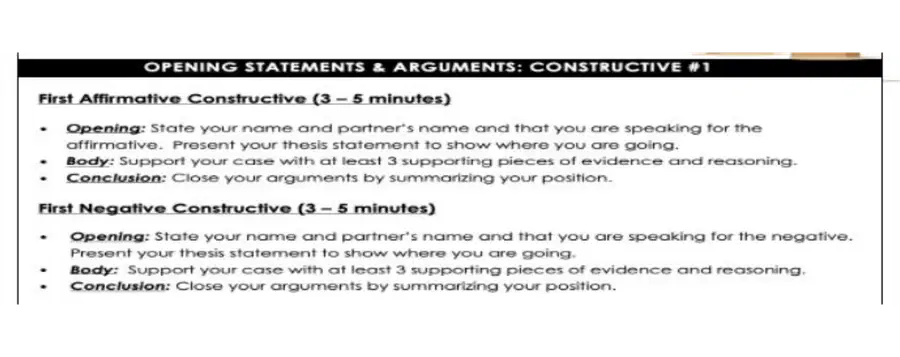
Open the debate by sharing
yours and your partner’s names,
your side (affirmative or
negative), and your thesis
statement.
OPENING STATEMENTS
Then, provide at least 3 pieces of
supporting evidence and
reasoning, and conclude with a
summary of your main points.
© Presto Plans
• 1st Affirmative Constructive
• 1st Negative Constructive
33

What are three Rhetorical devices commonly
used in persuasive writing and speech?
1.
2.
3.
34


Below is an example of what part
of an opening statement for the
affirmative side might sound like:
OPENING STATEMENTS
I’m Sarah Thompson, and this is my
debate partner, James Anderson. We
proudly advocate for the affirmative
position that cell phones should be
allowed in school. We believe that in an
increasingly digital world, integrating cell
phones into the learning environment
enhances educational outcomes.
Research indicates improved resource
access, communication efficiency, and
digital literacy development. Embracing
cell phones is not just a convenience but
a necessity for fostering a modern,
effective educational experience.
© Presto Plans
35


Affirmative Planning
FIRST NEGATIVE CONSTRUCTIVE (3-5 MINUTES)
Name:
PLANNING FOR YOUR DEBATE
OPENING
Thesis Statement
Partner name:
We sincerely take the
affirmative….
36


37


AFFIRMATIVE PLANNING
PLANNING FOR YOUR DEBATE
38


AFFIRMATIVE PLANNING
PLANNING FOR YOUR DEBATE
39

NEGATIVE PLANNING
40



NEGATIVE PLANNING
First Negative Constructive
41


NEGATIVE PLANNING
PLANNING FOR YOUR DEBATE
42


43

44


1. The deb
A. Is a process you can think of in the moment
B. follows a very specific, thoughtful structure that
is sequential.
C. Is a process that requires minimal work or
research
D. Is an easy process that anyone can complete.
2. Ethos, pathos, and logic are:
a. Rhetorical devices used to appeal to the
emotions of the audience
b. Not an essential part of the debate writing
process
c. Used only rarely to help support arguments
d. Used by unskilled debaters in their arguments
3.Every debate has two sides which are:
a.Counter-arguments and arguments that exist within
the debate
b. Claim, and evidence which explain each person’s side in the
debate
c.Affirmative and Negative, which explain the
argument for and the opposite side of the debate
d.Thesis statement and dropped argument which
explain both sides of the issue
4.When writing your argument, the argument consists of at least:
-
a.One part; the argument and explanation as to why
b.Two parts, the beginning and the ending of the claim
c.Three parts, the opening, body and conclusion
d.Four parts, the opening, body, conclusion,
and counterclaim for the argument
5. Why should you write a counterargument for your debate topic, even if you are arguing
the affirmative side? Explain your answer.
45
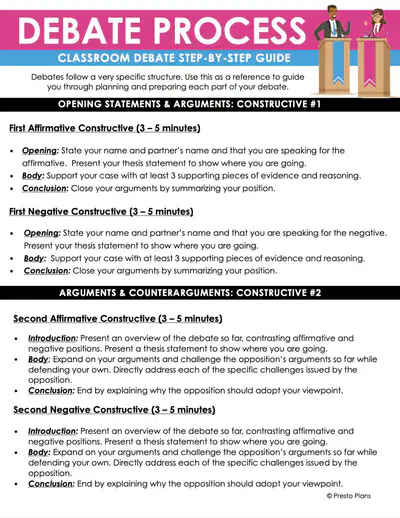
COUNTERARGUMENTS
Now that the debate is in full
swing, it’s time to dig deeper into
your main points. Improve your
argument by defending against
challenges to your position with
counter arguments.
Use a thesis here again to keep your
argument clear. Be sure to explain
why the opposition should adopt
your view.
© Presto Plans
• 2nd Affirmative Constructive
• 2nd Negative Constructive
46


Below is an example of what part
of a counterargument for the
affirmative side might sound like:
COUNTERARGUMENTS
© Presto Plans
After hearing from the opposition, we
continue to assert our position that cell
phones should be allowed in school.
Despite the negative stance that cell
phones cause distraction and behavior
issues in school, the evidence
overwhelmingly supports the improved
learning and connectivity cell phones
bring. Addressing these concerns, we
believe that proper guidelines can help
lessen distractions and foster responsible
usage in the classroom. Cell phones are
an invaluable learning tool, preparing
students for a tech-driven world.
47

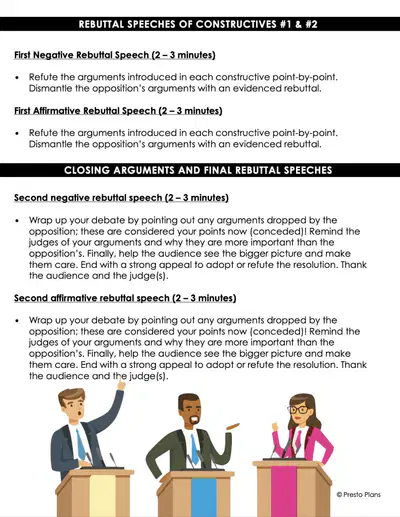
It’s now time to provide a
rebuttal for the arguments and
counterarguments made
against your position with a
rebuttal speech.
REBUTTAL SPEECHES
Give a point-by-point rebuttal
against both of your opposition’s
constructive speeches while
drawing on evidence for support.
© Presto Plans
• 1st Affirmative Rebuttal Speech
• 1st Negative Rebuttal Speech
48


Below is an example of what
part of a rebuttal for the
negative side might sound like:
While the opposition raises concerns about
distraction, studies show that clear guidelines
minimize misuse. Also, contrary to claims of
misconduct, cell phones promote
responsibility when integrated into the
curriculum. To address the counterargument
that technology could worsen educational
inequality, studies reveal improved access to
resources for all students. We continue to
emphasize the positive impact on learning
outcomes. Our opposition’s concerns are
valid, but our case, grounded in data and
research, demonstrates that allowing cell
phones in schools is not just sensible but
necessary for modern education.
REBUTTAL SPEECHES
© Presto Plans
49

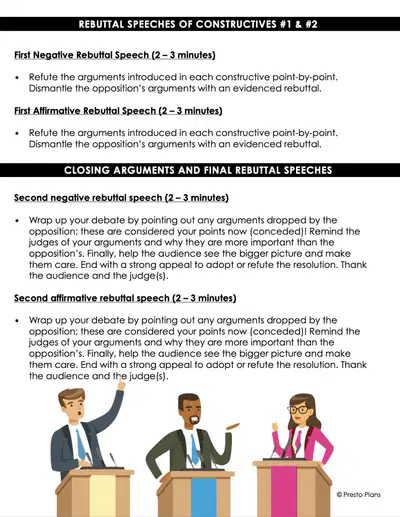
CLOSING ARGUMENTS
Wrap up your debate by pointing
out any arguments dropped by
the opposition; these are
considered your points now
(conceded)! Remind the judges
of your arguments and why they
are more important than the
opposition’s. Finally, help the
audience see the bigger picture
and make them care. End with a
strong appeal to adopt or refute
the resolution. Thank the audience
and the judge(s).
© Presto Plans
• 2nd Affirmative Rebuttal Speech
• 2nd Negative Rebuttal Speech
50


Below is an example of what part
of a closing argument for the
negative side might sound like:
CLOSING ARGUMENTS
© Presto Plans
In conclusion, the opposition conceded
crucial points—improved resource
access and digital literacy through cell
phone integration. These are not merely
luxuries but necessities for future-ready
education. Our opposition failed to
counter these important points. As we
champion progress and inclusivity,
consider the broader impact. In a
rapidly evolving world, our stance is not
just practical; it’s necessary for
developing a tech-savvy generation.
Thank you to our judges and audience
for your attention; let's pave the way for
a future-ready education!
51


Here are some debating tips and
techniques that can help you win
a debate and improve your
debating skills in general:
DEBATING TIPS
Research: Be sure to research your
topic so that when it comes time for
a rebuttal, you are prepared. Also,
be sure to use credible sources!
Be Prepared: Have notes at your
disposal with useful information to refer
to while your opposition is speaking. You
might also want to take notes while the
opposition is speaking as well.
© Presto Plans
52

Ethos, pathos, and logos are
rhetorical devices commonly used in
persuasive writing or speech. These
persuasive techniques help convince
an audience to adopt your
viewpoint by making appeals to their
emotions, ethics, and logic.
ETHOS, PATHOS, LOGOS
© Presto Plans
These rhetorical devices are often
used by politicians, activists, leaders,
advertisers—or anyone who needs to
convince an audience of something.
We can use these devices to
improve our debate skills!
53


Ethos focuses on the ethics and
credibility of the speaker. It involves
establishing trust and authority,
aiming to convince the audience
that the communicator is
knowledgeable, reliable, and
possesses a good character.
ETHOS
© Presto Plans
For example, if you are trying to
convince the audience that cell
phones should be allowed in school,
you might establish credibility by
demonstrating your knowledge on
technology in general—both the
benefits and the drawbacks—to build
your audience’s trust.
54


Pathos is an appeal to the
emotions of the audience and is
designed to evoke an emotional
response that can influence their
perspective or decision.
PATHOS
© Presto Plans
For example, continuing with
the subject of cell phones in
school, you might use pathos
by telling the audience an
emotional story about a time
when phones were used in the
classroom and something
powerful happened.
55


Logos is an appeal to logic and
involves using evidence, facts, and
sound reasoning to support an
argument. The goal of logos is to
persuade the audience by presenting
a clear, well-structured, and logical
case.
LOGOS
© Presto Plans
For example, one way you could use
logos is by drawing on statistics and
logical reasoning. For example, you might
say that over 90% of employed people in
the United States regularly use a cell
phone at work. Accordingly, banning cell
phones from the classroom would be
counterintuitive, given their use in the
workforce (for which students are being
prepared).
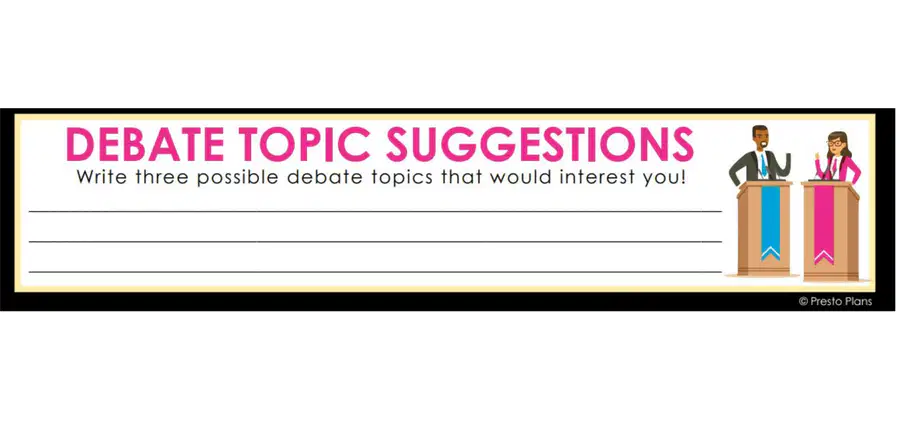
56

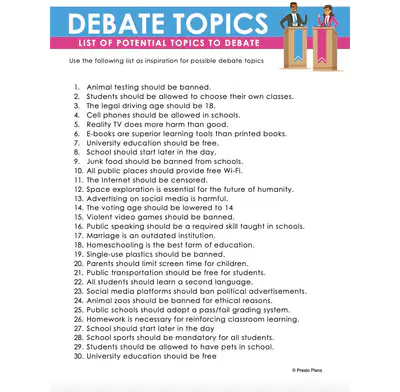
What topics would you like
to debate? Keep in mind
what you learned about
what makes for a strong
debate topic. Choose
three topics that are
specific, debatable, and
interesting, and be sure to
write each as a statement
(not a question).
WHAT INTERESTS YOU?
© Presto Plans
57

58

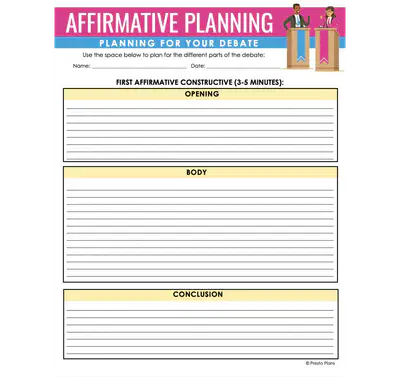
59

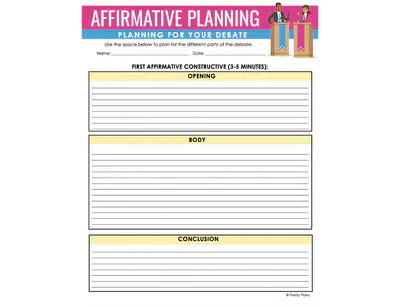
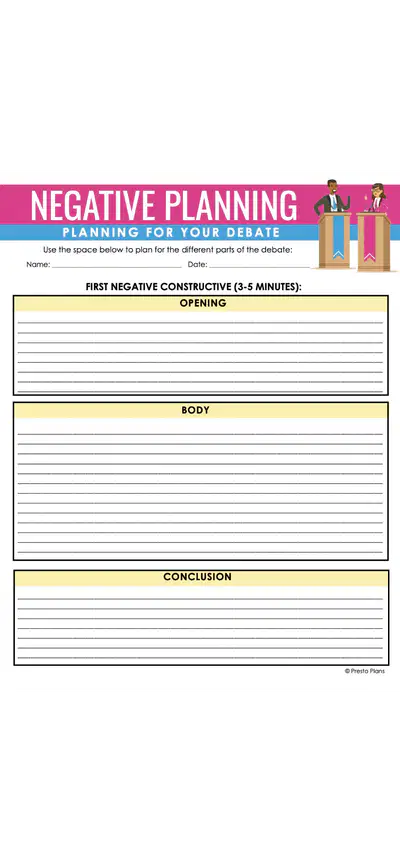
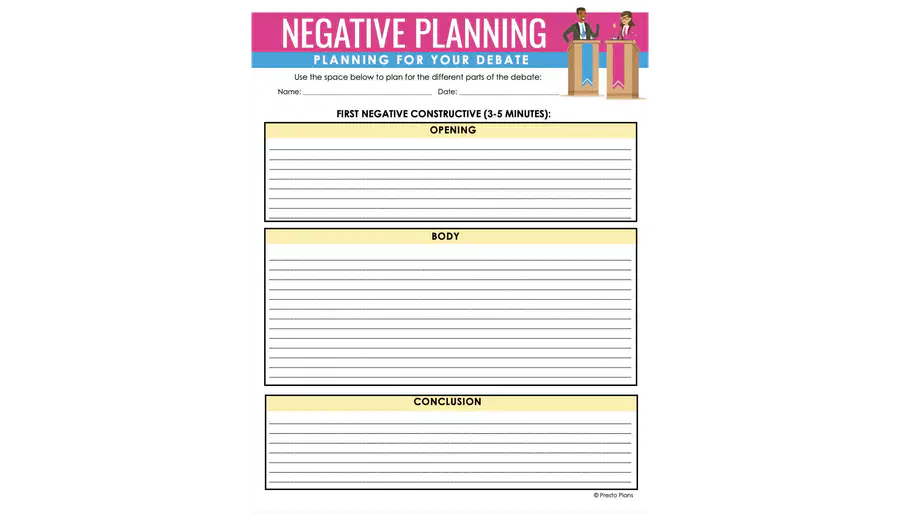
Once you have a debate
topic and a position
(affirmative or negative),
use the provided graphic
organizer to start planning
your first and second
constructive speeches!
DEBATE PLANNING
© Presto Plans
60


61

62

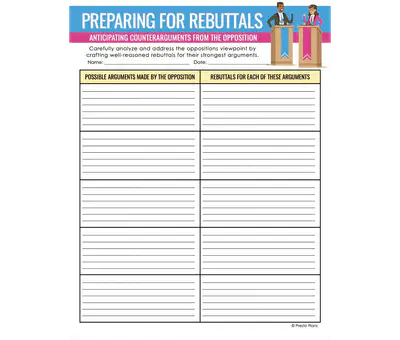
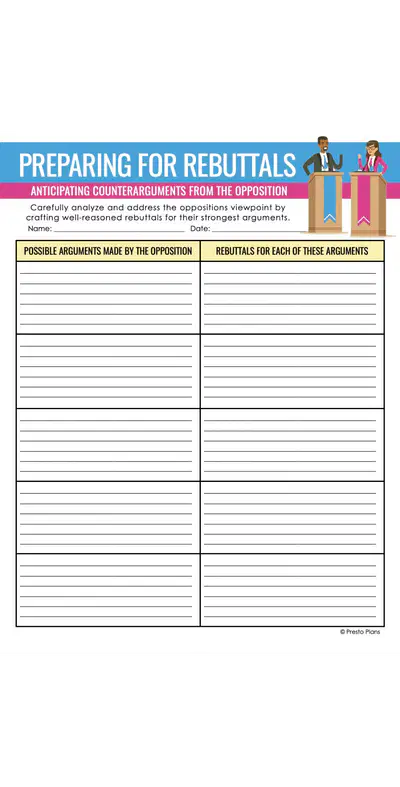
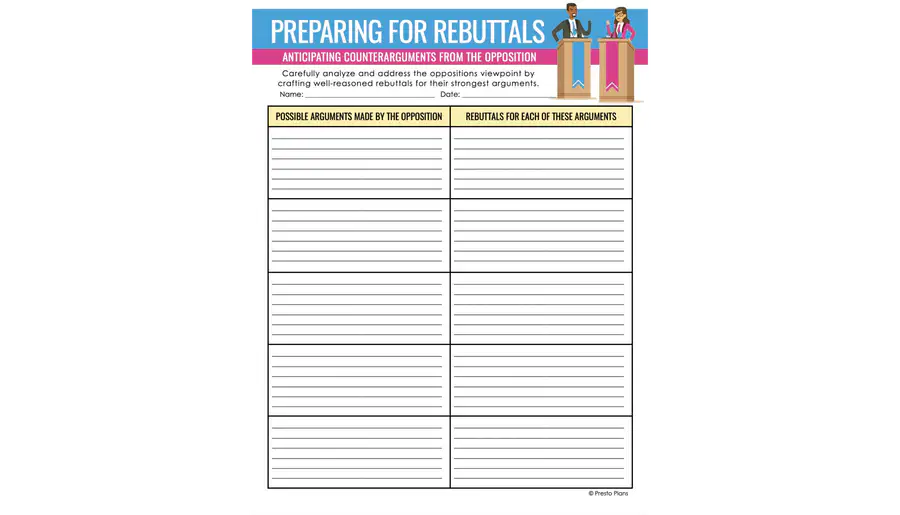
Finally, an important
technique often used in
debating is anticipating
arguments that the
opposition will make ahead
of time. Use the provided
graphic organizer to think of
which arguments your
opposition will make and plan
rebuttals that will counter
these claims!
ANTICIPATE ARGUMENTS
© Presto Plans
63

64


© Presto Plans
Show answer
Auto Play
Slide 1 / 64
SLIDE
Similar Resources on Wayground

61 questions
The Canterbury Tales: The Pardoner's Tale
Presentation
•
12th Grade
58 questions
MMRep_Level_1 Unit_5 Ex_3_77 [qzrk_005]
Presentation
•
12th Grade
61 questions
Collision Theory and Reaction Rate
Presentation
•
12th Grade
55 questions
Punctuation Lesson
Presentation
•
KG
60 questions
Week 2 (Day 3)
Presentation
•
University
59 questions
PAST TENSE
Presentation
•
10th - 12th Grade
58 questions
B2 -C1 Travel and Holidays
Presentation
•
University
56 questions
Days Gone By
Presentation
•
11th Grade
Popular Resources on Wayground
10 questions
Safety Day 2026 – Student Review

Quiz
•
9th Grade
21 questions
Continents and Oceans
Quiz
•
6th Grade
20 questions
Parts of Speech
Quiz
•
5th Grade
16 questions
Subject & Predicate
Quiz
•
5th Grade
25 questions
Multiplication Facts
Quiz
•
5th Grade
12 questions
Map Skills
Quiz
•
3rd Grade
22 questions
Continents and Oceans
Quiz
•
5th Grade
15 questions
Rounding Decimals
Quiz
•
5th Grade
Discover more resources for English
16 questions
Complete Sentences vs Fragments and Run-Ons
Presentation
•
5th - 12th Grade
28 questions
AP Vocab Group 7
Quiz
•
9th - 12th Grade
20 questions
Appositives & Commas
Quiz
•
9th - 12th Grade
20 questions
The Crucible Act 1 and 2 Quiz
Quiz
•
9th - 12th Grade
40 questions
Of Mice & Men Major Test Ch. 1-6
Quiz
•
9th - 12th Grade
20 questions
Ethos Pathos Logos
Quiz
•
9th - 12th Grade
21 questions
Evaluating Arguments 10th grade
Presentation
•
9th - 12th Grade
20 questions
SWBST (Summarizing)
Quiz
•
9th - 12th Grade