

Muscle physiology course

Presentation
•
Physical Ed
•
University
•
Practice Problem
•
Hard

ormond heather
Used 5+ times
FREE Resource
11 Slides • 7 Questions
1
Muscle physiology
2
What is a muscle?
How do muscular contractions occur?
Learning objectives

3
What do you know?
4
Multiple Choice

Which muscle does the black arrow point too?
Serratus anterior
5
Multiple Choice

Name the muscle included in the picture
Vastus lateralis
Tibialis Anterior
Vastus medialis
Tibialis medialis
6
Multiple Choice
Which of the below covers the fascicles?
7
Match

Match the numbers with their correct name (Excluding #6)
1
2
3
4
5
Tendon
Muscle
Perimysium
Muscle fibre
Fascicle
Tendon
Muscle
Perimysium
Muscle fibre
Fascicle
8
Multiple Choice
How many muscles are there approximately in the human body?
9
Multiple Choice
What chemical is released from the sarcoplasmic reticulum?
10
Muscle physiology is the study of the mechanisms behind a muscle contraction
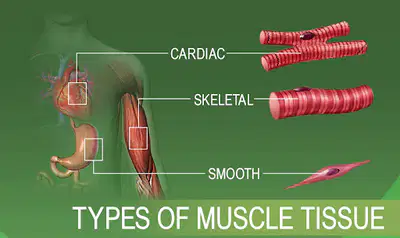
3 types
Cardiac (heart, involuntary)
Smooth (stomach, involuntary)
Skeletal (muscles, voluntary)
This lecture will focus on skeletal
11
Before discussing HOW a contraction occurs, lets look at WHAT is it!
Muscle physiology - Why?

12
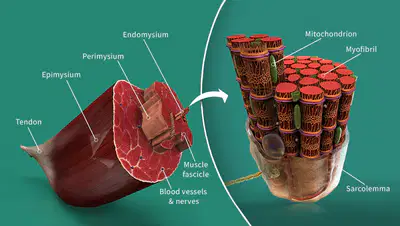
Muscle has many 'layers'
Largest = muscle
Smallest = myofibril
The muscle contraction occurs in the smallest layer of the muscle
Muscle physiology - Layers
13

15
What is the smallest layer?
What does it look like?
What about the largest layer?
Lets get a practical example

16
Foam rolling = Myofascial release
What do you think Myofascial release does?
Myofascial release

17
Contractile elements i.e. sarcomere
Series elastic components i.e. tendon
Parallel elastic components i.e. wrappings
3 contributors to produce force

18
Categorize
Muscle
Fascicle
Myofirbil
Perimysium
Endomysium
Epimysium
Epimysium
Perimysium
Endomysium
Organize these options into the right categories
Muscle physiology
Show answer
Auto Play
Slide 1 / 18
SLIDE
Similar Resources on Wayground

12 questions
INDIA SIZE AND LOCATION
Presentation
•
KG - University
12 questions
Chapter 3
Presentation
•
University
13 questions
A Well You
Presentation
•
12th Grade
13 questions
IB Biology 2016 Syllabus Topic 2.9 S3
Presentation
•
12th Grade
17 questions
Biotechnology
Presentation
•
12th Grade - University
15 questions
Elements of Exercise
Presentation
•
Professional Development
13 questions
C2 - Revision Unit 4
Presentation
•
University
14 questions
Let's get ready for the 2302 Final Exam!
Presentation
•
University
Popular Resources on Wayground
6 questions
Secondary Safety Quiz
Presentation
•
9th - 12th Grade
10 questions
MyPath Diagnostic Overview
Presentation
•
6th - 8th Grade
20 questions
Lab Safety Quiz

Quiz
•
6th Grade
21 questions
Continents and Oceans
Quiz
•
6th Grade
20 questions
Adding and Subtracting Decimals
Quiz
•
5th Grade
20 questions
Parts of Speech
Quiz
•
5th Grade
16 questions
Subject & Predicate
Quiz
•
5th Grade
21 questions
Lab Safety
Quiz
•
10th Grade
Discover more resources for Physical Ed
20 questions
Disney Trivia
Quiz
•
University
20 questions
Brand Trivia
Quiz
•
9th Grade - University
10 questions
Would you rather...
Quiz
•
KG - University
21 questions
Mapa países hispanohablantes
Quiz
•
1st Grade - University
10 questions
Spanish Greetings and Goodbyes!
Presentation
•
6th Grade - University
12 questions
CE 2b Early Documents Review
Quiz
•
7th Grade - University
30 questions
Multiplying and Dividing Integers
Quiz
•
6th Grade - University
13 questions
Back to School
Quiz
•
KG - University