
Intro to the Scientific Method

Presentation
•
English
•
5th Grade
•
Practice Problem
•
Hard
Standards-aligned

Em Villanueva
Used 5+ times
FREE Resource
12 Slides • 0 Questions
1

2
3
4
What is scientific method?
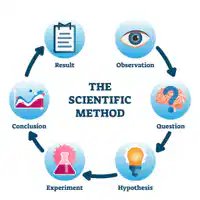
The Scientific Method is a step-by-step process that scientists use to study the world around them. It helps them find answers to questions, solve problems, and understand how things work. Think of it as a special way of thinking that helps us make discoveries.
5
6
Step 1: Ask a Question
Every scientific investigation begins with a question. This question usually comes from something you are curious about. For example, you might wonder, "Why does the sun rise in the east and set in the west?" or "What happens when you mix two different substances?"
Example Question: "What will happen if we mix baking soda and vinegar?"
7
Step 2: Do Background Research
Explanation: Before you start finding answers, it’s important to learn what other people already know about your question. This step is like doing a bit of homework—reading books, looking up information online, or asking someone who knows a lot about the topic.
Example: Researching why baking soda and vinegar react together by looking up what chemicals are in each.
8
Step 3: Form a Hypothesis
Explanation: A hypothesis is an educated guess about what you think will happen. It’s your prediction based on what you know. This statement often starts with "If" and ends with "then."
Example Hypothesis: "If we mix baking soda and vinegar, then the mixture will create bubbles and inflate the balloon."
9
Step 4: Conduct an Experiment
Explanation: This is where you test your hypothesis by doing something hands-on. You’ll follow a procedure, make observations, and gather data (information).
Key Points:
Procedure: A set of instructions for how to do the experiment.
Observations: What you see, hear, or measure during the experiment.
Data: The information you collect, like how much the balloon inflates.
10
Step 5: Analyze the Data
Explanation: After the experiment, you need to look at the data you collected to see what it tells you. Did things happen the way you expected? Did anything surprising happen?
Key Points:
Compare what actually happened to what you thought would happen.
Look for patterns or anything that stands out.
11
Step 6: Draw a Conclusion
Explanation: Based on your analysis, decide whether your hypothesis was correct. Your conclusion explains what you learned from the experiment. Sometimes your hypothesis is right, and sometimes it’s wrong—either way, you learn something new!
Example Conclusion: "The balloon inflated because the reaction between baking soda and vinegar produced carbon dioxide gas, which filled the balloon."
12
Show answer
Auto Play
Slide 1 / 12
SLIDE
Similar Resources on Wayground

10 questions
GIVING DIRECTIONS
Presentation
•
5th Grade
10 questions
Author's Claim
Presentation
•
5th Grade
10 questions
Main idea and supporting details
Presentation
•
5th Grade
9 questions
Commas Part 1
Presentation
•
5th Grade
10 questions
Percy Jackson and the Lightning Thief Chapter 2
Presentation
•
5th - 6th Grade
10 questions
Positive and Negative Connotation
Presentation
•
5th - 6th Grade
10 questions
What is Theme?
Presentation
•
4th - 5th Grade
11 questions
Non-Verbal Cues
Presentation
•
5th - 6th Grade
Popular Resources on Wayground
10 questions
Safety Day 2026 – Student Review

Quiz
•
9th Grade
21 questions
Continents and Oceans
Quiz
•
6th Grade
20 questions
Parts of Speech
Quiz
•
5th Grade
16 questions
Subject & Predicate
Quiz
•
5th Grade
25 questions
Multiplication Facts
Quiz
•
5th Grade
12 questions
Map Skills
Quiz
•
3rd Grade
22 questions
Continents and Oceans
Quiz
•
5th Grade
15 questions
Rounding Decimals
Quiz
•
5th Grade
Discover more resources for English
20 questions
Parts of Speech
Quiz
•
5th Grade
16 questions
Subject & Predicate
Quiz
•
5th Grade
12 questions
Figurative Language Review

Interactive video
•
5th Grade
20 questions
4 Types of Sentences
Quiz
•
4th - 5th Grade
20 questions
Main Idea and Details
Quiz
•
5th Grade
11 questions
Quiz: Review Simple, Compound, and Complex Sentences
Quiz
•
5th Grade
10 questions
Main Idea and Supporting Details
Quiz
•
3rd - 6th Grade
20 questions
Prepositions and Prepositional Phrases
Quiz
•
5th Grade