

Ch2_rcA&P

Presentation
•
Science
•
12th Grade
•
Practice Problem
•
Hard

Robert Castorena
FREE Resource
42 Slides • 0 Questions
1

Ionic Bonds:
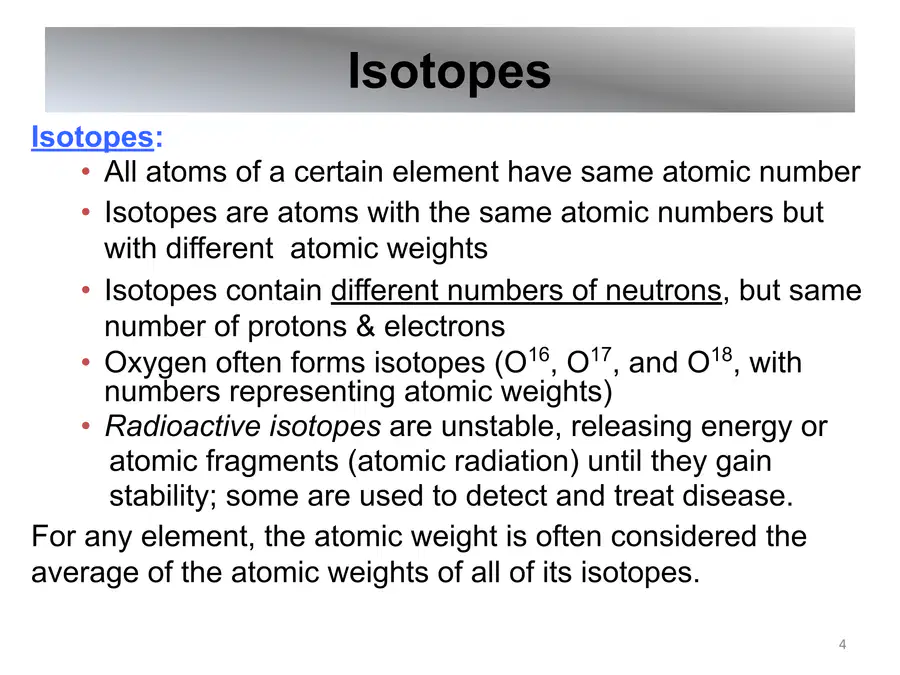
• Formed when electrons are transferred from one atom to
another atom
• The attraction between a cation and an anion forms a very
strong bond between the ions, called an ionic bond.
Bonding of Atoms: Ionic Bonds
7
2

Bonding of Atoms: Polar Molecules
9
Polar Molecules:
• Molecules with a slightly negative end & a slightly positive end
• Results from unequal sharing of electrons in covalent bonds
• Water is an important polar molecule
In this water molecule, the
O nucleus pulls the
electrons more strongly
than the H nuclei, since
it contains more positively
charged protons.
3

Electrolytes: Substances that release ions in water. The
solution can conduct an electric current, so it is called an
electrolyte.
NaCl 🡪 Na+ + Cl-
Acids: Electrolytes that dissociate to release hydrogen ions in
water
HCl 🡪 H+ + Cl-
Bases: Substances that release ions that can combine with
hydrogen ions
NaOH 🡪 Na+ + OH-
Salts: Electrolytes formed by the reaction between an acid
and a base
HCl + NaOH 🡪 H2O + NaCl
Acids, Bases, and Salts
12
4

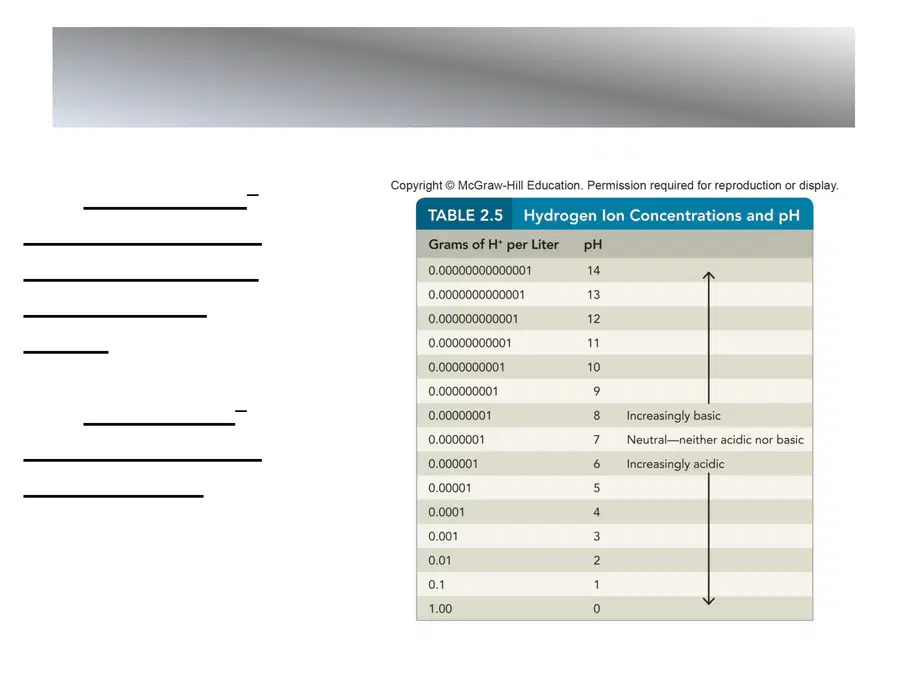
• Concentrations of acids and bases affect chemical
reactions in living organisms.
• H+ ion concentration is measured in g/L of body fluid
• pH scale is used as shorthand for H+ ion concentration; it
is based on the number of decimal places in the
concentration
• If H+ ion concentration = 0.01 g/L, the pH = 2
• If H+ ion concentration = 0.000000001 g/L, the pH =9
• pH scale runs from 0 – 14; each number represents a
tenfold difference in H+ ion concentration
• Acids have a pH <7, and bases have a pH >7
• A pH of 7 is neutral
Acid and Base Concentrations
13
5
Acid and Base Concentrations
14
The higher the H+
concentration, the
lower the pH, and
the higher the
acidity.
The lower the H+
concentration, the
higher the pH, and
the lower the acidity
(which corresponds
to higher alkalinity).
6

Acid and Base Concentrations
15
• pH Scale: Indicates the concentration of hydrogen ions in a
solution
• Neutral: A pH of 7 indicates equal concentrations of H+ and
OH-. This is the pH of water.
• Acidic: A pH of <7 indicates a greater concentration of H+
than OH-
• Basic (alkaline): A pH >7 indicates a higher concentration of
OH- than H+
7

Acid and Base Concentrations
16
Normal range of blood pH is 7.35 – 7.45
Acidosis occurs when blood pH drops to 7.0 – 7.3
•
Makes a person feel disoriented, fatigued
•
Caused by vomiting of alkaline intestinal contents,
diabetes, lung disease with impaired CO2 exhalation
Alkalosis occurs when blood pH rises to 7.5 – 7.8
•
Makes a person feel dizzy and agitated
•
Caused by high altitude breathing, vomiting of acidic
stomach contents, high fever, taking excess antacids
•
Homeostatic mechanisms help regulate pH
•
Buffers are chemical systems which act to resist pH
changes; bind and release H+ ions to regulate pH
8

Organic vs. Inorganic Molecules
• Organic molecules:
• Contain C and H
• Dissolve in water and organic liquids
• Water-soluble organic compounds do not release ions,
and are non-electrolytes
• Carbohydrates, proteins, lipids, and nucleic acids
• Inorganic molecules:
• Generally do not contain C and H
• Usually dissolve in water and dissociate, forming
ions, and are electrolytes
• Water, oxygen, carbon dioxide, and inorganic salts
2.3: Chemical Constituents of Cells
17
9

A triglyceride is composed of 1 glycerol molecule and 3 fatty
acids.
Organic Substances: Lipids
23
10

• Proteins are used as structural materials, energy source,
hormones, receptors, enzymes, antibodies
• Consist of building blocks called amino acids
• An amino acid contains an amino (-NH2) group, a carboxyl
(COOH) group, and a unique R (side chain) group
Organic Substances: Proteins
26
11

Two major types of nucleic acids: DNA and RNA
DNA:
• Stores the genetic code
• Contains the sugar deoxyribose
• Structure—double helix
• Composed of nucleotides
RNA:
• Interacts with DNA to conduct protein synthesis
• Contains the sugar ribose
• Structure—single strand
• Composed of nucleotides
Organic Substances: Nucleic Acids
29
12

13

Inorganic Substances
19
Carbon dioxide (CO2):
•Waste product released during metabolic reactions
• Must be removed from the body through exhaling
Inorganic salts:
•Abundant in body fluids
• Sources of necessary ions (Na+, Cl-, K+, Ca+2, etc.)
• Play important roles in metabolism
• Help control H2O concentration, pH, blood clotting,
nerve and muscle processes
• Electrolyte balance exists when gains equal losses
14

15

16

21
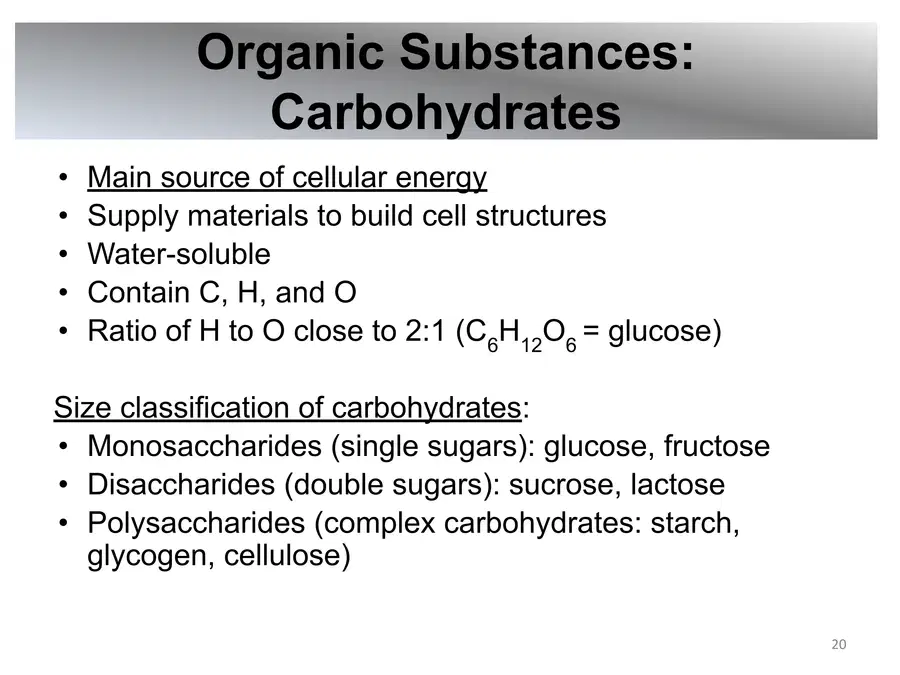
Organic Substances:
Carbohydrates
17
18

19

20

21

22

23

24

25

26

27

28

29

30

31

32

33
34

35

36

37

38

39

40

41

42

Ionic Bonds:
• Formed when electrons are transferred from one atom to
another atom
• The attraction between a cation and an anion forms a very
strong bond between the ions, called an ionic bond.
Bonding of Atoms: Ionic Bonds
7
Show answer
Auto Play
Slide 1 / 42
SLIDE
Similar Resources on Wayground

35 questions
Rocks and Minerals
Presentation
•
11th - 12th Grade
35 questions
Unit 2 Lesson 3: Speed, Velocity, & Acceleration
Presentation
•
12th Grade
38 questions
Ch 2.1 - 2.2
Presentation
•
11th - 12th Grade
39 questions
Muscle Contraction and Relaxation
Presentation
•
11th - 12th Grade
37 questions
Pemberontakan APRA, Andi Azis, dan RMS
Presentation
•
12th Grade
35 questions
Boyle's Law (Ideal Gases)
Presentation
•
11th Grade
40 questions
Nomenclatura química
Presentation
•
KG - University
40 questions
Acids, Bases and Buffers OCR Revision
Presentation
•
12th Grade
Popular Resources on Wayground
10 questions
Safety Day 2026 – Student Review

Quiz
•
9th Grade
21 questions
Continents and Oceans
Quiz
•
6th Grade
20 questions
Parts of Speech
Quiz
•
5th Grade
16 questions
Subject & Predicate
Quiz
•
5th Grade
25 questions
Multiplication Facts
Quiz
•
5th Grade
12 questions
Map Skills
Quiz
•
3rd Grade
22 questions
Continents and Oceans
Quiz
•
5th Grade
15 questions
Rounding Decimals
Quiz
•
5th Grade
Discover more resources for Science
7 questions
Newton's Laws Video Quiz

Interactive video
•
9th - 12th Grade
35 questions
Cell Transport/Enzyme/Cell/Macro Review
Quiz
•
9th - 12th Grade
13 questions
Explore Enzyme Functions and Interactions
Quiz
•
9th - 12th Grade
10 questions
Fact or Fiction: Microbes
Quiz
•
9th - 12th Grade
10 questions
Understand Cell Functions and Organelles
Quiz
•
9th - 12th Grade
19 questions
Explore Macromolecules in Living Organisms
Quiz
•
9th - 12th Grade
15 questions
Layers of Atmosphere passage

Passage
•
9th - 12th Grade
22 questions
Quiz Review Day 5 Water and Macromolecules
Quiz
•
9th - 12th Grade