Search Header Logo
8.2.3-Newton's Second Law

8.2.3-Newton's Second Law

Assessment

Presentation

Science

8th Grade

Medium

NGSS
MS-ESS1-2, MS-PS2-2, MS-PS2-4

+24

Standards-aligned

Created by

Jessica Freeman

Used 3+ times

FREE Resource

56 Slides • 45 Questions

1

media

2

media

3

media

4

media

5

media

6

media

7

media

8

​Forces Change Motion

​If we push a cart with more force, the motion of the cart increases. If we push with less force, the motion of the cart decreases. So, force causes a change in the speed and/or direction of objects. When unbalanced forces are applied to an object, it accelerates, or changes speed and/or direction.

media

9

​Balanced and Unbalanced Forces

​If an object is at rest, then there are either no outside forces acting on it or the

forces ​that are acting on it are

​balanced. Objects which are ​changing

direction or speed ​are being acted

upon by ​unbalanced forces. Some

​moving objects are also ​acted upon

by balanced ​forces.

​So, we need to be aware of an object's

change in motion and which forces

might be causing that change.

media

10

media

11

media

12

media

13

Newton's 2nd Law of Motion

Law of Acceleration

media

14

Acceleration and Mass

If the same force is applied to two objects:

As the mass increases the acceleration decreases.

Objects with more mass accelerate less.

Objects with less mass accelerate more.

media

15

Multiple Choice

Question image

If both rocks are pushed with the same amount of force, which rock would accelerate more?

1

The 400kg Rock because it weighs more.

2

The 40kg rock because it weighs less.

16


The 40kg rock will accelerate more because it weighs less. Remember the less mass, the more inertia.

media

17

Open Ended

Question image

Which object will accelerate more, the baseball or bowling ball? Explain your answer.

18


The baseball will accelerate more than the bowling ball because the bowling ball has more mass.

media

19

Multiple Choice

Question image

Which rock will accelerate the least?

1

The Small Rock

2

The Large Rock

20

The Large Rock accelerates the least because it has more mass than the small rock.

media

21

Multiple Choice

Question image

Which grocery basket will have the least acceleration, if both grocery baskets are pushed with the same amount of force?

1

The one without groceries because it has more mass.

2

The one with groceries because it has more mass.

3

The one without groceries because it has the least mass.

4

The one with groceries because it has least mass.

22

Multiple Choice

Question image

Both objects are pushed with the same amount of force, which object will accelerate more the car or the basket ball?

1

The basketball will accelerate the the most because it has the less mass than the car.

2

The basketball will accelerate the least because it has the more mass than the car.

3

The car will accelerate the the most because it has the less mass than the car.

4

The car will accelerate the least because it has the more mass than the basketball.

23

Multiple Choice

The larger the mass you have the _____ force you need to change its motion.
1
more
2
less

24

Multiple Choice

Question image

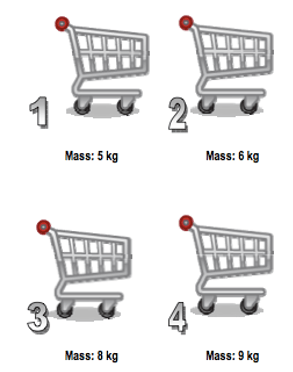
A force of 90N is applied to each cart below, which one will accelerate the fastest?

1

Cart 1

2

Cart 2

3

Cart 3

4

Cart 4

25

Acceleration and Force

As the force increases the acceleration increases.

Objects with less force accelerate less.

Objects with more force accelerate more.


media

26

Multiple Choice

The child applies a force of 5N when she pushes the swing. Her dad applies a force of 25N when he pushes the swing. Which swing will accelerate more2

1

The swing the Dad pushes.

2

The swing the child pushes.

27

The swing the dad pushes will accelerate more because the dad applies a greater force to the swing.

media

28

Multiple Choice

Johnny throws a baseball with 75 N of force. Roger throws a baseball with 200 N of force. Which person's baseball will accelerate the least?

1

Johnny's Baseball

2

Roger's Baseball

29


Johnny's baseball will accelerate the least because Johnny used 75N of force. Johnny used less force than Roger.

media

30

Multiple Choice

Joshua and Elijah are playing cars. Joshua pushed his car with 12N of force towards the finish line. Elijah pushed his car with 20N of force towards the finish line. Who's car made it to the finish line first?

1

Joshua's car made it to the finish line first because he applied more force so it accelerated more.

2

Joshua's car made it to the finish line first because he applied less force so it accelerated more.

3

Elijah's car made it to the finish line first because he applied more force so it accelerated more.

4

Elijah's car made it to the finish line first because he applied more less so it accelerated more.

31

Multiple Choice

A greater applied force is required to move an object with a greater mass than one with a smaller mass.
1
True
2
False

32

We will investigate and analyze Newton’s second law of motion (law of force and acceleration).


I will calculate the acceleration of an object given its mass and the force used on it.

33

media

34

media

35

Newton's 2nd Law of Motion

  • Law of Acceleration

  • There is an equation.

  • F=MA

  • Study the Triangle

media

36

Multiple Choice

Question image

Using the triangle. What is the formula for force?

1

Force = Mass x Acceleration

2

Accleration=Force ÷ MassAccleration=Force\ \div\ Mass

3

Mass=Force ÷Accleration Mass=Force\ \div Accleration\

37

Force = 

Mass x Acceleration 

media

38

Multiple Choice

Question image

Using the triangle. What is the formula for Acceleration?

1

Force = Mass x Acceleration

2

Accleration=Force ÷ MassAccleration=Force\ \div\ Mass

3

Mass=Force ÷Accleration Mass=Force\ \div Accleration\

39

Acceleration= 

Force / Mass

media

40

Multiple Choice

Question image

Using the triangle. What is the formula for Mass?

1

Force = Mass x Acceleration

2

Accleration=Force ÷ MassAccleration=Force\ \div\ Mass

3

Mass=Force ÷Accleration Mass=Force\ \div Accleration\

41

Mass= 

Force / Acceleration

media

42

To Find Force

  • Multiply the Mass and the Acceleration

  • Mass=kg

  • Acceleration=m/s2

media

43

Let's Practice Finding Force

  • An object with a mass of 2.0 kg accelerates 2.0 m/s2 when an unknown force is applied to it. What is the amount of the force? 

media

44

Multiple Choice

An object with a mass of 2.0 kg accelerates 2.0 m/s2 when an unknown force is applied to it. What is the amount of the force?


What is the question asking you tp solve?

1

force

2

mass

3

acceleration

45

The question is asking you to find the force. I underlined it so you would know.

  • An object with a mass of 2.0 kg accelerates 2.0 m/s2 when an unknown force is applied to it. What is the amount of the force? 

media

46

Multiple Select

According to the formula(f=mxa), and the triangle. What 2 variables are needed to calculate the force?

1

Mass

2

Acceleration

3

Force

47

You need to determine the mass and acceleration in the question.

I highlighted the Mass and Acceleration below. An object with a mass of 2.0 kg accelerates 2.0 m/s2 when an unknown force

is applied to it. What is the amount of the force? 

media

48

Multiple Choice

An object with a mass of 2.0 kg accelerates 2.0 m/s2 when an unknown force is applied to it. What is the amount of the force?

1

2.0kg

2

2.0m/s2

3

4N

4

20N

49

The answer is 4N.

  • F=MA

  • M=2kg

  • A=2.0m/s2

  • F=2kgx2m/s2

media

50

Multiple Choice

A 25 kg bike accelerates at 10 m/s2. What was the force?

1

250 N

2

2.5 N

3

25 N

4

15 N

51

To Find Acceleration

  • Divide the Force and the Mass

  • Mass=kg

  • Force =N

media

52

Let's Practice Finding Acceleration

  • An object with a mass of 5.0 kg has a force of 20.0 newtons applied to it. What is the resulting acceleration of the object?

media

53

Multiple Choice

An object with a mass of 5.0 kg has a force of 20.0 newtons applied to it. What is the resulting acceleration of the object?


What is this question asking you to solve for?

1

Mass

2

Acceleration

3

Speed

4

Force

54

The question is asking you to find the ACCERLERATION. I underlined it so you would know.

  • An object with a mass of 5.0 kg has a force of 20.0 newtons applied to it. What is the resulting acceleration of the object?

media

55

Multiple Select

Question image

According to the formula(f=mxa), and the triangle. What 2 variables are needed to calculate the acceleration?

Remember Acceleration = Force/Mass

1

Mass

2

Acceleration

3

Force

56

You need to determine the mass and acceleration in the question.

I underlined the Force and Mass below. An object with a mass of 5.0 kg has a force of 20.0 newtons applied to it. What is the resulting acceleration of the object?

media

57

Multiple Choice

An object with a mass of 5.0 kg has a force of 20.0 newtons applied to it. What is the resulting acceleration of the object?(Remember to divide the force and the mass.)

1

5kg

2

20 N

3

100 m/s2

4

4 m/s2

58

The Answer is 4 m/s2.

media

59

Multiple Choice

Question image
If a 2kg bird is pushed by the wind with a force of 2N, how fast does the bird accelerate?
1
1 m
2
2 m/s2
3
4m/s2
4
1 m/s2

60

To Find Mass

  • Divide the Force and the Acceleration

  • Force =N

  • Acceleration=m/s2

media

61

Let's Practice Finding Mass

  • An object accelerates 12.0 m/s2 when a force of 6.0 newtons is applied to it. What is the mass of the object?

media

62

Multiple Choice

An object accelerates 12.0 m/s2 when a force of 6.0 newtons is applied to it. What is the mass of the object?


What is this question asking you to solve for?

1

Mass

2

Acceleration

3

Speed

4

Force

63

The question is asking you to find the Mass. I underlined it so you would know.

  • An object accelerates 12.0 m/s2 when a force of 6.0 newtons is applied to it. What is the mass of the object?

media

64

Multiple Select

Question image

According to the formula(f=mxa), and the triangle. What 2 variables are needed to calculate the mass?

Remember Mass=Force/Acceleration

1

Mass

2

Acceleration

3

Force

4

Speed

65

You need to determine the FORCE and ACCELERATION in the question.

I highlighted the Force and Acceleration below. An object accelerates 12.0 m/s2 when a force of 6.0 newtons is applied to it. What is the mass of the object?

media

66

Multiple Choice

An object accelerates 12.0 m/s2 when a force of 6.0 newtons is applied to it. What is the mass of the object?

1

2 kg

2

0.5kg

3

6 kg

4

24 kg

67

The Answer is 0.5 kg.

  • undefined

  • F = 6N

  • A = 12.0 m/s 2 

  • Mass = 6N / 12.0m/s2

  • Mass = 0.5KG

media

68

Multiple Choice

If an object was accelerating at 5 m/s2, and a force of 10 newtons was required to accelerate it, what was the object's mass?

1

50 kg

2

2 kg

3

0.5 kg

4

5 kg

69

media
media
media

70

media

71

Centripetal Force and Centripetal Acceleration

media

72

Centripetal Force is

the force on an object that makes go in a circle. The force is always directed toward the center of the circle.


F=mv2/r

73

media

74

Multiple Choice

What force is needed to make an object move in a

circle?

1

kinetic friction

2

centripetal force

3

static friction

4

weight

75

Multiple Choice

An object is traveling in a circular path

whose radius is 65m. Its acceleration is 3.0 m/s2 .

What is its velocity?

1

14 m/s

2

7 m/s

3

8 m/s

76

Multiple Choice

Question image

Centripetal force is indicated by the __________ ray.

1

black

2

green

77

Circular Motion

  • Circular motion is any motion in which an object is moving along in a curved path.

  • Centripetal Force - in a circular motion, a force that acts perpendicular to the direction of motion, toward the center of the curve.

  • Centripetal force is the force that keeps the object moving in a circular path. It does this by pulling an object toward the center of a circle.

78

The Motion of Satellites and Planets

  • An example of a centripetal force is a satellite- an object in space that orbits a larger object. 

  • Gravity is the centripetal force that keeps a satellite in orbit by changing its direction.

  • The moon is a satellite of Earth, Earth gravity changes the moon’s direction

  • The sun’s gravity changes the direction of its satellites, including Earth.

79

media

80

media

81

Multiple Choice

The force that causes an object to move in a circle is called centripetal force?

1

True

2

False

82

Multiple Choice

If you could turn off a centripetal force, ___________ would cause the object to fly off in a straight line.

1

inertia

2

momentum

3

Earth

4

force

83

Multiple Choice

______________ is the centripetal force that causes a satellite to move in a circle.

1

String

2

Space Shuttle

3

Gravity

4

Helicopter

84

Multiple Choice

Any object that travels around another object in space is a satellite.

1

True

2

False

85

Multiple Choice

Satellites in orbit around the Earth travel in almost circular path because Earth is

1

centripetal

2

free falling

3

curved

4

massive

86

Multiple Choice

The force that causes an object to move in a circle is called centripetal force?

1

True

2

False

87

Multiple Choice

______________ is the centripetal force that causes a satellite to move in a circle.

1

String

2

Space Shuttle

3

Gravity

4

Helicopter

88

​Circular Motion

Circular motion is any motion in which an object is moving along a curved path. There are two primary forces occurring during circular motion: the force of the object moving forward (shown in blue), and the force called centripetal force (shown in red). Each of these forces are constantly causing acceleration in the object.

media

89

​Circular Motion

Centripetal force is the force which acts perpendicular to the direction of motion, toward the center of the curve. The motions of satellites and planets are also circular motion and are subject to centripetal force just like a yoyo being spun around or your keys on your lanyard when you spin them.​

media

90

Multiple Choice

Question image

Centripetal force is indicated by the __________ ray.

1

black

2

green

91

Multiple Choice

True or False:

According to Newton's First Law, all moving objects must have some force causing their acceleration.

1

True

2

False

92

media

93

Multiple Choice

Which of the following is the correct formula for force?

1

f = ma

2

f = m/a

3

f = a/m

4

f = a + m

94

Multiple Select

If an object is accelerating, then it is changing _____________ and/or ______________.

1

speed

2

direction

3

color

4

sound

95

Multiple Choice

True or False:

If an object is not accelerating, then there are no external or internal forces acting on it or the forces acting on it are balanced.

1

True

2

False

96

media
media
media
media
media

Newton’s 2nd Law of Motion

The greater the mass of the object, the

greater the amount of force needed to
accelerate the object.

Or F = MA

(force) = (mass) x (acceleration)

97

media
media

Newton’s 2nd law helps us predict who will eat it
in a collision (more mass = more force, AND
more force required to change a more massive
object’s velocity!)

98

Multiple Choice

Question image

Which of Newton's Laws is this an example of?

1

Newton's First Law

2

Newton's Second Law

3

Newton's Third Law

99

Multiple Select

Question image

Which of Newton's Laws is this an example of?

1

Newton's First Law

2

Newton's Second Law

3

Newton's Third Law

100

Multiple Choice

Question image

Which of Newton's Laws is this an example of?

1

Newton's First Law

2

Newton's Second Law

3

Newton's Third Law

101

Multiple Choice

Question image

Which of Newton's Laws is this an example of?

1

Newton's First Law

2

Newton's Second Law

3

Newton's Third Law

media

Show answer

Auto Play

Slide 1 / 101

SLIDE