Search Header Logo
Biology Unit 1 Review

Biology Unit 1 Review

Assessment

Presentation

Science

9th - 12th Grade

Medium

NGSS
MS-ESS1-1, MS-LS1-5, MS-ESS2-4

+18

Standards-aligned

Created by

Katherine Heter

Used 23+ times

FREE Resource

10 Slides • 17 Questions

1

2

media

3

media

4

media

​Observation vs Inference

5

Multiple Choice

Question image

What is the DEPENDENT variable (effect) in this experiment?


"Does eating breakfast improve test scores?"

1

eating breakfast or not

2

the grade you got on the test

3

what time you get up in the morning

4

how tasty the breakfast is

6

Multiple Choice

Question image

You are testing how the amount you water a plant affects its growth. What would be the INDEPENDENT VARIABLE in this experiment.

1

They type of pot you put the plants in.

2

The amount you water each plant.

3

The amount of sunlight the plants get.

4

The amount the plant grows.

7

Multiple Choice

Michael believes that fertilizer will make the plant grow faster, so he treated one plant with fertilizer and the other plant did not receive fertilizer. They both received the same amounts of water & sunlight? What is the control group?

1

plant receiving fertilizer

2

plant not receiving fertilizer

3

lima beans

4

both plants

8

Multiple Choice

Question image
Which statement is an inference about this picture?
1
The van is tan.
2

The  van is in the KFC. 

3
The driver was hungry. 
4

The KFC has a hole in it

9

Multiple Choice

Question image
What is an observation for this picture?
1
The man is scared
2
The man is going to get eaten
3
There is a man in a kayak
4
The man is paddling fast

10

media

11

Multiple Choice

Lilly was trying to explain to her friend the difference between a theory and a law in science. She used the theory of plate tectonics and the law of superposition as examples.. Which statement could Lilly use to correctly describe the difference between a theory and a law in science?

1

A theory describes a natural event, while a law explains it.

2

A theory explains a natural event, while a law tells the why it happens.

3

A theory explains a natural event, while a law tells what happens.

4

A theory predicts a natural event, while a law explains it.

12

Multiple Choice

In 1897, Joseph Thomson discovered that atoms contained electrons. He proposed a change in the atomic theory of that time, and the theory was modified because of his discovery. Since Thomson’s discovery, atomic theory has been further modified. What is the best explanation for why scientific theories are modified?

1

Theories more than ten years old are usually out of date.

2

Scientists want to prove that the work of other scientists is wrong.

3

New evidence that supports a change prompts scientists to modify earlier theories.

4

So much information is available today that it is harder to focus research and disprove theories.

13

media

14

Multiple Choice

Plants are able to get water to come into their roots even if the water in the soil is slightly downhill from the root. What property of water molecules makes it possible for this to happen?

1

The charged molecules in the soil push the polarized water molecules away and force them into the roots.

2

The polarized water molecules stick to each other and to the water molecules already in the roots and soil. 

3

Water molecules only have three atoms, and they are tiny enough that gravity won't affect them.

4

The water molecules begin to evaporate as the soil warms, and they float uphill and into the roots.

15

Multiple Choice

Water molecules evaporate from lakes and rivers when the Sun gives them enough energy to be able to escape the hold of the other water molecules around them.

What makes these water molecules eventually form into clouds and drop again as rain or snow, instead of continuing to float around?

1

They are heavier than the air around them, so eventually they will have to fall down.

2

Each water molecule expands when heated, making it rise, and the molecules fall as they lose heat.

3

They are polarized, so they will stick to each other as they lose heat energy and slow down. 

4

Once the water molecules hit a cloud, they give up their heat to the cloud and fall down.

16

Multiple Choice

Some insects can walk on the surface of water. Their feet push against the surface of the water and the water surface bends down under their weight but does not break. What do the individual water molecules do that makes this possible?

1

The molecules push on the ones below them and only sink a little.

2

The molecules hang on to each other because they are polarized. 

3

The polarized water molecules are drawn toward the insect's feet.

4

The surface water molecules push on the insect as they evaporate.

17

Multiple Choice

Polar bears spend most of their lives roaming the Arctic on large sheets of floating ice, using them as platforms from which they hunt seals when the seals make holes in the ice to breathe. Rising average temperatures are causing these ice sheets to diminish in size, putting stress on the polar bears' way of life. Ice in a glass of water floats just like ice sheets in the arctic. What characteristic of frozen water makes it float instead of sink?

1

The water traps air bubbles as it freezes, which makes it float.

2

Some of the water evaporates as it freezes, making the ice lighter.

3

The molecules in ice are less densely packed than in liquid water. 

4

The ice molecules become polarized so they migrate upward in the glass.

18

media

19

Multiple Choice

Which of these describes the structure and function of a protein molecule?

1

A molecule composed of amino acids used as a biological catalyst in cells.

2

A molecule composed of glycerol and fatty acids used for structural support in cells.

3

A molecule composed of nitrogen bases for coding amino acid sequences in cells.

4

A molecule composed of carbon, hydrogen, and oxygen used as an energy source in cells.

20

Multiple Choice

Question image

Use the diagram to answer the question.

Which statement describes the primary function of the macromolecule in the diagram above?

1

The macromolecule is broken into monomers and use to form the cell membrane.

2

The macromolecule is used to speed up metabolic processes in cells.

3

The macromolecule is broken into monomers and used for energy.

4

The macromolecule is used to transmit hereditary information.

21

Multiple Choice

Question image

The diagram shows the structure of a certain biological macromolecule. Carbon bonds are not drawn to scale.

1

lipids

2

protein

3

nucleic acid

4

carbohydrate

22

media

23

media

24

Multiple Choice

Question image
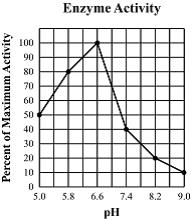
Which of the following conclusions can be drawn from this graph?
1
The optimum pH of the enzyme is 6.6.
2
The optimum pH of the enzyme is 5.8
3
The enzyme’s activity increases as pH increases 5.0 to 9.0
4
The enzyme’s activity is greater around pH of 8.0 .

25

Multiple Choice

What is the function of an enzyme?
1
enzymes break themselves into small pieces
2
enzymes slow down chemical reactions
3
enzymes speed up chemical reactions
4
enzymes combine products to form reactants 

26

Multiple Choice

What happens when enzymes are heated to a high temperature?
1
The enzymes die.
2
The shapes of the enzyme are altered denature
3
The enzymes' amino acid sequence changes.
4
The enzymes remain the same

27

Show answer

Auto Play

Slide 1 / 27

SLIDE