

Review-Early humans to civilization

Presentation
•
Social Studies
•
5th Grade
•
Medium

Chris Gilhooley
Used 11+ times
FREE Resource
11 Slides • 27 Questions
1
Multiple Choice
What was mankind's 1st achievement
Fire
Farming
Weapons/tools
Civilization
2
Multiple Choice
What was mankind's 2nd achievement?
Weapons
Fire
Civilization
Farming/Agriculture
3
Multiple Choice
What was mankind's 3rd major achievement
Weapons
Fire
Agriculture- Farming
Civilization
4
Multiple Choice
Mankind used weapons and fire to survive as nomads. Eventually they discovered/learned how to use farming which led to
The invention of the wheel
The ice age
Farmer's tan
Development of civilization
5
Multiple Choice
The first humans_______________ here from Asia.
Beringia
Migrated
Civilization
Land bridge
6
Multiple Choice
These first settlers crossed over a_________________
Mountain
Tunnel
Big old wooden bridge
Land bridge
7
Multiple Choice
This land bridge has been named___________________ by researchers
Beringia
Mound Builders
Landbrigia
Paleocrossing
8
Multiple Choice
Beringia was formed because of a_____________
Lack of migration option
Glacier during the Ice Age
Early architect project
major earthquake
9
Multiple Choice
When they settled in one area they started religions and made laws which began the earliest______________
Civilization
County
Stare
City
10
Multiple Choice
The ancestors of the Native Americans crossed over Beringia, or what it's known as today, the______________
Bering Straight
Appalachian Trail
Green Mile
Finish Line
11
12
Multiple Choice
Who were the early Native American groups that developed in the Southwest?
The Aztecs
The Hohokam
The Mayans
The Incas
13
Multiple Choice
What rivers were near the area where the Hohokam settled?
Mississippi and Missouri
Colorado and Rio Grande
Salt River and Gila River
Amazon and Nile
14
Multiple Choice
How much rain did the area receive where the Hohokam settled?
Ten inches a year
Five inches a year
Three inches a year
One inch a year
15
Multiple Choice
What system did the Hohokam build to bring water to their fields?
Aqueducts
Wells
Irrigation canals
Water towers
16
Multiple Choice
What farming method did the Ancestral Pueblo develop?
Irrigation canals
Dry farming
Terrace farming
Hydroponics
17
Multiple Choice
What are the Ancestral Pueblo known as?
River dwellers
Cliff dwellers
Forest dwellers
Desert dwellers
18
Multiple Choice
What is the significance of Mesa Verde for the Ancestral Pueblo?
It was a trading center
It was a defensive location
It was a religious site
It was a farming area
19
Multiple Choice
What is the main feature of the Ancestral Pueblo's living arrangements?
Underground homes
Cliffside dwellings
Floating houses
Treehouses
20
Multiple Choice
What is the geographical area where the Ancestral Pueblo settled?
Rocky Mountains
Four Corners
Appalachian Mountains
Great Lakes
21
22
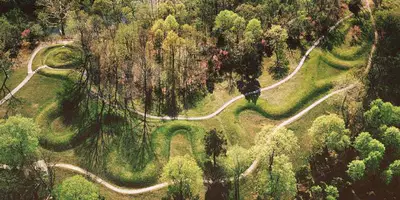
Developed in the Ohio and Mississippi river valleys
Built big mounds (small hills) out of dirt
Some were cone shaped
some were animal shapes
Archaeologists call them the "Mound Builders"
23
The Adena were the earliest in the Ohio and Mississippi River valley
Lived in log homes with bark roofs
Began as Hunter Gatherer society
ended as a farming community
Traveled long distances to trade shells and jewelry
These artifacts that were once buried is evidence of the trade network
24
The Hopewell lived in the same time period as the Adena
The 2 had a lot in common.
They made jewelry out of shells, mica, and obsidian
They too traveled for trade purposes
25
The Mississippians were the last major civilization
Very successful farmers
Grew an abundance of food.
the population grew.
The largest city was Cahokia
26
27
28
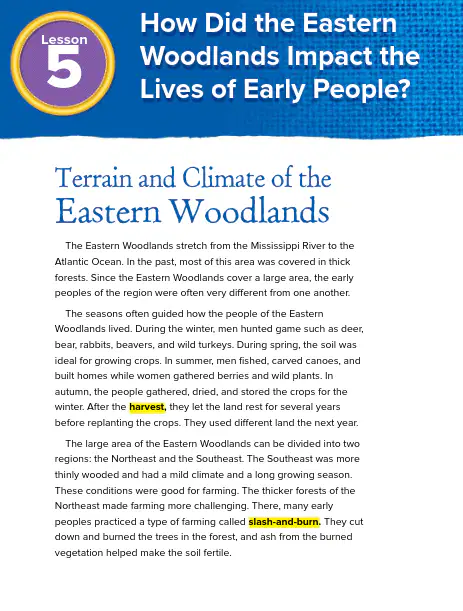
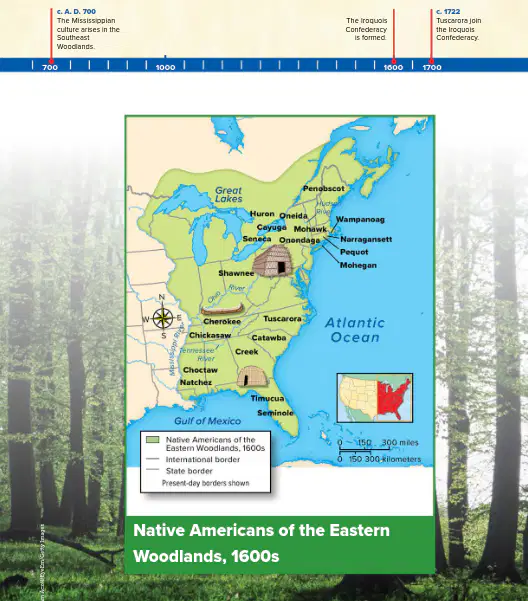
Eastern Woodlands- Atlantic ocean to the Mississippi river
was mostly covered in thick forests
It covered a huge area and its people were often very different from one another.
The Seasons guided how people lived.
Summer-Fishing, building shelters, gathering wild plants/berries
Winter-Men hunted
Spring- Begin planting crops
Autumn- gather, dry, and store crops for winter.
Harvest- Closing farm for the season
used new land for next years farm
29
The Eastern Woodlands are divided up into the Northeast and Southeast
Southeast
Thinly wooded
mild climate
Long growing season
All very good for farming
Northeast
Thicker forests
colder climate
challenging to farm
Natives would cut down and burn all vegetation in one area.
All the ash would get mixed with the soil and made it more fertile
This was called Slash-and-Burn
30
31
Multiple Choice
What geographical area do the Eastern Woodlands cover?
From the Mississippi River to the Rocky Mountains
From the Mississippi River to the Atlantic Ocean
From the Great Lakes to the Gulf of Mexico
From the Appalachian Mountains to the Pacific Ocean
32
Multiple Choice
What type of game did men hunt during the winter in the Eastern Woodlands?
Lions and tigers
Deer, rabbits, beavers, and wild turkeys
Elephants and rhinos
Kangaroos and koalas
33
Multiple Choice
What activity did women in the Eastern Woodlands primarily engage in during the summer?
Building skyscrapers
Fishing in the ocean
Gathering berries and wild plants
Mining for gold
34
Multiple Choice
What did the people of the Eastern Woodlands do with their crops in autumn?
Sold them in the market
Burned them
Gathered, dried, and stored them
Used them as animal feed
35
Multiple Choice
What is the term for the farming method where trees are cut down and burned?
Crop rotation
Slash-and-burn
Terrace farming
Hydroponics
36
Multiple Choice
What was the climate like in the Southeast region of the Eastern Woodlands?
Cold and snowy
Hot and dry
Mild with a long growing season
Extremely windy
37
Multiple Choice
Why did the people of the Eastern Woodlands let the land rest for several years after the harvest?
To build houses on it
To allow the soil to recover
To use it for grazing animals
To turn it into a forest
38
Multiple Choice
What made farming more challenging in the Northeast region of the Eastern Woodlands?
Frequent earthquakes
Thick forests
Lack of water
High temperatures
What was mankind's 1st achievement
Fire
Farming
Weapons/tools
Civilization
Show answer
Auto Play
Slide 1 / 38
MULTIPLE CHOICE
Similar Resources on Wayground

36 questions
Q4 Lesson 3 - Discriminations and Mutinies
Presentation
•
5th Grade
35 questions
Pronouns
Presentation
•
5th Grade
30 questions
Causes of the American Revolution
Presentation
•
4th Grade
32 questions
Mini-Lesson: Bill of Rights
Presentation
•
5th Grade
34 questions
GCC People and Development
Presentation
•
5th Grade
33 questions
Central America review
Presentation
•
6th Grade
29 questions
Monotheistic Religions
Presentation
•
5th - 6th Grade
32 questions
5th Grade Reading STAAR review
Presentation
•
5th Grade
Popular Resources on Wayground
25 questions
The Ultimate College Knowledge Quiz

Quiz
•
8th Grade
20 questions
Math Review
Quiz
•
3rd Grade
15 questions
Fast food
Quiz
•
7th Grade
20 questions
Math Review
Quiz
•
6th Grade
20 questions
Context Clues
Quiz
•
6th Grade
20 questions
Inferences
Quiz
•
4th Grade
19 questions
Classifying Quadrilaterals
Quiz
•
3rd Grade
20 questions
Figurative Language Review
Quiz
•
6th Grade
Discover more resources for Social Studies
10 questions
Memorial Day
Quiz
•
2nd - 5th Grade
50 questions
All Fifty states and capitals
Quiz
•
5th Grade
50 questions
United States Map
Quiz
•
5th Grade
10 questions
Understanding the Role of the President

Interactive video
•
2nd - 5th Grade
37 questions
Unit 2 Test Review: Challenges of New & Expanding Nation
Quiz
•
5th Grade
12 questions
Midwest State Capitals
Quiz
•
5th Grade