

UNIT FORCE AND MOTION REVIEW

Presentation
•
Science
•
6th - 8th Grade
•
Medium
+18
Standards-aligned

Janet Webster
Used 16+ times
FREE Resource
26 Slides • 25 Questions
1


TEKS 6.7B, 6.7C,
7.7D
LOOK BACK PRESENTATION
Force, Motion, and
Acceleration
Copyright © Savvas Learning Company LLC. All Rights Reserved. Savvas is not responsible for any modifications made by end users to the content posted in its original format.
2


Copyright © Savvas Learning Company LLC. All Rights Reserved. Savvas is not responsible for any modifications made by end users to the content posted in its original format.
What is Newton’s First Law of Motion?
Photo credit: Ruth Jenkinson/Dorling Kindersley ltd/Alamy Stock Photo
3


Copyright © Savvas Learning Company LLC. All Rights Reserved. Savvas is not responsible for any modifications made by end users to the content posted in its original format.
What is Newton’s First Law of Motion?
continued
A force is a push or a
pull. An object will stay
at rest or in uniform
motion unless acted
upon by an unbalanced
force. That tendency is
called inertia. Newton’s
first law of motion
states that an object
will maintain its state of
motion unless a force
acts upon it.
Photo credit: Ruth Jenkinson/Dorling Kindersley ltd/Alamy Stock Photo
4


Copyright © Savvas Learning Company LLC. All Rights Reserved. Savvas is not responsible for any modifications made by end users to the content posted in its original format.
How do unbalanced forces affect motion?
Photo credit: Bruce Leighty - Sports Images/Alamy Stock Photo
5


Copyright © Savvas Learning Company LLC. All Rights Reserved. Savvas is not responsible for any modifications made by end users to the content posted in its original format.
How do unbalanced forces affect motion?
continued
Unbalanced forces
can move an object or
change the motion of
an object that is
already moving. The
more speed a moving
object has, the more
force is required to
change its motion.
Photo credit: Bruce Leighty - Sports Images/Alamy Stock Photo
6


Copyright © Savvas Learning Company LLC. All Rights Reserved. Savvas is not responsible for any modifications made by end users to the content posted in its original format.
How do balanced forces affect motion?
Photo credit: Stephen Simpson/Getty Images
7


Copyright © Savvas Learning Company LLC. All Rights Reserved. Savvas is not responsible for any modifications made by end users to the content posted in its original format.
How do balanced forces affect motion? continued
Balanced forces produce a net force of zero if they
are acting on the same object. When an object is at
rest, the downward force of gravity is balanced by
other, upward forces.
Photo credit: Stephen Simpson/Getty Images
8


Copyright © Savvas Learning Company LLC. All Rights Reserved. Savvas is not responsible for any modifications made by end users to the content posted in its original format.
What are balanced and unbalanced forces?
Balanced Forces
Unbalanced Forces
9


Copyright © Savvas Learning Company LLC. All Rights Reserved. Savvas is not responsible for any modifications made by end users to the content posted in its original format.
What are balanced and unbalanced forces?
continued
Balanced Forces
Unbalanced Forces
Two forces acting on an object that are equal in strength and
opposite in direction are balanced forces. Two forces that are not
equal in strength or opposite in direction are unbalanced forces.
10
Multiple Choice
A lamp sitting on a table.
Balanced Force
Unbalanced Force
11
Multiple Choice
A car accelerating around a mountain curve.
Balanced Force
Unbalanced Force
12
Multiple Choice
A skier skiing through flags in a race down the mountain.
Balanced Force
Unbalanced Force
13
Multiple Choice
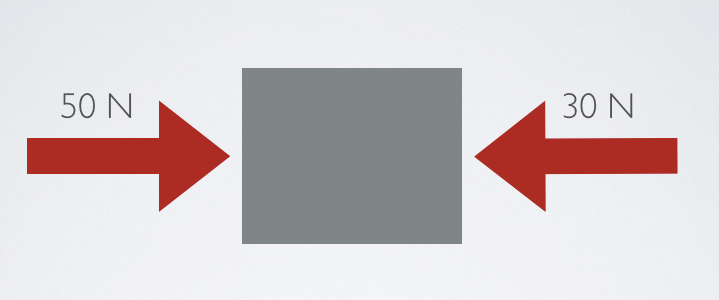
14
Multiple Choice
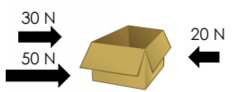
15


Copyright © Savvas Learning Company LLC. All Rights Reserved. Savvas is not responsible for any modifications made by end users to the content posted in its original format.
How is net force calculated 1 continued
Forces Applied in the Same Direction
Net force is the combination of all
the forces acting on an object. If
the forces act in the same
direction, then the net force is the
sum of the forces.
A net force of zero means forces
are balanced and the object’s
position, motion, or shape does
not change.
A nonzero net force means that
the forces are unbalanced and
that the object’s position, motion,
or shape is changing.
Net force = 18 N + 12 N = 30 N
16


Copyright © Savvas Learning Company LLC. All Rights Reserved. Savvas is not responsible for any modifications made by end users to the content posted in its original format.
How is net force calculated 1
Forces Applied in the Same Direction
17


Copyright © Savvas Learning Company LLC. All Rights Reserved. Savvas is not responsible for any modifications made by end users to the content posted in its original format.
How is net force calculated 2
Forces Applied in Opposite Directions
18


Copyright © Savvas Learning Company LLC. All Rights Reserved. Savvas is not responsible for any modifications made by end users to the content posted in its original format.
How is net force calculated 2 continued
Forces Applied in Opposite Directions
Net force = 18 N − 12 N = 6 N
Net force = 6 N − 5 N = 1 N
If the forces act in opposite directions, then the net force
is the difference in the strengths of those forces. Net
force is calculated the same way for forces exerted in a
horizontal direction and in a vertical direction.
19
Multiple Choice

20
Multiple Choice

21
Multiple Choice

What is the net force (calculation).
5
11 N Right
5 N Right
0 N
22
Multiple Choice
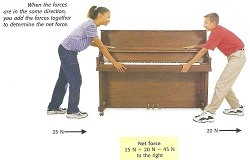
23
Multiple Choice
Two teams were having a tug of war. Team A had four people on the team, and each of them pulled with 25N of force. Team B had three people on the team, and each of them pulled with 35 N of force. Which team won, and how much greater was their net force on the rope?
Team B by 10 N
Team B by 30 N
Team A by 20 N
Team B by 65 N
24
Multiple Choice

25
Multiple Choice

26
Multiple Choice

27
Multiple Choice
Omar and Katey reach for the same toy car at the same time. Omar pulls the toy away from Katey with a force of 10 N. Katey is pulling back with a force of 6 N. What is the net force?
4 N
6 N
10 N
16 N
28


Copyright © Savvas Learning Company LLC. All Rights Reserved. Savvas is not responsible for any modifications made by end users to the content posted in its original format.
What is Newton’s Third Law of Motion?
29


Copyright © Savvas Learning Company LLC. All Rights Reserved. Savvas is not responsible for any modifications made by end users to the content posted in its original format.
What is Newton’s Third Law of Motion?
continued
Newton’s third law of motion states that if one object
exerts a force on another object, then the second
object exerts an equal force on the first object in the
opposite direction.
The action-reaction forces described by Newton’s third
law are known as force pairs.
30


TEKS 8.7B, 8.5B
Newton’s Laws
of Motion
KEY IDEAS
• What are Newton’s laws?
• How do Newton’s laws explain motion
in systems?
Words to Know
system
Newton’s first law
Newton’s third law
Copyright © Savvas Learning Company LLC. All Rights Reserved. Savvas is not responsible for any modifications made by end users to the content posted in its original format.
31

Copyright © Savvas Learning Company LLC. All Rights Reserved. Savvas is not responsible for any modifications made by end users to the content posted in its original format.
What are Newton’s Laws?
First
Law
Second
Law
Third
Law
Inertia
Force and
Acceleration
Action and
Reaction
A body at rest will remain at rest,
and a body in motion will remain
in uniform motion, unless acted
upon by an external force.
The force acting upon an object
is equal to the mass of an object
times its acceleration.
For every action there is an
equal and opposite reaction.
Newton’s Laws of Motion
32

Copyright © Savvas Learning Company LLC. All Rights Reserved. Savvas is not responsible for any modifications made by end users to the content posted in its original format.
What are Newton’s Laws? continued
In a system, Newton’s laws of inertia, force, and reactions
apply and interact simultaneously. This is especially true of
real-world systems, including those that humans have
engineered.
Newton’s Laws of Motion
First
Law
Second
Law
Third
Law
Inertia
Force and
Acceleration
Action and
Reaction
A body at rest will remain at rest,
and a body in motion will remain
in uniform motion, unless acted
upon by an external force.
The force acting upon an object is
equal to the mass of an object
times its acceleration.
For every action there is an
equal and opposite reaction.
33

Copyright © Savvas Learning Company LLC. All Rights Reserved. Savvas is not responsible for any modifications made by end users to the content posted in its original format.
Fix Newton’s Laws
Describe Provide new endings for the flawed statements
of Newton’s laws.
3.
For every action there is an equal reaction in the same direction.
1.
Objects that are motionless or have uniform motion tend to stay
that way unless the forces acting upon them are removed.
2.
Newton’s second law is represented by the equation F = m + a.
34

Copyright © Savvas Learning Company LLC. All Rights Reserved. Savvas is not responsible for any modifications made by end users to the content posted in its original format.
Fix Newton’s Laws Answers
Describe Provide new endings for the flawed statements
of Newton’s laws.
1.
Objects that are motionless or have uniform motion tend to
stay that way unless the forces acting upon them are removed.
…unless an external force acts upon them.
2.
Newton’s second law is represented by the equation F = m + a.
… represented by the equation F = ma.
3.
For every action there is an equal reaction in the same direction.
… there is an equal and opposite reaction.
35


Copyright © Savvas Learning Company LLC. All Rights Reserved. Savvas is not responsible for any modifications made by end users to the content posted in its original format.
How do Newton’s laws explain
motion in systems?
36


Copyright © Savvas Learning Company LLC. All Rights Reserved. Savvas is not responsible for any modifications made by end users to the content posted in its original format.
How do Newton’s laws explain
motion in systems? continued
Bumper cars demonstrate
Newton’s three laws.
First Law: collisions with
unbalanced forces cause
changes in motion
Second Law: masses and
accelerations of the cars
determine the forces that
the riders feel
Third Law: one car strikes
another and the colliding
car bounces back
37


Copyright © Savvas Learning Company LLC. All Rights Reserved. Savvas is not responsible for any modifications made by end users to the content posted in its original format.
Analyzing Motion in a System
AnalyzeGive examples of Newton’s laws in the system shown.
2.
Second Law
3.
Third Law
1.
First Law
Photo credit: Josefkubes/Shutterstock
38


Copyright © Savvas Learning Company LLC. All Rights Reserved. Savvas is not responsible for any modifications made by end users to the content posted in its original format.
Analyzing Motion in a System Answers
AnalyzeGive examples of Newton’s laws in the system shown.
2.
Second Law
3.
Third Law
Acceleration increases as the
mass of the rocket decreases
from the spent fuel.
Thrust from the rocket causes
it to launch.
1.
First Law
Burning fuel pushes the rocket
forward while being pushed
out the back.
Photo credit: Josefkubes/Shutterstock
39


Copyright © Savvas Learning Company LLC. All Rights Reserved. Savvas is not responsible for any modifications made by end users to the content posted in its original format.
Poll: Which of Newton’s Laws are Shown?
Analyze Discuss whether you can see evidence of each of
Newton’s three laws in the system in this image.
First Law
#
Second Law
#
Third Law
#
All of the above
#
Photo credit: Suriyapong Thongsawang/Getty Images
40


Copyright © Savvas Learning Company LLC. All Rights Reserved. Savvas is not responsible for any modifications made by end users to the content posted in its original format.
Exit Ticket
Choose one of the following ways to
describe a system in which all three of
Newton’s laws of motion are
demonstrated.
1.
Write a 7–8 sentence paragraph
about a system, citing how each law
is demonstrated.
2.
Draw and label a diagram of the
system so each law is highlighted.
41
Multiple Choice
Which of the following objects has the greatest inertia?
A large truck parked in the side of the street
A softball traveling at 95 miles per hour
A laptop sitting on your desk
42
Multiple Choice
According to Newton's 2nd Law of Motion, force equals mass times ?
inertia
speed
acceleration
weight
43
Multiple Choice
When a water rocket pushes water out of the nozzle and the rocket is able to travel across the field - What # of Newton's Law is this?
1
2
3
44
Multiple Choice
A garbage can full of trash needs a stronger force to move it to the curb than an empty garbage can. Which of Newton's Laws does this represent?
1
2
3
45
Multiple Choice

Which part of the picture is the 'action' and the 'reaction'
The action is the rocket lifting off and the reaction is the smoke coming out of the bottom
The action is the smoke coming out of the bottom and the reaction is the rocket lifting off
46
Multiple Choice
Newton's third law states.......
For each action there is a larger reaction associated with it.
None of these choices
For each action there is an equal and opposite reaction.
For each action there is a smaller reaction associated with it.
47
Multiple Choice
A force of 40 N acts upon a 2 kg block. Calculate the acceleration of the object.
20 m/s2
20 m/s
80 m/s2
80 m/s
48
Multiple Choice
An object with a mass of 100 kg is observed to accelerate at the rate of 5 m/s2. Calculate the force required to produce this acceleration.
20N
500 M/S
500 Kg
500N
49
Multiple Choice
Newton's First Law States........
Objects at rest tend to stay at rest unless acted on by an outside force.
Objects accelerate often and it is difficult to know when or how they will accelerate.
Objects in motion tend to stay in motion unless acted on by an outside force.
Both A & C
50
Multiple Choice

51
Multiple Choice
TEKS 6.7B, 6.7C,
7.7D
LOOK BACK PRESENTATION
Force, Motion, and
Acceleration
Copyright © Savvas Learning Company LLC. All Rights Reserved. Savvas is not responsible for any modifications made by end users to the content posted in its original format.
Show answer
Auto Play
Slide 1 / 51
SLIDE
Similar Resources on Wayground

44 questions
Layers of the Earth (lesson)
Presentation
•
6th - 8th Grade
43 questions
Evidence of Evolution Notes
Presentation
•
6th - 8th Grade
46 questions
Experimental and Control Variables
Presentation
•
6th - 8th Grade
46 questions
Control Variable
Presentation
•
6th - 8th Grade
46 questions
APT Test Review
Presentation
•
6th - 8th Grade
49 questions
Electromagnetic Spectrum
Presentation
•
6th - 8th Grade
45 questions
Lewis Dot Structures
Presentation
•
7th - 8th Grade
Popular Resources on Wayground
10 questions
Safety Day 2026 – Student Review

Quiz
•
9th Grade
21 questions
Continents and Oceans
Quiz
•
6th Grade
20 questions
Parts of Speech
Quiz
•
5th Grade
16 questions
Subject & Predicate
Quiz
•
5th Grade
25 questions
Multiplication Facts
Quiz
•
5th Grade
12 questions
Map Skills
Quiz
•
3rd Grade
22 questions
Continents and Oceans
Quiz
•
5th Grade
15 questions
Rounding Decimals
Quiz
•
5th Grade
Discover more resources for Science
20 questions
Newton's Laws of Motion
Quiz
•
8th Grade
20 questions
Elements, compounds, and mixtures
Quiz
•
6th Grade
10 questions
6.6D - Relative Density Review
Quiz
•
6th Grade
15 questions
potential and kinetic energy
Quiz
•
8th Grade
21 questions
Newton's Laws of Motion
Quiz
•
8th Grade
20 questions
Elements, Compounds and Mixtures
Quiz
•
8th Grade
10 questions
Exploring Chemical and Physical Changes

Interactive video
•
6th - 10th Grade
20 questions
CONDUCTION,CONVECTION AND RADIATION
Quiz
•
6th Grade