

Alg2 Lesson 2.3: Inverting Operations

Presentation
•
Mathematics
•
9th - 12th Grade
•
Practice Problem
•
Easy
+8
Standards-aligned

Monica Ramirez
Used 1+ times
FREE Resource
22 Slides • 10 Questions
1

Lesson 2.3: Inverting
Operations
Obj: I can use inverse operations to solve equations.
EQ: How do I use logarithmic operations to solve
exponential equations?
2

Roles:
Facilitator
Scribe
Resourcer
Includer
Lesson Goals:
● Creative Thinking
● Talk through controversies and conflict
● Recognize and reduce ambiguity
● Encourage thinking based on formulas and prior info
● Help explain ideas to each other
● Own your ideas and work
● Record ideas in your journal
● Answer Questions on Slides
● Follow your team roles
3

Facilitator
• Make sure that all peers are staying on task.
• Give advice or suggestions to resolve the problem.
• Be sure everyone is able to explain.
4

Scribe
• Make sure peers organize their results on their own papers.
• Remind peers to use color, arrows, and other math tools to
communicate your mathematics, reasons, and connections.
• Be ready to join the teacher for a huddle.
5

Resourcer
• Make sure peers are getting the materials needed.
• Make sure that all materials are put away neatly.
• Make sure that peers are logged in to the needed site.
• Help troubleshoot any technology difficulties that may arise.
6

Includer
• Make sure that all peers are talking about their work.
• Helps keep peers’ voice volume low.
• Encourages everyone to ask questions.
• Communicates conflicts or questions to the teacher.
7

● Check off tasks & skills on calendar.
● Select skills to work on.
● Work on Deltamath.
Remember to work on the following too…
8
Poll
Which best describes what you'll do during this lesson?
Includer
Facilitator
Scribe
Resourcer
I'm working on this ahead of time at home
9

Part 1: Basic Inverting
Operations
10

Inverses are Opposites
that undo each other.
Write the opposite of each scenario.
Scenario
Inverse
Turn on the TV.
Place a book in your backpack.
Type the word “math” into your device.
Add 3.
Multiply by 5.
Subtract 2.
Divide by -4.
Square a number.
Put a sock on, and then put a shoe on.
Add 3 to a number, and then multiply by 5.
Square a number, and then subtract 2.

11

One way of thinking about an equation is as a statement or a question. For each of the following equations, one partner should write a sentence that translates the mathematical equation into words. You do not need to solve the equations. The other partner should then write the inverse actions out in words. Be ready to share your statements and inverse actions with the class.
Eq into Words
Equation
Inverse Actions of Words
A number multiplied by 3 and
added to 4 equals 19.
3x + 4 = 19
Subtract 4 from 19, and then divide by 3.
x/5 - 1 = -7
x² + 1 = 50
(x + 4)² - 5 = 20
5(x - 3)² + 2 = 11
2^x = 8
12
Word Cloud
Write two things that are opposites of one another here.
13

Part 2: Introducing a New
Inverting Operation
14

We examined the equation 2^x = 8 and realized we
do not know any inverse operations to use to solve for x. Work with a partner to complete the following problems to determine an estimate for the value of x.
15

Write these & answer them in your journal…
1.
Create a possible scenario that can be modeled by 2^x = 8. Describe in words a context that could lead to this mathematical equation.
2.
Determine a low estimate and a high estimate for the value of x. Remember to consider input and output values.
3.
Discuss whether you think the value of x is closer to your low estimate or closer to your high estimate and explain why.
4.
Write 2^x = 8 as a system of two equations in two variables. Then graph this system of equations using a graphing utility.
5.
Look for the intersection point of the two equations you graphed. What is it? How does this compare with the estimated value of x you settled on for problem 3?
16


17

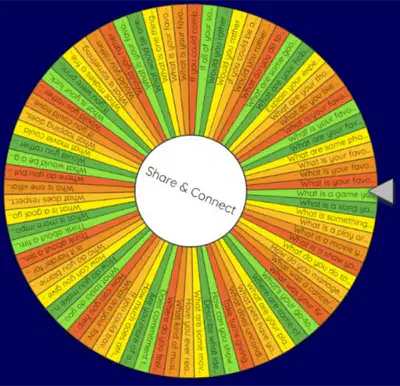
Random Question of the Day Time
https://wheelofnames.com/4ke-epz We’ll spin the wheel as a class and spend a minute or so
discussing our answers.
18

Part 3: Evaluating
Logarithmic Expressions
19

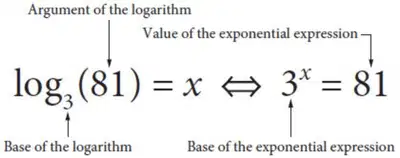

Handout 2.3.A: Exploring Logarithmic Expressions
For each of these logarithmic expressions, complete the following:
(a) Write an exponential equation that the logarithmic expression can be used to solve.
(b) Determine the value of each logarithmic expression. Show how you determined your answer.
(c) If the value is not rational, explain how you determined an approximate value.
20
Drag and Drop
log5(5) =
log6(1/36) =
log2(1) =
21
Drag and Drop
log7(35) =
log4(1/32) =
log2(-4) =
22
Poll
Which expression(s) on Handout 2.3.A were the most challenging for you?
1
2&4
3&7
5&6
8
23
Drag and Drop
Given log_b(c) where b > 0, what value(s) of c make this expression undefined?
Given log_b(b) where b > 0, what is always true? The expression is
Given log_b(1) where b > 0, what is always true? The expression is
24


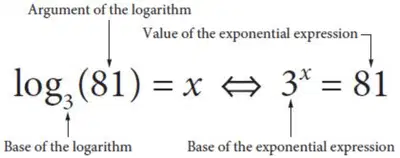
Handout 2.3.B: Using Logarithms to Solve Exponential Equations
For each of the following equations, express the solution as a logarithmic expression. Then determine its exact or
approximate value to three decimal places.
25
Dropdown
18x = 18; x =
10x = 1/100; x =
3x = 1; x =
26
Dropdown
3x = 80; x =
5x = 120; x =
6x = -36; x =
27
Multiple Choice
What is the relationship between 4^x = 20 and x = log_4(20)?
They are inverses of each other, they are equivalent.
They are inverses of each other, they are not the same.
28

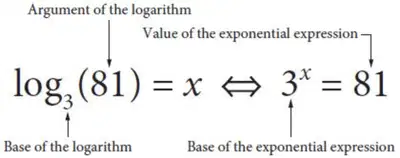
Common Log Vs Natural Log
Log(x) is the same as Log_10(x). This is known as the common logarithm.
Ln(x) is the same as Log_e(x). This is known as the natural logarithm.
e is Euler’s number, an irrational number commonly used in continuous
compounding in scenarios such as population growth.
29

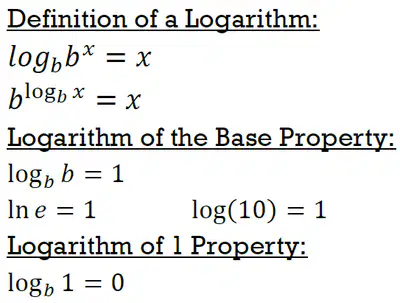
Key Takeaways
● We now know there is an inverting operation, called taking
a logarithm, that is used as an inverse operation to undo an exponential expression.
● Evaluating a logarithmic expression is equivalent to
solving its related exponential equation.
30
31



32
Poll
How do you feel about today's lesson?
I can explain it!
I feel confident about it!
I need more practice.
I need to go back and do the slides over..
Lesson 2.3: Inverting
Operations
Obj: I can use inverse operations to solve equations.
EQ: How do I use logarithmic operations to solve
exponential equations?
Show answer
Auto Play
Slide 1 / 32
SLIDE
Similar Resources on Wayground

26 questions
Characteristics of Exponential and Logarithmic Functions
Presentation
•
9th - 12th Grade
24 questions
Solving Quadratic Equations by Graphing
Presentation
•
9th - 12th Grade
27 questions
Lesson on Factoring GCF and Difference of Two Squares
Presentation
•
9th - 12th Grade
24 questions
Sketching Angles and Radians
Presentation
•
9th - 12th Grade
24 questions
Parallel Lines, Angles, & Transversals
Presentation
•
10th - 12th Grade
23 questions
SOHCAHTOA
Presentation
•
10th - 12th Grade
26 questions
5.1 Angles of Triangles
Presentation
•
9th - 12th Grade
26 questions
Notes on Compound Inequalities
Presentation
•
9th - 12th Grade
Popular Resources on Wayground
10 questions
How much do you know about our Portrait of an Eagle?

Quiz
•
10th Grade
10 questions
Fast Food Slogans
Quiz
•
6th - 8th Grade
21 questions
Continents and Oceans
Quiz
•
6th Grade
20 questions
Parts of Speech
Quiz
•
5th Grade
16 questions
Subject & Predicate
Quiz
•
5th Grade
25 questions
Multiplication Facts
Quiz
•
5th Grade
12 questions
Map Skills
Quiz
•
3rd Grade
22 questions
Continents and Oceans
Quiz
•
5th Grade
Discover more resources for Mathematics
20 questions
Graphing Inequalities on a Number Line
Quiz
•
6th - 9th Grade
10 questions
Translating Algebraic Expressions
Quiz
•
9th Grade
20 questions
Exponent Rules
Quiz
•
8th - 9th Grade
20 questions
Function or Not a Function
Quiz
•
8th - 9th Grade
10 questions
Literal Equations
Quiz
•
9th Grade
18 questions
Discrete Vs. Continuous Practice
Quiz
•
9th Grade
10 questions
Solving Absolute Value Equations
Quiz
•
9th Grade
10 questions
Identifying equations
Quiz
•
KG - University