
Electron Configuration

Presentation
•
Chemistry
•
9th - 12th Grade
•
Practice Problem
•
Hard

Razelina Monguez
Used 2+ times
FREE Resource
58 Slides • 0 Questions
1


Electron
Configurations
2

3

4

5

6

7

8

9

10

11

12

13

14

15

16

17

18

19

20

21

22

23

24

25

26

27

28

29

30

31


Electron Arrangement in an Atom
• The arrangement of electrons in an atom is its
electron configuration.
• It is impossible to know where an electron is
or how fast it is traveling at any given time
(Heisenberg Uncertainty Principle? Walter White?).
• Models of the atom, such as the Bohr model are
very inaccurate (oops!) according to modern
atomic theory.
• Atoms and electrons are more
complicated than planets orbiting
the Sun.
32


Energy Levels
• There are “shells” or energy levels around an
atom. The farther away an energy level is
from the nucleus, the more energy the
sublevel has.
33

Electron Orbitals
• Orbitals are clouds of probability within an
energy level, so an actual orbital is a region of
space, where an electron might be found.
• Two orbital clouds are pictured below. There
are more dots near the center of the picture,
because an electron is most likely to be near
the nucleus (center) of the atom (the electron
which is negative is attracted to the positive
protons).
34

Types of Orbitals
• Within the energy shells are different shaped
orbitals (represented by the letters s, p, d, and
f) that can contain different total numbers of
electrons. A number can be placed in front of
the orbital letter to represent the energy level
that an orbital belongs to.
For example: 1s is an s shaped orbital on the 1st
energy level, which is closest to the nucleus
35

Orbitals, con’td
• Different shaped orbitals can hold different
numbers of electrons:
– s orbital can hold up to 2 electrons (1 pair)
– p orbital can hold up to 6 electrons (3 pairs)
– d orbitals can hold up to 10 electrons (5 pairs)
– f orbitals can hold up to 14 electrons (7 pairs)
36


If a vehicle were an orbital…..
• Match the orbital to the vehicle that most
represents it!
37


So how do the orbitals REALLY look?
38


Putting the s and p orbitals together…..
So what number represents the highest energy
level as well as the outermost level in this
atom of Neon?
39


Another way to look at it….
• The boxes represent the different orbitals. As the
number of the level increases, the energy increases.
Each individual box can hold 2 electrons at a time.
40

How are electrons in their orbitals like
an apartment house?
• Different floors in the apartment represent
different energy levels or shells.
• Each room on each floor of the apartment
house corresponds to an orbital, or one box
from the previous diagram.
41

How are electrons in their orbitals like
an apartment house?
•
Different floors in the apartment represent different energy levels
or shells.
•
Each room on each floor of the apartment house corresponds to an
orbital, or one box from the previous diagram.
• Each room on each floor can hold up to 2 people
(the electrons), and each room is filled with one
person first before the rooms become double
occupancy.
• Only a man and a woman can live together in a
room in the apartment house. (this represents
the “spin” of the electrons – one has an up-spin,
the other has a down-spin)
42

Who figured this out and how does it relate to
the apartment analogy?!?
Apartment House Rules
Electron Rules
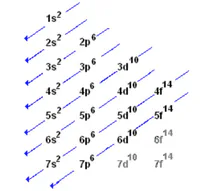
From the Bottom Up: Rooms must be filled
from the ground floor up. Fill the one room on
the first floor before starting to put new
tenants on the second floor. Then fill the s
room before the p rooms. At higher floors the
order might change a bit.
Aufbau Principle: the electrons fill the
available orbitals from lowest energy to
highest energy. In the ground state all the
electrons are in the lowest possible energy
level.
Singles First: the owner of the building wants
to have the tenants spread out as much as
possible. For that reason singles are placed in
rooms before couples. If couples must be
placed into a room then all of the other rooms
on that floor must already have a single in
them.
Hund’s Rule: The electrons must be placed
into the orbitals in such a way that no pairs are
put together unless absolutely necessary. That
is, single electrons must be placed into boxes
first and then paired up if necessary.
Opposite “Gender” Only: When two people
are placed in a room they must be of opposite
genders. No men may room together and no
women may room together. This is an
arbitrary rule on the part of the owners: in a
just world we wouldn’t have to follow it. But
quantum mechanics has nothing to do with
justice.
Pauli Exclusion Principle: Electrons
come in two varieties based on the direction
they are ‘spinning’. There is an Up spin and a
Down spin. Up and Down spins are always
paired together and Up-Up or Down-Down
combinations are not allowed. No two
electrons can ever be in the same place at the
same time.
43


The Periodic Table – A Cheat Sheet for Knowing
the Order of Filling Electron Orbitals
1
2
3
4
5
6
7
44


Practice!
• Fill in the electron orbitals corresponding to
He, then write out the complete electron
configuration.
45


More Practice
• Fill in the electron orbitals for Si, then write
out the complete electron configuration.
1s22s22p63s23p2
46


Electron Configs
with Elements in the d Block
Notice that when you get to the 3d orbital, it is higher in
energy than the 4s orbital. The rule is that electrons fill
lower energy orbitals first, so electrons will actually fill the
4s orbital after 3p, then electrons will begin to fill the 3d
orbital.
47


Practice with the d Block
• Write the electron configuration for Titanium
(Ti).
1s22s22p63s23p64s23d2
48

Noble Gas Notation
• This is much shorter and more convenient than writing
out the entire electron configuration.
• Use the symbol for the noble gas that is just before the
element you are configuring. (The noble gas and the
element will have the same configuration, or inner
electron structure, up to that point)
• Then complete the configuration that comes after the
noble gas for the element in question.
• Example: The complete configuration for Na is
1s22s22p63s1. Neon is the noble gas that comes before
Na on the periodic table. So the noble gas notation for
Na would be: [Ne]3s1
49

Practice!
• Write the noble gas notation for the following
elements:
– Chlorine
– Beryllium
[Ne]3s23p5
[He]2s2
50

More Practice
• Which element has the following
configuration: [Xe]6s2?
Barium
51

Electron Configurations
and Valence Electrons
• The outermost shell of electrons in an atom is the
valence shell and it contains the valence
electrons.
• The outermost shell contains the electrons that
can interact most with the rest of the world.
• A full valence shell contains 8 electrons (2 from
an s orbital and 6 from a p orbital), unless you’re
hydrogen or helium (only want 2 to fill their
outermost s shell to become stable).
52

53

How many valence electrons in….
• Oxygen - 1s22s22p4
• Sulfur - 1s22s22p63s23p4
The outermost shell contains the
valence electrons, so find the highest
number in the electron configuration
and count the number of electrons in it.
54

Valence Electrons and Lewis Dot
Structures
• Remember valence electrons determine the
chemical properties of an element because
they are the outermost electrons that interact
with the outside world.
• We can use Lewis dot structures to help
represent these important valence electrons
for each element.
55


56


Practice!
• Step 1: Use the periodic table to determine the
number of valence electrons in an atom of a
certain element.
• Step 2: Write the element symbol and place the
dots (valence electrons) on each of the four sides
of the symbol; singles first and then pair them if
necessary.
57


Check Your Work
58

Ions and Electron Configuration
• Remember that CATIONS are positively charged
atoms and ANIONS are negatively charged atoms.
• These form because of the need for an atom to
achieve stability that the noble gases have.
• Understanding electron arrangement in an atom,
especially the electrons in the outermost shell
(valence), can help you determine why the
elements form the ions that they do.
• PRE-AP ONLY
Electron
Configurations
Show answer
Auto Play
Slide 1 / 58
SLIDE
Similar Resources on Wayground

50 questions
Por vs. Para
Presentation
•
10th - 12th Grade
54 questions
Chp 9 Food Safety and Sanitation
Presentation
•
9th - 12th Grade
59 questions
NAMING BINARY IONIC COMPOUNDS
Presentation
•
10th - 12th Grade
54 questions
S1 Unit 3 Toc Toc
Presentation
•
9th - 12th Grade
52 questions
ALG1_SD_09.22_A.2A_A.3C QUIZIZZ
Presentation
•
9th - 12th Grade
55 questions
Moles Conversion Practice
Presentation
•
9th - 12th Grade
57 questions
Genes and Punnett squares
Presentation
•
9th - 12th Grade
54 questions
WWI - A Flawed Peace
Presentation
•
10th - 12th Grade
Popular Resources on Wayground
21 questions
Continents and Oceans

Quiz
•
6th Grade
20 questions
Parts of Speech
Quiz
•
5th Grade
16 questions
Subject & Predicate
Quiz
•
5th Grade
25 questions
Multiplication Facts
Quiz
•
5th Grade
12 questions
Map Skills
Quiz
•
3rd Grade
22 questions
Continents and Oceans
Quiz
•
5th Grade
15 questions
Rounding Decimals
Quiz
•
5th Grade
20 questions
Brand Labels
Quiz
•
5th - 12th Grade
Discover more resources for Chemistry
20 questions
Metric Conversions
Quiz
•
11th Grade
20 questions
electron configurations and orbital notation
Quiz
•
9th - 12th Grade
20 questions
Periodic Table Trends
Quiz
•
11th Grade
20 questions
COUNTING ATOMS
Quiz
•
10th Grade
20 questions
Practice: E-Con, Orbital Notation, Noble Gas Notation
Quiz
•
10th Grade
11 questions
Balancing Chemical Equations
Presentation
•
9th Grade
50 questions
Unit 3: Atomic Assault Summative Review
Quiz
•
11th Grade
15 questions
Heating and Cooling Curves
Quiz
•
9th - 12th Grade