

Unit 4 Lesson 4.2.4

Presentation
•
Science
•
6th Grade
•
Practice Problem
•
Medium
+9
Standards-aligned

Joe Porr
Used 2+ times
FREE Resource
21 Slides • 10 Questions
1

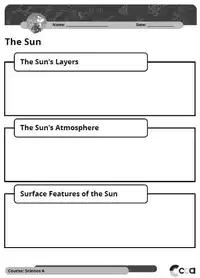
The Sun
Lesson 4.2.4
2
Open Ended
What do you think would happen if we did not have the sun?
3
-science notebook
Materials
describe the layers of the Sun
describe the surface features of the Sun
What we will learn...
Lesson Objectives
4

Essential for life on Earth
Provides light for plants to grow.
Provides heat for life to survive.
Central in the solar system.
Composed of several layers
Made primarily of hydrogen and helium.
Sun Basics
5

spacecraft that has provided details about the sun.
Been collecting data for 30 years.
Has been able to capture images of the sun.
The Solar and Heliospheric Observatory (SOHO)
6
7
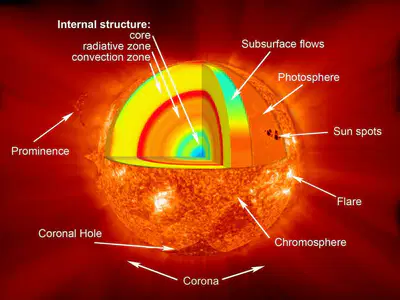
Made of plasma (similar to gas).
3 main layers
the core
radiative zone
convection zone
Beyond convection zone is the Sun's atmosphere.
Let's check out each layer.
The Sun's Layers
8
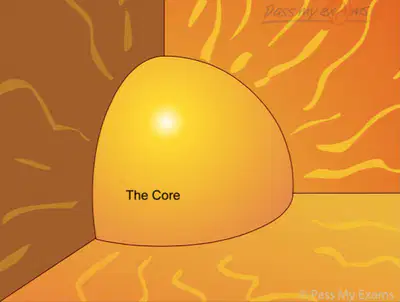
The intense heat comes from the core.
Hydrogen atoms smash together and forms helium which causes a reaction that produces heat and energy.
Has been going on for nearly 4.6 billion years.
The Core
9
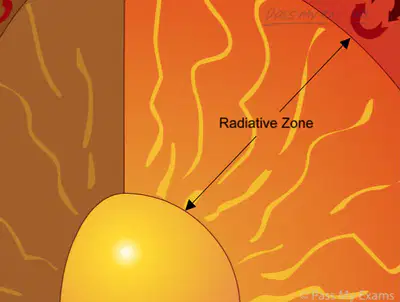
The second section from the middle (core).
Energy from the core moves outward through this section.
The Radiative Zone
10
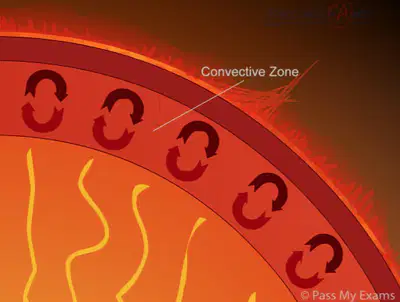
The third section from the middle (core).
This section is in motion.
The deeper hotter zones rise up.
The cool outer plasma sinks into the radiative zone.
The Convection Zone
11
Hotspot
Which one is the convection zone
12
Hotspot
Which one is the radiative zone
13
Hotspot
Which spot is the core
14
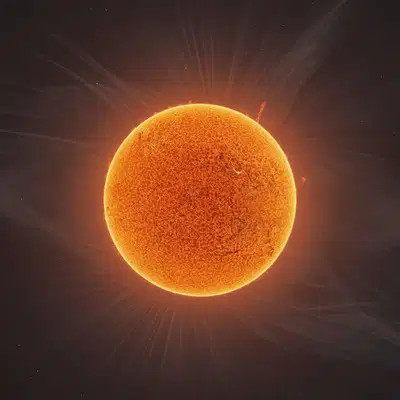
The sun does not have a solid surface like Earth.
Made of thin layers of gasses.
Surrounds the three main layers.
3 main layers:
photosphere
chromosphere
corona
Let's explore these three layers.
The Sun's Atmosphere
15
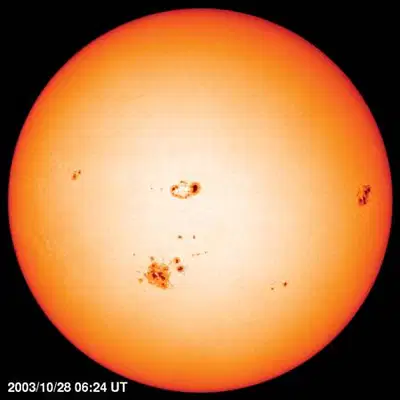
First layer
The sun's surface
Not solid
It is the part we see everyday.
This layer is often illustrated as a solid yellow.
If viewed through a telescope it is covered in granules.
The granules are caused by temperature differences.
Photosphere
16
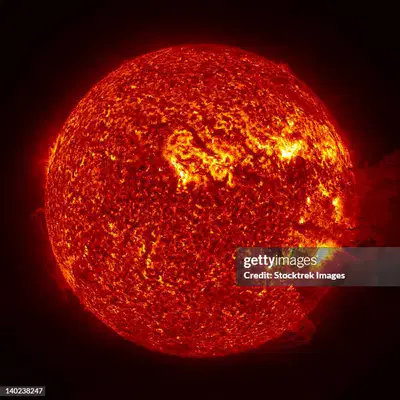
Located above the photosphere
Has fast moving gas particles.
These gas particles make the outer part of this layer hotter than the lower part.
Temps range from 7,640-720,000 degrees F.
Chromosphere
17
Outer layer
Very thin
Stretches out far into space
Usually invisible to us except during a solar eclipse when the moon covers the center of the sun.
Corona
18
Match
Match the description with the layer of the Sun's atmosphere.
chromosphere
Corona
photosphere
This layer includes fast-moving gas part
This layer is the outer atmospheric laye
This layer is the brightest layer of the
This layer includes fast-moving gas part
This layer is the outer atmospheric laye
This layer is the brightest layer of the
19
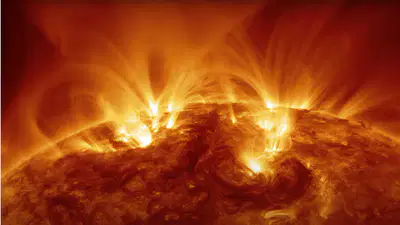
Has a magnetic field
The magnetic field interacts with the gases and plasma making different features on the surface.
These features are
sunspots
solar flares
solar wind
Let's explore these features more
Surface Features
20
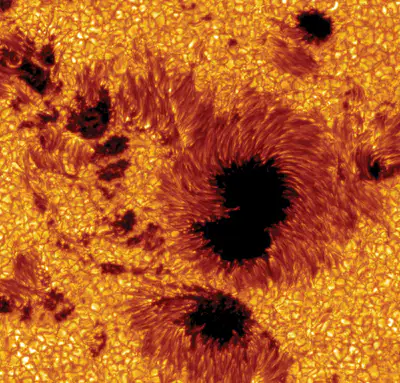
Dark marks on the sun
Cooler parts of the sun
Usually last for weeks and then will fade away.
Sunspots
21
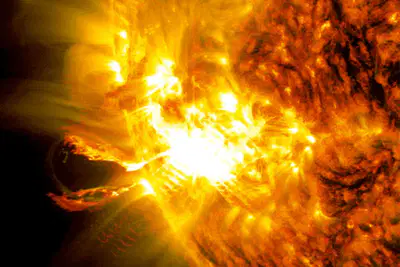
Sudden eruption on the surface.
Very violent
Release high amounts of energy.
Solar Flares
22
23
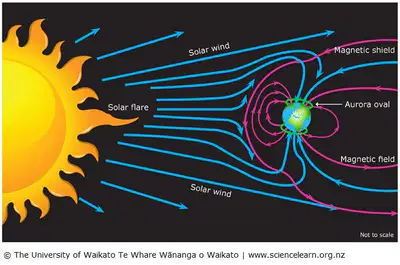
Constantly coming from the sun.
Stream of charged particles.
The Earth's magnetic field protects us from these particles.
Solar winds can cause northern and southern lights in the sky.
The solar wind will cause different colors in the sky.
Solar Wind
24
Hotspot
In the model, identify the sunspot
25
Hotspot
In the model, identify the solar wind
26
Hotspot
In the model, identify the solar flare
27

Could damage your eyes
Radiation from the sun can lead to long term damage.
This can make it hard to study the sun.
Let's check out a video for more information on this.
Why you should not look at the sun
28
29
Multiple Choice
What is the safest way to study the Sun?
Observe the Sun directly by using a pair of binoculars.
Observe a reflection of the Sun that passes through a pinhole.
Observe the Sun only during sunrise or sunset.
Observe the Sun directly but squint to reduce how bright it is.
30
Review
What did we learn...
the layers of the Sun and the source of the Sun's heat and energy;
the layers of the Sun's atmosphere and why the photosphere is considered the Sun's surface;
features that appear on the Sun's surface; and
the dangers of looking at the Sun and ways to safely observe it.
31
Open Ended
3,2,1, show me what you know.
Tell the 3 main layers of the sun
Tell 2 of the surface features of the sun
Tell the 1 layer of the sun's atmosphere we see
Sentence Starters
3 main layers are...
2 surface features are...
The layer we see is...
The Sun
Lesson 4.2.4
Show answer
Auto Play
Slide 1 / 31
SLIDE
Similar Resources on Wayground

22 questions
Respiratory System
Presentation
•
6th - 7th Grade
20 questions
Integumentary System
Presentation
•
6th Grade
25 questions
Erosion and Deposition
Presentation
•
6th Grade
25 questions
Unit 2 Metals, Nonmetals, and Metalloids Lesson
Presentation
•
6th Grade
26 questions
Forms of Energy Lesson
Presentation
•
6th Grade
23 questions
Asteroids, Meteors, and Comets
Presentation
•
6th Grade
21 questions
Respiratory System
Presentation
•
6th Grade
25 questions
Characteristics and Properties of Waves Review
Presentation
•
6th Grade
Popular Resources on Wayground
10 questions
GPA Lesson
Presentation
•
9th - 12th Grade
7 questions
Albert Einstein

Quiz
•
3rd Grade
31 questions
Bridge A Review
Quiz
•
3rd Grade
6 questions
Blue Sue and Red Ruth
Quiz
•
3rd Grade
8 questions
(Day12 HW) Inverse Trig Ratios
Quiz
•
9th Grade
20 questions
Summer Geometry QUIZ (Week3)
Quiz
•
9th Grade
16 questions
Theme Practice
Quiz
•
7th Grade
20 questions
Taxes
Quiz
•
9th - 12th Grade