
HC 7.3 Balancing Equations

Presentation
•
Chemistry
•
11th Grade
•
Practice Problem
•
Medium
Standards-aligned

Robert Oliver
Used 2+ times
FREE Resource
5 Slides • 11 Questions
1


Chapter 7
Chemical Reactions: An Introduction
Steven S. Zumdahl
Susan A. Zumdahl
Donald J. DeCoste
Gretchen M. Adams • University of Illinois at Urbana-Champaign
2


• Write a balanced equation for a chemical reaction
Core Ideas and Skills
Balancing Chemical Equations
Section 7.3
3


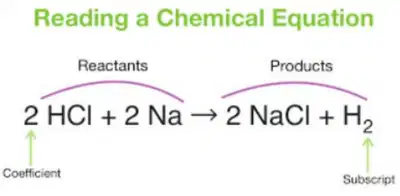
• A chemical reaction is balanced using a systematic approach:
▪ Write the formulas of the reactants and products to give the
unbalancedchemical equation.
▪ Balance by trial and error starting with the most complicated molecule.
▪ At the end, check that the coefficients used give the same number of
each type of atom on both sides of the arrow.
Balancing Chemical Equations
Section 7.3
4
Multiple Select
When balancing this chemical equation, which molecule should you start with?
H2 + O2 → H2O
(Choose 2 answers)
H2
O2
H2O
the most complex molecule
the simplest molecule
5
Multiple Choice
In a balanced chemical equation, what must be the same on both sides of the arrow?
the number of molecules
(of each type)
the number atoms (of each type)
the number of products must equal the number of reactants
the same coefficients must be used on both sides
6
Multiple Choice
What does the coefficient in a chemical equation represent?
number of molecules
number of atoms
speed of reaction
temperature of reaction
7
8


Hydrogen gas and oxygen gas combine to form liquid water.
Example
Balancing Chemical Equations
Section 7.3
9
Multiple Select
Hydrogen gas and oxygen gas combine to form liquid water.
Which would be correct for the 1st step? Choose all correct answers.
H2(g) + O2(g) → H2O(l)
H2 + O2 → H2O
H + O → H2O
10
Drag and Drop
Add coefficients to balance the equation.
11
Drag and Drop
2H2(g) + O2(g) → 2H2O(l)
12
Multiple Choice
Al + O2 --> 2Al2O3
13
Multiple Choice
2C2H2 + 5O2 --> 4CO2 + 2H2O
14
Multiple Choice
Balance the following equation:
___ Mg+ ___ O2→___ MgO
1, 1, 3
2, 1, 2
1, 2, 1
2, 2, 2
15
Multiple Choice
Balance the following equation:
___ SeCl6+ ___ O2→___ SeO2+____Cl2
1, 1, 1, 3
2, 1, 2, 1
1, 2, 1, 2
2, 2, 2, 4
16
Drag and Drop
Chapter 7
Chemical Reactions: An Introduction
Steven S. Zumdahl
Susan A. Zumdahl
Donald J. DeCoste
Gretchen M. Adams • University of Illinois at Urbana-Champaign
Show answer
Auto Play
Slide 1 / 16
SLIDE
Similar Resources on Wayground

12 questions
Prepositions
Presentation
•
3rd Grade
11 questions
Chapter 11 Section 2 Boyle's Law
Presentation
•
11th - 12th Grade
10 questions
SULFURIC ACID
Presentation
•
11th Grade
12 questions
Dimensional Analysis
Presentation
•
11th Grade
11 questions
Composition of Glass and its Uses
Presentation
•
11th Grade
10 questions
Termokimia SMABosch
Presentation
•
11th Grade
12 questions
REVISÃO (2ºEM)- 4ºBI
Presentation
•
11th Grade
12 questions
EDUQATION KIMIA Kelas 11
Presentation
•
11th Grade
Popular Resources on Wayground
6 questions
PRIDE Always and Everywhere
Presentation
•
12th Grade
20 questions
Lab Safety Quiz

Quiz
•
6th Grade
26 questions
KOR Review Kahoot Questions
Quiz
•
8th Grade
21 questions
Continents and Oceans
Quiz
•
6th Grade
12 questions
Unit Zero lesson 2 cafeteria
Presentation
•
9th - 12th Grade
20 questions
Parts of Speech
Quiz
•
5th Grade
10 questions
Riddles Riddles fun Riddles
Quiz
•
6th - 12th Grade
16 questions
Subject & Predicate
Quiz
•
5th Grade
Discover more resources for Chemistry
20 questions
Scientific Method
Quiz
•
10th - 12th Grade
20 questions
Metric Conversions
Quiz
•
11th Grade
12 questions
Significant figures
Quiz
•
9th - 12th Grade
11 questions
AP Chemistry - Unit 1 Review
Quiz
•
11th Grade
14 questions
Matter Module Exam Practice Quiz
Quiz
•
9th - 12th Grade
15 questions
Lab Safety & Equpiment
Quiz
•
9th - 12th Grade
20 questions
Chemistry Flame Assessment
Quiz
•
9th - 12th Grade
15 questions
Solutions: Solute and Solvent
Quiz
•
9th - 12th Grade