Search Header Logo
Review Study Guide

Review Study Guide

Assessment

Presentation

Biology

12th Grade

Easy

NGSS
HS-LS4-2, HS-LS4-4, HS-LS4-1

+10

Standards-aligned

Created by

Michelle Daniels

Used 1+ times

FREE Resource

3 Slides • 77 Questions

1

Discover new features in Lessons!
Finish all phases of “I-do ; We-do ; You-do” with Quizizz

media
media
media
media

​You can also create lessons directly on Google Slides using “Quizizz Extension”.
Read more about it here

2

Multiple Choice

The benefit of this descriptive research is that it allows researchers to view naturally occurring behaviors without controlling the situation.

1

Natural observation

2

Survey

3

Case Study

4

Correlation

3

Multiple Choice

Question image
Josie was performing an experiment where she grew the same kind of tomatoes in the same soil and amount of water.  She sat one in the sun and one in a closet for 14 days.  What is the independent variable in Josie's experiment?
1
tomatoes
2
soil
3
sunlight
4
water

4

Multiple Choice

Which of the following shows the correct sequence for the scientific method inquiry?

1

Conclusion, Experimentation, Hypothesis, Observation

2

Observation, Experimentation, Hypothesis, Conclusion

3

Observation, Hypothesis, Experimentation, Conclusion

4

Experimentation, Conclusion, Observation, Hypothesis

5

Drag and Drop

An ​ ​
variable causes the ​
variable to change..
Drag these tiles and drop them in the correct blank above
independent
dependent

6

Multiple Choice

Any experiment factor which is not being tested for the Cause-and-Effect Relationship.

1

controlled

2

independent

3

experimental

4

dependent

7

Multiple Choice

Question image

Why do we keep everything in an experiment the same except for the variable we are testing? Hint: This is called constants

1

So we can get mixed results and have a valid scientific methods based experiment

2

So we are comparing apples to apples, and we will only get results based on the ine variable we are testing.

8

Multiple Choice

Question image

The birds image represents Quantitative or Qualitative?

1

Quantitative

2

Qualitative

9

Multiple Choice

Question image

The image with the trees is Qualitative or Quantitative data?

1

Qualitative

2

Quantitative

10

Multiple Choice

Question image

What does this image represent, and is it in the proper order?

1

Scientific Mustard, yes

2

Scientific methods , no

3

Scientific methods, yes

4

Scientificly modified , no

11

Multiple Choice

Question image

This guy represents what, and what is the saying?

1

Scientific Methods order, Only Quiet Raccoons have evolved to drink Rootbeer

2

Evolution order, Only Quick Racoons evolve to damage Rome

12

Multiple Choice

Question image

In this experiment you are measuring the height of the plants growth in cm when different amounts of fertilizer is applied. which is the independent variable?

1

Fertilizer drops

2

light

3

water

4

height

13

Multiple Choice

Question image

What are the variables in this experiment?

1

Lisa and hair

2

Rogaoti, and hair growth

14

Multiple Choice

Question image

Why did we study this in class?

1

to learn about pulleys and how they apply to physics

2

To learn about models and how they help explain thngs we can't see or easily represent

3

to learn how toilet paper works and how to flush properly

15

Multiple Choice

Question image

What is the purpose of using models in science?

1

because they are gross and cool

2

because they are pretty

3

to understand and represent things that are hard to see such as too big, too small, or hidden.

16

Multiple Choice

Question image

By observing the graph, what is this experiment about?

1

How to make the most of your money by investing

2

How to make money selling different liquids to thirsty people

3

How different liquids tarnish a penny

4

Which liquid best cleans a penny

17

Explanation Slide...

Extrapolation is making a prediction based on that graph that you are given. With this graph, they didn't measure the mass of a baby badger at 9 months, but we can predict what the weight would be based on the graph.

18

Open Ended

Question image

Extrapolate from this graph: At 9 months old, what would the mass of a baby badger be?

19

Explanation Slide...

Independent Variable: The thing that is changed by the scientist

20

Multiple Choice

Question image

Sarika wants to find out what type of soil plants grow best in. What is the independent variable?

1

Type of Soil

2

Height of Plants

3

Amount of Sunlight

4

Amount of Water

21

Multiple Choice

Goggles are worn in the laboratory

1

A. to avoid eye strain.

2

B. to improve your vision

3

C. only if you don’t have corrective glasses.

4

D. any time chemicals, heat, or glassware are used.

22

Multiple Choice

If you do not understand a direction or part of a lab procedure, you should—

1

Figure it out as you do the lab

2

Try several methods until something works

3

ask the instructor before proceeding

4

skip it and go on to the next part

23

Multiple Choice

After completing an experiment, all chemical wastes should be—

1

Left at your lab station for the next class

2

Disposed of according to your instructor's directions

3

Dumped in the sink

4

Taken home

24

Multiple Choice

Long hair in the laboratory must be

1

cut short

2

held away from the experiment with one hand

3

always neatly groomed

4

tied back or kept entirely out of the way with a hair band

25

Multiple Choice

horseplay and practical jokes in the laboratory are

1

always against the rules

2

okay

3

not dangerous

4

okay if you are working alone

26

Multiple Choice

Sharp objects in the laboratory should be carried by

1

holding the handle with the tip pointed up.

2

holding the handle with the tip pointed down.

3

holding the handle with the tip pointed toward your body.

4

holding the blade

27

Multiple Choice

If a harmful chemical splashes in your eyes or on your skin, you should—

1

ignore it and hope it goes away.

2

wipe it off with a paper towel and finish the lab.

3

flush with water at the eyewash station or in the lab shower and tell the teacher.

4

run to the bathroom.

28

Multiple Choice

Question image
1
beaker
2
flask
3
graduated cylinder
4
test tube

29

Multiple Choice

Question image
1
hot plate
2
flame thrower
3
heater
4
bunsen burner

30

Multiple Choice

Question image
1
buret
2
erlenmeyer flask
3
graduated cylinder
4
beaker

31

Multiple Choice

Question image
Identify the equipment shown here:
1
beaker
2
Erlenmeyer flask
3
Florence flask
4
volumetric flask

32

Multiple Choice

What does Evidence mean? 
1
All scientific data that supports your claim
2
An opinion
3
Statement you believe to be true
4
A statement of an opposing argument

33

Multiple Choice

Males of the bighorn sheep species fight one another to show females who is the dominant male and are more likely to mate with females.

1

Natural Selection

2

Mutation

3

Genetic Drift

4

Non-Random Mating

34

Multiple Choice

During a hurricane, a population of beetles almost gets completely wiped out. The only beetles that survived were lucky that they were in their nest at the time of the hurricane and had enough food to survive.

1

Natural selection

2

Genetic Drift

3

Gene Flow

4

Non-Random Mating

35

Multiple Choice

Insects become resistant to pesticides very quickly, sometime in one generation. If an insect is resistant to the chemical, most of the offspring will also be resistant. Considering that insect generations can be a matter of weeks, insects in an area can become immune to a chemical within months.

1

Mutation

2

Natural Selection

3

Genetic Drift

4

Gene Flow

36

Multiple Choice

A chemical spill causes a genetic change in the offspring of ladybugs to have blue dots instead of black dots.

1

Natural Selection

2

Genetic Drift

3

Mutation

4

Gene Flow

37

Multiple Choice

This is one of the mechanisms of evolution; it is a continuous process in which organisms with traits that make them better-adapted to their environment are more likely to survive and reproduce than organisms without such adaptations

1

Directional selection

2

Microevolution

3

Gene flow / genetic drift

4

Natural selection

38

Multiple Choice

This is the process that ultimately creates new variations and changes in DNA; leads to the creation of new alleles

1

Mutation

2

Microevolution

3

Natural selection

4

Gene flow / genetic drift

39

Multiple Choice

This is a pattern of natural selection in which the average (or intermediate) form of a trait is the most advantageous, and so a population evolves away from the extremes and toward the average

1

Disruptive selection

2

Directional selection

3

Stabilizing selection

4

Middle selection

40

Multiple Choice

Question image

This makes an organism more suited to its environment

1

species

2

lifespan

3

adaptation

4

mutation

41

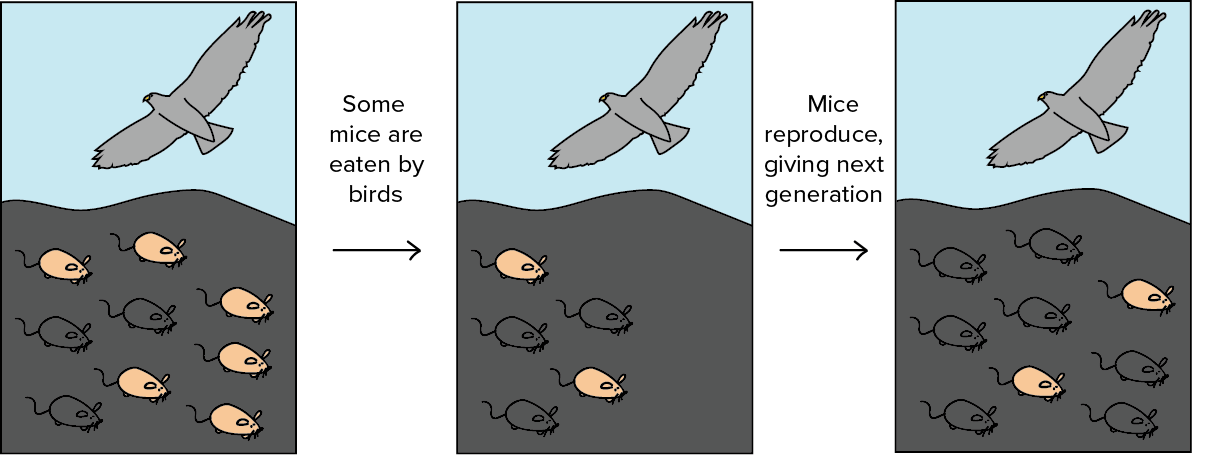
Multiple Choice

Question image
Why is the mouse population changing over time?
1

The light mice can reproduce more successfully than the dark mice

2

The hawks eat more dark mice than light mice because the dark mice taste better

3

The hawks eat more light mice than dark mice because they can see the light mice more easily

4

The hawks eat more dark mice than light mice because they can see the dark mice more easily

42

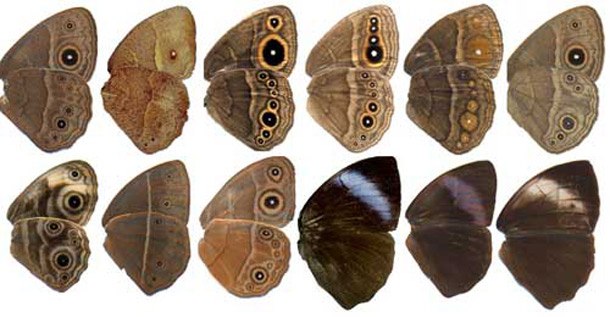
Multiple Choice

Question image
These moths are all the same species. The differences between their wings is an example of ________________
1

Natural Selection

2

Variation

3

Homeostasis

4

Extinction

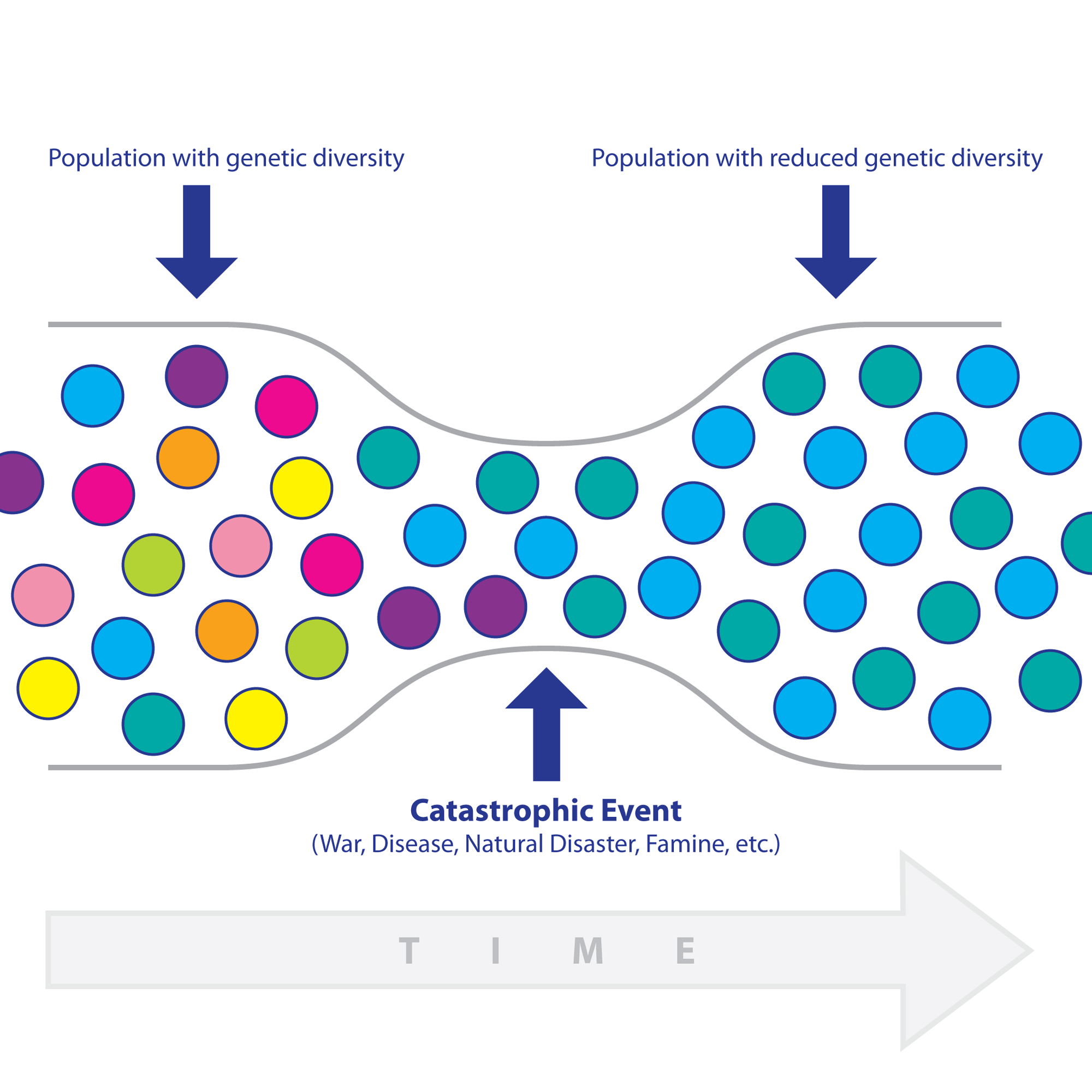
43

Multiple Choice

Question image

A drastic reduction in the size of a population that can change allele frequencies is called

1

the bottleneck effect

2

the founder effect

3

the gene flow effect

4

the Thanos effect

44

Multiple Choice

If you take antibiotics only the resistant bacteria survive and the non-resistant bacteria die. This is an example of...

1

Resistance

2

Survival of the fittest

3

How antibiotics work

45

Multiple Choice

Question image

Humans evolved from chimpanzees

1

True

2

False

46

Multiple Choice

Question image

According to the diagram, crocodiles evolved from dinosaurs and birds.

1

True

2

False

47

Multiple Choice

Humans, birds, whales, and lizards all have similar arm bones. What is the reason for this?
1
The function of these bones is the same in all animals
2
They live in similar environments
3
They have a common ancestor
4
All organisms resemble humans

48

Multiple Choice

Charles Darwin observed that finches of different species on the Galápagos Islands have many similar physical characteristics, this supports the hypothesis that these finches

1

are twins

2

acquired traits through use and disuse.

3

all eat the same type of food.

4

descended from a common ancestor.

49

Multiple Choice

Question image
The diagram shows fossils in different rock layers. Which of these statements about the age of these fossils is most likely correct?
1
Fossil A and C are the same age
2
Fossil B is older than fossil C
3
Fossils A is older than fossil B
4
Fossil D is older than fossil C

50

Match

Match the following

Organism

Population

Community

ecosystem

biosphere

51

Match

Match the following pictures with the words they represent

Analogous Structure

Homologous Structure

Artificial selection

Natural selection

52

Multiple Choice

Question image

Many different groups of organisms have wings, even though they do not share a recent common ancestor. This is because they evolved in environments with similar selective pressures. Wings are an example of a(n) ______________ structure.

1

vestigial

2

analogous

3

homologous

53

Multiple Choice

Which statement best describes Natural selection?

1

The best adapted organisms survive and reproduce.

2

There are a set amount of organisms.

3

Organisms only change through genetic engineering.

4

Organisms slowly adapt to their surroundings over a lifetime.

54

Multiple Choice

Question image
Which layer is oldest?
1
A
2
W
3
G
4
Z

55

Multiple Choice

Question image
Why don't all living things become fossils?
1
because some living things are too big
2
because some are subject to catastrophism and others are not
3

because environmental conditions have to be just right (for formation & to prevent decay)

56

Multiple Choice

Question image

Why are vestigial structures evidence for evolution?

1

They are useful in the organism and show natural selection at work.

2

They are not useful in the organism but they were probably useful in some ancestor of that species.

3

They show that these organs or behaviors help an organism adapt to new environments

57

Multiple Choice

Question image

The pelvic bone of whales is not needed for movement within the water. This is an example of a(n) ______________ structure.

1

vestigial

2

analogous

3

homologous

58

Multiple Choice

Question image

In this example of natural selection, what environmental factor is acting as a selection force - or environmental pressure - on the giraffe?

1

Food is found on tree tops

2

Having a long neck

3

Being cursed with beauty

4

Having spots that act as camouflage

59

Multiple Choice

Question image

Two organisms that are closely related would have

1

very similar DNA sequence

2

exactly the same DNA sequences

3

no proteins in common

4

completely different DNA sequence

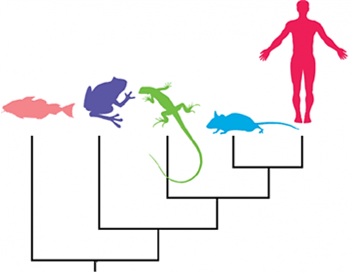
60

Multiple Choice

Question image

What is the human most closely related to?

1

Fish

2

mouse

3

Salamander

4

Human

61

Multiple Choice

The first word in a scientific name is the

1

species

2

phylum

3

genus

4

class

62

Multiple Choice

The science of grouping and naming organisms

1

Phylogeny

2

Dichotomy

3

Taxonomy

4

Genetics

63

Multiple Choice

Which taxonomic level would include the LEAST number of organisms?

1

species

2

genus

3

order

4

phylum

64

Multiple Choice

(Taxonomy) Which level of classification is the most broad?

1

Species

2

Class

3

Domain

4

Kingdom

65

Multiple Choice

(Taxonomy) What languages are scientific names written in?

1

Latin or Spanish

2

Spanish or German

3

German or Greek

4

Greek or Latin

66

Multiple Choice

(Taxonomy) How many scientific names does an organism have?

1

1

2

2

3

3

4

many

67

Multiple Choice

(Taxonomy) How many common names does an organism have?

1

1

2

2

3

3

4

many

68

Multiple Choice

(Taxonomy) Which is the correct way to write an organisms scientific name?

1

Ailuropoda Melanoleuca

2

ailuropoda melanoleuca

3

Ailuropoda melanoleuca

4

ailuropoda Melanoleuca

69

Multiple Choice

(Domain) Which domain(s) include only prokaryotic cells? (without nucleus)

1

Eukarya & Bacteria

2

Archaeabacteria

3

Bacteria & Archeabacteria

4

Bacteria

70

Multiple Choice

(Domain) Which domain(s) include organisms that have eukaryotic cells? (has nucleus)

1

Eukarya

2

Eukarya & Bacteria

3

Bacteria

4

Archaeabacteria

71

Multiple Choice

(Taxonomy) What is hierarchy of classification from broad to most specific?

1

Species, Genus, Family, Order, Class, Phylum, Kingdom, Domain

2

Kingdom, Domain, Phylum, Family, Order, Class, Genus, Species

3

Domain, Kingdom, Phylum, Class, Order, Family, Genus, Species

4

Domain, Kingdom, Phylum, Order, Family, Class, Genus, Species

72

Multiple Choice

Question image

Use the following to decide which tree this leaf belongs to:

1

Blue Atlas Cedar

2

Arizona Cypress

3

Southern Catalpa

4

Lilac Chaste Tree

73

Multiple Choice

Question image
The scientific name for water bear is Hypsibius dujardini.  What is its genus?
1
Hypsibius 
2
dujardini
3
water 
4
tardigrade

74

Multiple Choice

What are the 8 levels of classification of living things from most general to most specific?
1
domain, kingdom, phylum, class, order, family, genus, species
2
domain, kingdom, phylum, class, order, family, genius, species
3
domain, kingdom, phamily, class, order, family, genus, species
4
domain, king, phillip, class, order, family, genus, species

75

Multiple Choice

Question image
Use the dichotomous key above to classify the unknown organism in the picture
1
Kentuckyus
2
Californius
3
WalaWala
4
Beverlus

76

Multiple Choice

Bacteria are found in which of the following places?

1

In digestive system

2

In the air

3

In soil

4

In all of the above

77

Multiple Choice

Which structure does bacteria NOT have?

1

Cell membrane

2

Chromosome

3

Golgi apparatus

4

Capsule

78

Multiple Choice

A small circular strand of DNA found in bacteria is called a

1

Conjugate

2

Peptidoglycan

3

Plasmid

4

Ribosome

79

Multiple Choice

To escape poor conditions such as extreme heat or cold, some bacteria form

1

Blobs

2

Capsules

3

Capsids

4

Endospores

80

Poll

In your opinion, bacteria is...

disgusting

delicious

out of sight, out of mind

something I've never really thought about.

Discover new features in Lessons!
Finish all phases of “I-do ; We-do ; You-do” with Quizizz

media
media
media
media

​You can also create lessons directly on Google Slides using “Quizizz Extension”.
Read more about it here

Show answer

Auto Play

Slide 1 / 80

SLIDE