Search Header Logo
25S1 W3 Enzymes and Macromolecules

25S1 W3 Enzymes and Macromolecules

Assessment

Presentation

Biology

11th Grade

Medium

Created by

Aleisha Bliesner

Used 2+ times

FREE Resource

55 Slides • 23 Questions

1

media

2

media

3

media

4

media

5

media

6

media

7

media

8

media
media

9

media

10

media

11

media

12

13

media

14

media

15

media

16

media

17

media

18

media

19

Multiple Choice

What is the monomer that makes up carbohydrates?

1

Monosaccarides

2

Fatty Acids

3

Amino Acids

4

Nucleotides

20

media

21

media

22

media

23

media

24

media

25

media

26

Multiple Choice

What are triglycerides made of?

1

Monosaccarides

2

Fatty Acids

3

Amino Acids

4

Nucleotides

27

media

28

media

29

media

30

media

31

media

32

media

33

media

34

media

35

Multiple Choice

What is the monomer that makes up proteins?

1

Monosaccarides

2

Fatty Acids

3

Amino Acids

4

Nucleotides

36

Multiple Choice

Amino acids all have the same general structure except for the:
1
Amino Group
2
Carboxyl Group
3
'R' Group
4
Carbonyl Group

37

Multiple Choice

Which protein structure describes the sequence of amino acids?

1

Primary structure

2

Secondary structure

3

Tertiary structure

4

Quaternary structure

38

Multiple Choice

Which of the following describes the secondary structure of proteins?

1

The sequence of amino acids

2

The α-helix and β-pleated sheet folding

3

The folding of the polypeptide chain due to the 'R' groups

4

The joining of different protein molecules to make one big molecule

39

Multiple Choice

Which protein structure describes a protein's three-dimensional shape?

1

Primary structure

2

Secondary structure

3

Tertiary structure

4

Quaternary structure

40

Multiple Choice

Haemoglobin is a quaternary protein because:

1

It has more than one peptide bonds

2

Its shape is globular

3

It consists of more than one polypeptide chains

4

It has iron in each heme group

41

media

42

media

43

media

44

Multiple Choice

What is the monomer that make up nucleic acids?

1

Monosaccarides

2

Fatty Acids

3

Amino Acids

4

Nucleotides

45

media

46

Multiple Choice

Cellulose, starch and glycogen are examples of:

1

monosaccharides

2

disaccharides

3

lipids

4

polysaccharides

47

Multiple Choice

What does organic mean (in chemistry)?

1

It costs more at the grocery store

2

It contains carbon and hydrogen

3

It is made of many individual parts

4

It produces energy

48

Multiple Choice

Question image

What is the following molecule?

1

triglyceride

2

phospholipid

3

steroid

4

protein

49

Multiple Choice

Question image

What is the following molecule?

1

alpha glcuose

2

beta glucose

3

amino acid

4

disaccharide

50

media

51

52

media

53

media

54

media

55

Fill in the Blank

An ______ is a special type of catalyst that is made by a living organism. We sometimes call them biological catalysts. 

56

Multiple Choice

What is the name of the special region of an enzyme that binds to the substrate? 

1

Active area

2

Unique site

3

Complementary region

4

Active site

57

Multiple Choice

Any substance that is acted upon by an enzyme is called a:

1

Coenzyme

2

Substrate

3

Vitamin

4

Polypeptide

58

Multiple Choice

After the enzyme and substrate bind together and perform the reaction, what does the substrate become?
1
a substrate
2
an enzyme
3
a product
4
an active site

59

media

60

media

61

media

62

media

63

media

64

Multiple Choice

At first, scientists thought that in order for an enzyme to catalyse a reaction, the substrate had to fit perfectly into the active site.

What was the name for this model of enzyme action?

1

The original model

2

The lock and key model

3

The induced fit model

4

The induced key model

65

Multiple Choice

We now know that in order for an enzyme to catalyse a reaction, the enzymes active site actually changes shape slightly as it binds to the substrate.

What do we call this model of enzyme action?

1

The new model

2

The lock and key model

3

The induced fit model

4

The induced key model

66

Multiple Choice

Pancreatic amylase is a digestive enzyme found in the small intestine. It helps break down large starch molecules later in the digestive process. Pancreatic amylase is unable to break down proteins.

Which of the following best explains why pancreatic amylase is able to break down starches, but not proteins?

1

Enzymes are specific to their substrates

2

Proteins are too large to be affected by enzymes

3

Enzymes and proteins cannot break down other proteins

4

Proteins are able to easily denture enzymes

67

Multiple Choice

Question image

An enzyme speeds up a reaction by:

1

lowering the activation energy

2

raising the activation energy

3

releasing energy

4

absorbing energy

68

media

69

70

media

71

media

72

73

media

74

media

75

media

76

Multiple Choice

What effect does high temperature have on enzymes?

1

Denatures them

2

Inactivates them

3

Destroys them

77

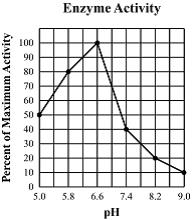
Multiple Choice

Question image
Which of the following conclusions can be drawn from this graph?
1
The optimum pH of the enzyme is 6.6.
2
The optimum pH of the enzyme is 5.8
3
The enzyme’s activity increases as pH increases 5.0 to 9.0
4
The enzyme’s activity is greater around pH of 8.0 .

78

media
media

Show answer

Auto Play

Slide 1 / 78

SLIDE