Matter
Presentation
•
Biology
•
9th - 12th Grade
•
Easy
Standards-aligned
Leah Wade
Used 2+ times
FREE Resource
14 Slides • 21 Questions
1
2
3
Open Ended
What makes up everything around us?
4
5
6
7
8
9
Multiple Choice
10
Multiple Choice
11
Multiple Choice
Which subatomic particle has a positive charge?
proton
neutron
electron
12
Multiple Choice
Which subatomic particle has a neutral or no charge?
proton
neutron
electron
13
Multiple Choice
Which subatomic particle has a negative charge?
proton
neutron
electron
14
Multiple Choice
Which describes the particle or particles that are in the nucleus of an atom ?
electron and neutron
electron only
neutron and proton
proton and electron
15
Multiple Choice
16
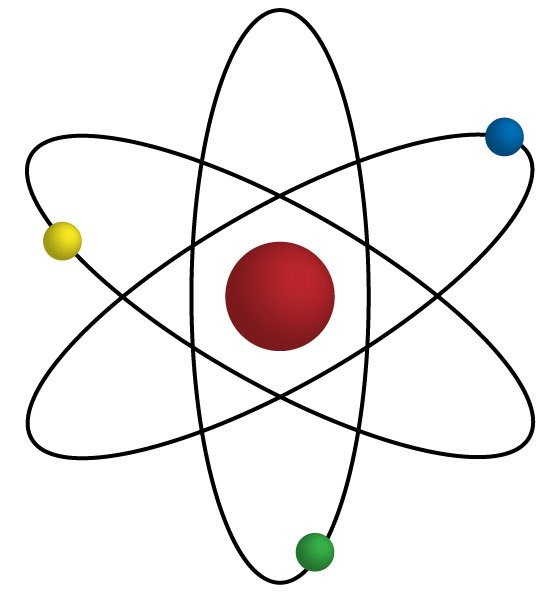
Draw
Circle the nucleus
17
Multiple Choice
If an atom has no charge, which of the following must be true?
It has more neutrons than protons or electrons.
There are only neutrons inside the atom.
Its number of protons is equal to its number of electrons.
The neutrons in the atom outnumber the electrons and protons.
18
19
20
Multiple Choice
An element and an atom are different but related because
A particular element is made up of many different types of atoms
A molecule is the same as an atom
An element is made up of all the same type of atom
An element is smaller than an atom
21
22
Multiple Choice
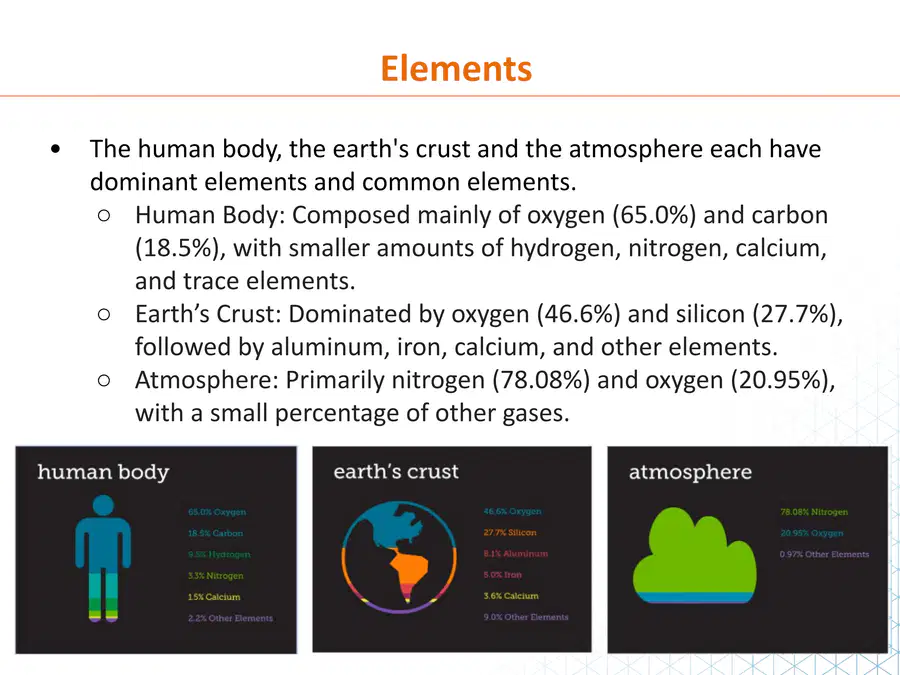
Which element is abundant in the human body, earth's crust and i the atmosphere?
23
24
Multiple Choice
25
26
Multiple Choice
Why do elements bond?
To be friends
To create a new element
To become stable
To get bigger
27
28
29
Multiple Choice
A _______ is the force that holds atoms together in a compound.
Chemical Formula
Chemical Reaction
Chemical Bond
Synthesis Reaction
30
Multiple Choice
31
Multiple Choice
When an atom loses an electron, it becomes a(n) _____________ ion.
32
Multiple Choice
When an atom gains an electron, it becomes a(n) _____________ ion.
33
Multiple Choice
34
Multiple Choice
The chemical bond formed when two atoms share electrons is call a(n)
covalent bond
ionic bond
metallic bond
electron bond
35
Multiple Choice
What is a molecule?
a compound held together with a covelant bond
a mixture of different substances
smallest individual particles
two elements bonded together with an ionic bond
Show answer
Auto Play
Slide 1 / 35
SLIDE

Similar Resources on Wayground
27 questions
Chemistry review for AP Bio
Presentation
•
9th - 12th Grade
29 questions
2 Lesson: BIO.A.2.2 Polymerization
Presentation
•
9th - 12th Grade
30 questions
Ohm's Law in Series and Parallel Circuits
Presentation
•
9th - 12th Grade
27 questions
Biomolecules Re-Teach
Presentation
•
9th - 12th Grade
27 questions
Biology Chemistry
Presentation
•
9th - 12th Grade
25 questions
Balancing Chemical Reactions
Presentation
•
9th - 12th Grade
28 questions
Intermolecular Forces & Physical Properties
Presentation
•
9th - 12th Grade
26 questions
DNA Structure, Function and Replication Basics
Presentation
•
10th - 11th Grade
Popular Resources on Wayground
10 questions
How much do you know about our Portrait of an Eagle?
Quiz
•
10th Grade
10 questions
Fast Food Slogans
Quiz
•
6th - 8th Grade
21 questions
Continents and Oceans
Quiz
•
6th Grade
20 questions
Parts of Speech
Quiz
•
5th Grade
16 questions
Subject & Predicate
Quiz
•
5th Grade
25 questions
Multiplication Facts
Quiz
•
5th Grade
12 questions
Map Skills
Quiz
•
3rd Grade
22 questions
Continents and Oceans
Quiz
•
5th Grade
Discover more resources for Biology
20 questions
Characteristics of Life
Quiz
•
9th - 10th Grade
10 questions
Exploring the 4 Major Macromolecules and Their Functions
Interactive video
•
9th - 12th Grade
20 questions
Cell organelles and functions
Quiz
•
10th Grade
20 questions
Cell Transport
Quiz
•
9th - 12th Grade
25 questions
photosynthesis and cellular respiration
Quiz
•
9th Grade
20 questions
Macromolecules
Quiz
•
10th Grade
16 questions
Population Ecology
Quiz
•
9th - 12th Grade
20 questions
Cell Organelles
Quiz
•
9th Grade