

Fiscal Policy Lecture Slides

Presentation
•
Social Studies
•
12th Grade
•
Practice Problem
•
Medium

Natalie Harmon
Used 6+ times
FREE Resource
18 Slides • 18 Questions
1

Unit 4
Fiscal Policy
Economics
2

3
Multiple Choice
Who do you think was the last president to get the republicans and democrats in Congress to come together and agree on a balanced budget for the Federal Government (meaning only spending what the government makes in tax revenue)?
President Trump
President Obama
President Bush Jr.
President Clinton
4
5
Multiple Select
What is included in Mandatory spending in the Federal Budget. Select all that apply.
Social Security, Government Salaries, Interest on Debt
Social Security, Military, Education
Medicare (Health insurance for elderly), Military, Government Salaries
Social Security, Medicare (Health insurance for elderly), Medicaid (Health Insurance for the poor)
6

7

8
Multiple Choice
Fiscal policy is controlled by...
The Federal Reserve
The Federal Government
9

10
Multiple Choice
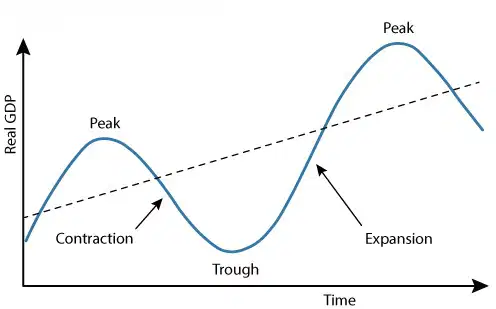
During an Expansionary phase of the business cycle, we would expect the unemployment rate to be...
Inverse to GDP, so declining
Following GDP, so rising
nothing, there is no relationship to GDP and the unemployment rate
11

12

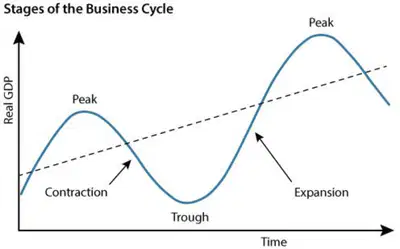
Economics Goals & Business Cycle
Remember the Government’s economics goals
are:
1.Growth
2.
Full Employment
3.
Price Stability
When our economic is operating at full
employment, the government's goals is to
generally have a balancebudget→ Spending
only what it takes in through taxes (income)
We want our economy to follow the trend line
13
Multiple Choice

This economic model is called:
The business cycle
Supply & demand
Production Possibilities Curve
Circular Flow Model
14
Multiple Choice
Points 1 and 4 represent
Peaks and expansion
Troughs and recession
Peaks and depression
Contraction and expansion
15

16

17
Dropdown
18
Multiple Choice
What does the government end up with a budget deficit when using Expansionary fiscal policy?
The government is usually taking in less tax revenue, but at the same time spending less.
The government is usually taking in more tax revenue, but at the same time spending less.
The government is usually taking in less tax revenue, but at the same time spending more.
The government is usually taking in more tax revenue, but at the same time spending more.
19

20

21
National Debt
Use the website on the following page to answer the following questions about the National Debt.
22
Understanding the National Debt | U.S. Treasury Fiscal Data
You can open this webpage in a new tab.
23
Multiple Choice
What is the current approximate amount of the U.S. National Debt?
$13 Trillion
$33 Billion
$38 Trillion
$0
24
Multiple Choice
What is the national debt?
The total amount of money borrowed by state governments.
The total amount of money borrowed by U.S. citizens.
The total amount of money the U.S. government has borrowed over its history.
The total amount of money borrowed by private corporations.
25
Multiple Choice
What is the significance of the debt to GDP ratio?
It measures the interest rate on the national debt.
It reflects the total amount of debt held by foreign investors.
It shows the burden of debt relative to the country's economic output.
It indicates the total amount of debt held by the public.
26
Multiple Choice
Which of the following is a major cause of increased national debt during the COVID-19 pandemic?
Increased government spending and decreased tax revenue.
Increased exports and decreased imports.
Decreased government spending and increased tax revenue.
Decreased unemployment rates.
27
Multiple Choice
Why can't the government just print more money to pay off the national debt?
It would increase the national debt.
It is illegal under the U.S. Constitution.
It would lead to inflation and devalue the currency.
It would decrease the national debt.
28

29
Dropdown
30
Multiple Choice
Contractionary fiscal policy goal is to...
Reduce Unemployment
Reduce Inflation
Reduce Taxes
Increase Government Spending
31
Match
Match the terms regarding fiscal policy
Expansionary Policy
Contractionary Policy
Spending More than tax revenue
Spending less than tax revenue
Fiscal Policy Tools
Business Cycle Contraction (recession)
Business Cycle Expansion
Budget Deficit
Budget Surplus
Taxes & Spending
Business Cycle Contraction (recession)
Business Cycle Expansion
Budget Deficit
Budget Surplus
Taxes & Spending
32

33
Multiple Choice
Why is Stagflation so bad?
Inflation and Unemployment are both low while GDP is high
Inflation is high, unemployment low, and GDP high
Inflation and unemployment are both high, while GDP is low
34

35
Multiple Choice
Which of the following best describes the difference between expansionary and contractionary fiscal policy?
Expansionary increases government spending and/or decreases taxes, while contractionary decreases government spending and/or increases taxes.
Expansionary decreases government spending and increases taxes, while contractionary increases government spending and decreases taxes.
Both policies increase government spending and decrease taxes.
Both policies decrease government spending and increase taxes.
36
Unit 4
Fiscal Policy
Economics
Show answer
Auto Play
Slide 1 / 36
SLIDE
Similar Resources on Wayground

27 questions
Developmental Day 2
Presentation
•
12th Grade
28 questions
How do I show who I am?
Presentation
•
12th Grade
33 questions
Economic Growth Factors
Presentation
•
12th Grade
29 questions
Ruminants
Presentation
•
12th Grade
31 questions
UCSP-WEEK 1
Presentation
•
12th Grade
31 questions
Polarity and Intermolecular Forces
Presentation
•
11th - 12th Grade
25 questions
Sociological Perspectives
Presentation
•
11th - 12th Grade
Popular Resources on Wayground
10 questions
How much do you know about our Portrait of an Eagle?

Quiz
•
10th Grade
10 questions
Fast Food Slogans
Quiz
•
6th - 8th Grade
21 questions
Continents and Oceans
Quiz
•
6th Grade
20 questions
Parts of Speech
Quiz
•
5th Grade
16 questions
Subject & Predicate
Quiz
•
5th Grade
25 questions
Multiplication Facts
Quiz
•
5th Grade
12 questions
Map Skills
Quiz
•
3rd Grade
22 questions
Continents and Oceans
Quiz
•
5th Grade
Discover more resources for Social Studies
46 questions
Unit 1 Test REVIEW Ancient Greece and Rome
Quiz
•
9th - 12th Grade
27 questions
Supply & Demand Test Review
Quiz
•
12th Grade
36 questions
Unit 5 Key Terms
Quiz
•
11th Grade - University
12 questions
supply and demand shifters
Quiz
•
9th - 12th Grade
25 questions
NGPF Budgeting - Unit Test
Quiz
•
12th Grade
16 questions
Unit 3 Personal Finance Guided Notes
Presentation
•
9th - 12th Grade
19 questions
USHC 5 Spanish-American War to Panama Canal
Quiz
•
9th - 12th Grade
22 questions
2.5A: Changes in Political Parties Over Time
Presentation
•
12th Grade