Search Header Logo
Chemistry Exam Preparation

Chemistry Exam Preparation

Assessment

Presentation

•

Chemistry

•

8th Grade

•

Easy

•
NGSS
HS-PS1-2, HS-PS1-1, HS-PS1-4

+3

Standards-aligned

Created by

Adonia Halel

Used 12+ times

FREE Resource

28 Slides • 64 Questions

1

media

2

media

3

media

4

media

5

media

6

media

7

Multiple Choice

What is weather?

1

The amount of moisture in the air

2

The number of clouds in the sky

3

The speed of the wind

4

The state of the atmosphere at any particular time.

8

media

9

Multiple Choice

climate

1

day-to-day changes in atmospheric conditions, including temperature, air pressure, humidity, wind, cloud coverage, or precipitation

2

moisture in the air

3

measures air pressure

4

long-term average of weather in an area

10

media

11

media

12

Multiple Choice

Question image

Which climate zone gets the least amount of precipitation?

1

Tropical Rain Forest

2

Tundra

3

Highland

4

Desert

13

Multiple Choice

Question image

Mild winter and hot, dry summer

1

Mediterranean

2

Arid

3

Tropical

4

Tundra

14

Multiple Choice

Question image

Found in the extreme north of North America, this climate zone has permafrost (permanently frozen ground).

1

Tropical

2

Arid

3

Desert

4

Tundra

15

Multiple Choice

Polar

1

Cold winter and mild summer

2

Very cold and dry all year

3

Very cold all year

4

Hot and wet all year

16

Multiple Choice

Temperate

1

Cold winter and mild summer

2

Very cold and dry all year

3

Very cold all year

4

Hot and wet all year

17

Multiple Choice

Tropical

1

Cold winter and mild summer

2

Very cold and dry all year

3

Very cold all year

4

Hot and wet all year

18

media

19

Multiple Choice

What is a glacial period?

1

A glacial period is a period of time when the climate was warmer and glaciers melted rapidly.

2

A glacial period is a period of time when the climate was stable and glaciers did not change in size.

3

A glacial period is a period of time when the Earth's surface was covered in volcanic ash.

4

A glacial period is a period of time in the Earth's history when the climate was colder and glaciers covered a large part of the Earth's surface.

20

media

21

Multiple Choice

What is an interglacial period?

1

An interglacial period is a time when the Earth is closest to the sun

2

An interglacial period is a period of extreme cold and ice formation

3

An interglacial period is a short-term period of drought and desertification

4

An interglacial period is a geological interval of warmer global average temperature lasting thousands of years that separates consecutive glacial periods within an ice age.

22

Multiple Choice

What is the difference between a glacial period and an interglacial period?

1

The main difference is that a glacial period is a long period of cold climate and extensive ice sheets, while an interglacial period is a shorter period of warmer climate between glacial periods.

2

An interglacial period is a long period of cold climate and extensive ice sheets

3

A glacial period is warmer than an interglacial period

4

There is no difference between a glacial period and an interglacial period

23

Multiple Select

Which of the evidences supports that the Earth was colder in the past? (multiple answers)

1

Rock layers

2

The glaciers carry rocks with them.

3

The rocks were left behind when glaciers melted.

4

None of the above

24

Multiple Choice

How do scientists study past climates and ice ages?

1

By studying the migration patterns of birds

2

By analyzing the growth of coral reefs

3

By observing the behavior of polar bears

4

By analyzing ice cores, tree rings, sediment layers, and other geological records.

25

media

26

Multiple Choice

In New Zealand, a scientist extracted a core of soil from a

1

peat bog

2

rock

3

plants

4

glaciers

27

Multiple Select

Question image

Which of the following statements are true about peat bog? (multiple answers)

1

The deeper the peat, the older it is.

2

The layers of the peat bog represent the different periods of histroy.

3

The core must be removed carefully to keep the correct order.

4

Undetermine

28

media

29

Multiple Choice

Gold jewelry is marked to tell you how pure the gold is. Which is the marking that has the most gold?

1
10K
2
14K
3
18K
4
24K

30

Multiple Choice

To calculate the purity of the gold, you can divide the carat marking by the 24 carat (pure gold) and times it by 100. What is the purity of 12K gold?

1
100%
2
50%
3
25%
4
75%

31

media

32

media

33

Multiple Choice

Which two particles would be attracted to each other?

1

protons and neutrons

2

electrons and protons

3

electrons and neutrons

4

All particles are attracted to each other.

34

Multiple Choice

Which of the following is NOT a subatomic particle?

1

proton

2

neutron

3

electron

4

megatron

35

Multiple Choice

Which subatomic particle has a positive charge?

1

proton

2

neutron

3

electron

36

Multiple Choice

Which subatomic particle has a neutral (no) charge?

1

electron

2

neutron

3

electron

37

Multiple Choice

The center of an atom is called the __________ ?

1

neutron

2

nucleus

3

number

38

Multiple Choice

Question image

How many protons are in one atom of Carbon?

1

6

2

12

3

18

39

Multiple Choice

Question image

How many neutrons are in one atom of Carbon?

1

6

2

12

3

18

40

Multiple Choice

Question image

How many electrons are in one atom of Carbon?

1

6

2

12

3

18

41

Multiple Choice

An element has electronic structure of 2, 8, 4. Which group does this element belongs to?

1
Group 1
2
Group 3
3

Group 4

4

Group 8

42

Multiple Choice

Chlorine has 17 electrons. Which group does chlorine belongs to?

1
Group 1
2
Group 3
3

Group 7

4

Group 8

43

Multiple Choice

Question image

State the melting and boiling points trend of group 1.

1
Melting and boiling points increase down Group 1.
2
Melting point decreases, boiling point increases down Group 1.
3
Melting and boiling points remain constant down Group 1.
4
Melting and boiling points decrease down Group 1.

44

Multiple Choice

Question image

State the melting and boiling point trends of group 7.

1
Melting and boiling points increase down Group 7.
2
Melting and boiling points remain constant down Group 7.
3
Melting point increases, boiling point decreases down Group 7.
4
Melting and boiling points decrease down Group 7.

45

Multiple Choice

Question image

Predict the electronic structure of Bromine.

1
2, 7, 8
2

2, 8, 6,

3

2, 8, 8, 7

4
1, 8, 7

46

Multiple Choice

Question image

State the melting and boiling points trends in group 8.

1
Melting and boiling points remain constant down the group.
2
Melting points increase while boiling points decrease down the group.
3
Melting and boiling points increase down the group.
4
Melting and boiling points decrease down the group.

47

Multiple Choice

Which group is known as non reactive group?

1
Noble gases
2
Transition metals
3
Alkali metals
4
Halogens

48

media

49

Multiple Choice

What makes Sodium atom become Sodium ion? (Na = 11 electrons)

1
A sodium atom remains unchanged when it becomes a sodium ion.
2
A sodium atom loses one electron to become a sodium ion.
3
A sodium atom gains one electron to become a sodium ion.
4
A sodium atom loses two electrons to become a sodium ion.

50

media

51

Multiple Choice

Ionic bonds are between...
1
Metal and Non-metal
2
Non-metal and Non-metal
3
Metal and Metal

52

Multiple Choice

How are ionic bonds formed?
1
Transfer of electrons
2
Sharing of electrons

53

Multiple Choice

Why do elements bond?
1
To be friends
2
To create a new element
3
To become stable

54

Multiple Choice

Two or more atoms held together by a chemical bond is called what?
1
A molecule
2
A molecure

55

Multiple Choice

Atoms that gain electrons become...
1
negatively charged
2
positively charged
3
remain neutrally charged

56

Multiple Choice

Atoms that loses electrons become...

1
negatively charged
2
positively charged
3
remain neutrally charged

57

media

58

Multiple Choice

Compared to ionic compounds, molecular compounds generally have...
1
good conductivity
2
greater densities
3
more chemical bonds
4
a low boiling point

59

Multiple Choice

Compared to ionic compounds, molecular compounds generally have...
1
stronger chemical bonds
2
poor conductivity
3
a high melting point
4
lower densities

60

Multiple Choice

How do covalent bonds form?

1

Donating & receiving electrons between atoms.

2

Scientists are still not sure how they form.

3

Sharing electron between atoms.

61

Multiple Choice

In covalent bonding, electrons are

1

shared

2

transferred

3

wiped out

62

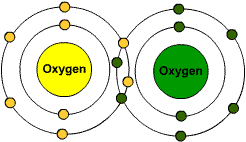
Multiple Choice

Question image
Is this image an example of covalent bonding?
1
Yes
2
No

63

Multiple Choice

Question image
What molecule is this?
1
CO
2
CO2
3
C2O
4
C2O2

64

Multiple Choice

Atoms are most stable when their outer shell is complete.
1
true
2
false

65

Multiple Choice

State one difference between ionic bond and covalent bond.

1
Covalent bonds involve metal atoms only.
2

Ionic bonds are weaker than covalent bonds.

3
Ionic bonds involve electron transfer; covalent bonds involve electron sharing.
4
Ionic bonds form between two nonmetals.

66

media

67

Multiple Choice

Which of the following diagram represents Rutherford's Model of Atom?

1
2
3
4

68

Multiple Choice

Which of the following diagram represents Bohr's Model of Atom?

1
2
3
4

69

media

70

media

71

media

72

media

73

media

74

Multiple Choice

Question image

Salts that are made with hydrochloric acid are called ______________.

1

chlorides

2

sulfates

3

nitrates

4

carbonates

75

Multiple Choice

Question image

What are the products if magnesium reacts with hydrochloric acid?

1

Magnesium chloride + Hydrogen

2

Magnesium sulfate + Hydrogen

3

Magnesium oxide + Hydrogen

4

Magnesium sulfide + Hydrogen

76

Multiple Choice

Complete the following word equation:

Metalcarbonate + acid -->

1

Salt + Hydrogen

2

Salt + Water + Carbon Dioxide

3

Salt + Water

77

Multiple Choice

Complete the following word equation:

Metal + Acid -->

1

Salt + water

2

Salt + hydrogen

3

Salt + Water + Carbon dioxide

78

Multiple Choice

What is the test for Carbon Dioxide?

1

Add Litmus paper

2

Lime water turning milky

3

Squeaky pop

79

Multiple Choice

Zinc + nitric acid --> ?
1
zinc sulfate + water
2
zinc sulfate + hydrogen
3
zinc nitrate + hydrogen
4
zinc chloride + water

80

media

81

Multiple Choice

How do you remove the water to leave solid copper sulfate crystals?

1

Filter

2

Evaporate

3

Distill

82

Multiple Choice

How do you separate an excess insoluble reactant from a solution?

1

Filtration

2

Precipitation

3

Crystalisation

4

Evaporation

83

Multiple Choice

Why do you need to leave a saturated salt solution for few days?

1
To prevent the solution from becoming too concentrated.
2

To allow the salt to crystallize.

3
To allow the salt to fully dissolve and reach equilibrium.
4
To cool the solution to room temperature.

84

media

85

Multiple Choice

Iron + copper oxide =

1

Iron + copper oxide

2

Iron oxide + copper oxide

3

Iron oxide + copper

4

Magic

86

Multiple Choice

Question image

Which of the following is more reactive?

1

Calcium

2

Magnesium

3

Zinc

4

Magnesium

87

Multiple Choice

Which one of the following combinations result in a displacement reaction?

1

Iron with magnesium chloride

2

magnesium with iron chloride

3

Iron with Zinc Sulphate

4

gold with silver nitrate

88

Multiple Choice

A displacement reaction will occur when...
1
a more reactive metal displaces a less reactive metal from its compound.
2
A less reactive metal displaces a more reactive metal from its compound
3
Displacement only occurs when two of the same metals are reacted 
4
Displacement reactions will only occur in metals above iron in the reactivity series

89

Multiple Choice

What will the products of this reaction be?

calcium + zinc nitrate --------->

1

Calcium + zinc nitrate

2

Zinc + calcium nitrate

3

there will be no reaction

4

Zinc + calcium chloride

90

Multiple Choice

Which of the following will not undergo reaction?
1
zinc metal  +  zinc oxide 
2
iron metal  +  copper oxide
3
zinc metal +  iron oxide
4
magnesium  +  iron oxide

91

media

92

media
media

Show answer

Auto Play

Slide 1 / 92

SLIDE