
Galaxies and the Origin of the Universe

Presentation
•
Science
•
8th Grade
•
Medium
Standards-aligned

Alfonso Guzman
Used 8+ times
FREE Resource
18 Slides • 20 Questions
1

November 18-22
Bell ringer
Hook
Lesson
Practice
Closure
Gravity and
Galaxies
Origin of the
Universe
Bell ringer
Hook
Lesson
Practice
Closure
Review
Bell ringer
Hook
Lesson
Practice
Closure
Test
Test
Review
Galaxies and the Origin
of universe
*Teacher instructions on speaker notes
.
..
2

Monday
November 18
3


Bell Ringer
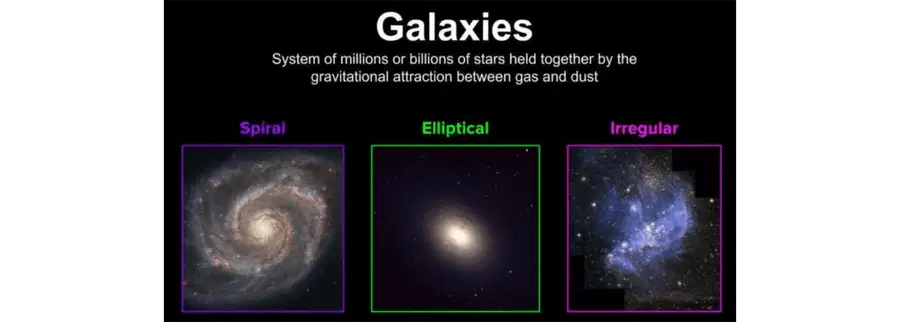
Discuss the difference in appearance between the
three types of galaxies.
1
4


HOOK
Hypothetically, what would happen to the galaxy if
gravity was non existent?
2
5

Content Objective
8.9B- categorize galaxies as spiral, elliptical,and irregular
and locate Earth's solar system within the Milky Way galaxy
Language Objective
Students will participate in discussions and group sharing activities using
content-based terms and common abstract vocabulary.
Students will participate in shared writing activities using the English
language
3
6

I CAN distinguish between different types
of galaxies based off of their shape.
I WILL distinguish between different
types of galaxies by discussing,
observing, listening and writing about it.
3
7

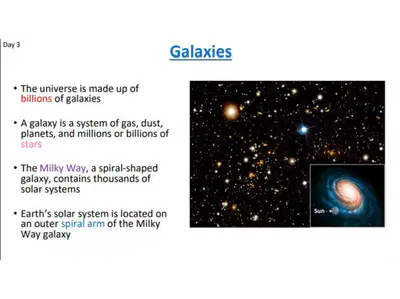
●The universe is made up of billions of
galaxies.
●A galaxy is a system of gas, dust,
planets, and millions or billions of
stars.
●The Milky Way, a spiral-shaped galaxy,
contains thousands of solar systems.
●Earth’s Solar System is located on the
outer spiral arm of the Milky Way
galaxy.
Galaxies
8


Question
Talking stem
A _____ is larger…
Turn and Talk
Which is larger:
● A star or a galaxy?
● A galaxy or a solar
system?
● A galaxy or a
universe?
3A
9

Gravity
●All of these systems are held
together by a force called gravity.
●Gravity is an attractive, or pulling,
force that exists between all
objects in the universe.
○
●The force of gravity between two
objects depends on their masses
and the distance between them.
○
●The greater the masses and the
shorter the distance, the stronger
the force of gravity.
10


Question
Talking stem
The force of gravity between
two objects would increase
if…
Think-pair-share
Which of these changes
would increase the force of
gravity between two
objects?
A. Decreasing the mass
B. Increasing the mass
C. Increasing the distance
between two objects.
3A
11

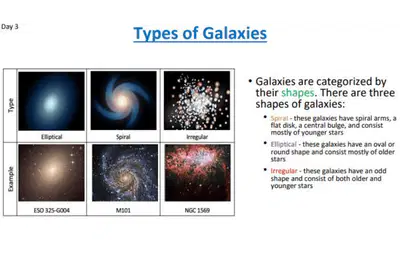
Different types of galaxies
Galaxies are categorized by their
shapes. There are three shapes of
galaxies:
●Spiral- these galaxies have spiral
arms, a flat disk, a central bulge,
and consist mostly of younger
stars.
●Elliptical- these galaxies have an
oval or round shape and consist
mostly of older stars.
●Irregular- These galaxies have an
odd shape and consist of both
older and younger stars.
12

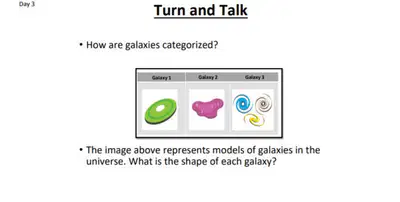

Question
Talking stem
The shape of galaxy 1 is…
galaxy 2 is… and galaxy 3
is…
Turn and Talk
The image below represents
models of galaxies in the
universe. What is the shape
of each galaxy?
3A
13

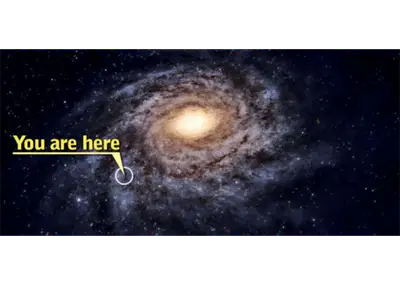
The Solar system
● Remember: our Sun is
located in a spiral galaxy
called the Milky Way.
● Our Sun is NOT located in
the middle of the Milky
Way. Instead we are
located on one of the
outer arms.
14


Question
Talking stem
I think a galaxy is… and
earth is located on…
Turn and Talk
1. What is a galaxy?
2. Where is earth’s
solar system
located in the
Milky Way
galaxy?
3A
15

Light-Years
● Objects in space are so far apart. The distance between
two objects is a huge number of miles- so many miles it
doesn't make sense to use that unit of measurement.
○ So we say that 1 light year = 5.8 trillion miles.
● Scientists use light years to measure distances in
space, because a light year is a long (and appropriate)
distance.
16




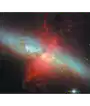


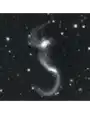


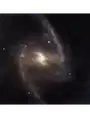


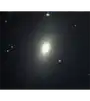

On your
own:
Classify
the
galaxies
into the
correct
category.
PRINT VERSION
Practice
4
17



On your own: Draw a line to Match the examples below to the correct galaxy.
Optional extension Practice
4
18
Multiple Choice
A huge system of millions or billions of stars, together with gas and dust, held together by gravity.
galaxy
solar system
nebula
asteroid
19
Multiple Choice
A random scattered type of galaxy that does not form a distinct shape or pattern.
irregular galaxy
spiral galaxy
elliptical galaxy
random galaxy
20
Multiple Choice
A flat, disk-shaped galaxy with a central bulge and winding "arms" that extend outward.
irregular galaxy
spiral galaxy
elliptical galaxy
random galaxy
21
Multiple Choice
The most abundant type of galaxy that has a smooth circular or oval shape.
irregular galaxy
spiral galaxy
elliptical galaxy
random galaxy
22
Multiple Choice
A light year is the measurement of ________ light travels in one year.
time
distance
23
Multiple Choice
A scientist that studies stars, planets, and other objects in space.
astrologist
zoologist
astronomer
plantologist
24
Multiple Choice
All of space and everything in it.
planet
solar system
galaxy
universe
25
Multiple Choice
The milky way is the ______ galaxy in which we live in.
irregular
spiral
elliptical
26
Multiple Choice
This type of galaxy contains a lot of dust and gas.
irregular
spiral
elliptical
all galaxies
27
Multiple Choice
This type of galaxy contains very little dust and gas.
irregular
spiral
elliptical
all galaxies
28
Multiple Choice
This type of galaxy contains only young stars.
irregular
spiral
elliptical
all galaxies
29
Multiple Choice
This type of galaxy contains only old stars.
irregular
spiral
elliptical
all galaxies
30
Multiple Choice
This type of galaxy contains a mixture of all ages of stars.
irregular
spiral
elliptical
all galaxies
31
Multiple Choice

Identify the galaxy in the image.
irregular
spiral
elliptical
none listed
32
Multiple Choice

Identify the galaxy in the image.
irregular
spiral
elliptical
none listed
33
Multiple Choice

Identify the galaxy in the image.
irregular
spiral
elliptical
none listed
34
Multiple Choice

Identify the galaxy in the image.
irregular
spiral
elliptical
none listed
35
Multiple Choice

Identify the galaxy in the image.
irregular
spiral
elliptical
none listed
36
Multiple Choice

Identify the galaxy in the image.
irregular
spiral
elliptical
none listed
37


Lesson Closure
Summarize what you learned
today. Make sure to include
gravity, the types of galaxies and
the location of our solar system.
5
38
Multiple Choice

Identify the galaxy in the image.
irregular
spiral
elliptical
none listed
November 18-22
Bell ringer
Hook
Lesson
Practice
Closure
Gravity and
Galaxies
Origin of the
Universe
Bell ringer
Hook
Lesson
Practice
Closure
Review
Bell ringer
Hook
Lesson
Practice
Closure
Test
Test
Review
Galaxies and the Origin
of universe
*Teacher instructions on speaker notes
.
..
Show answer
Auto Play
Slide 1 / 38
SLIDE
Similar Resources on Wayground

34 questions
Rights of the Accused: A Bill of Rights Trivia Experience
Presentation
•
8th Grade
35 questions
7.9A Properties of Our Solar System
Presentation
•
7th Grade
32 questions
Lesson: Density, Mass, & Volume
Presentation
•
8th Grade
28 questions
Atoms and the Periodic Table Review
Presentation
•
8th Grade
33 questions
Cosmology Lesson
Presentation
•
8th Grade
31 questions
The Universe and Its Stars
Presentation
•
8th Grade
29 questions
May the 4th Be With You.... Always
Presentation
•
8th Grade
37 questions
Rocks and the Rock Cycle Notes Quizizz
Presentation
•
8th Grade
Popular Resources on Wayground
10 questions
HCS SCI 03 Summer School Review 4

Quiz
•
3rd Grade
11 questions
HSMS - Standard Response Protocol
Quiz
•
6th - 8th Grade
16 questions
1.1-1.2 Quiz Review
Quiz
•
9th - 12th Grade
12 questions
Exponent Expressions
Quiz
•
6th Grade
20 questions
Adding and Subtracting Integers
Quiz
•
6th - 7th Grade
11 questions
Northeast States
Quiz
•
3rd - 4th Grade
10 questions
Characterization
Quiz
•
3rd - 7th Grade
10 questions
Common Denominators
Quiz
•
5th Grade