Search Header Logo
Unit 4 Reassessment Review

Unit 4 Reassessment Review

Assessment

Presentation

Science

9th - 12th Grade

Medium

NGSS
MS-ESS1-4, 4-ESS1-1, HS-PS1-8

+1

Standards-aligned

Created by

Kurt Trout

Used 1+ times

FREE Resource

13 Slides • 37 Questions

1

Discover new features in Lessons!
Finish all phases of “I-do ; We-do ; You-do” with Quizizz

media
media
media
media

​You can also create lessons directly on Google Slides using “Quizizz Extension”.
Read more about it here

2

What is Dating?

  • When geologists date rocks, they are determining how long ago they formed

  • There are two ways to do this: Relative Dating and Absolute Dating

3

Relative Dating

  • When you give the age of a rock or fossil compared to another rock or fossil

  • An actual age in years is not determined: uses words like "older" "or younger" instead of exact numbers

  • Example: Rock A is OLDER than Rock B

4

Drag and Drop

If I want to find if something older or younger compared to something else, I would use ​​


If I wanted to find out the year or exactly how old something is I would use ​
Drag these tiles and drop them in the correct blank above
relative dating
absolute dating.
superpositional dating
precision dating

5

Law of Superposition

The principle that in undisturbed rock layers, the oldest rocks are on the bottom

media

6

Multiple Choice

Question image

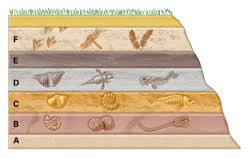
Which rock layer in the diagram seems to be the oldest?

1

F

2

E

3

B

4

A

7

Multiple Choice

Question image

According to the law of superposition, which layer is the youngest?

1

A

2

B

3

C

8

Multiple Choice

Relative dating of rock layers tells us that the deeper we dig, _______.

1

the younger the rocks get

2

the smellier the rocks get

3

the harder the rocks get

4

the older the rocks get

9

Law of Crosscutting

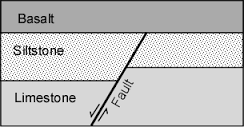
If an intrusion or a fault cuts through existing rocks, the intrusion/fault is YOUNGER than the rock it cuts through

media

10

Multiple Choice

How does the law of crosscutting explain the age of a fault?
1
The fault is younger than the rocks above it.
2
The fault is younger than the rocks it cuts through.
3
The fault is older than the rocks above it.
4
The fault is older than the rocks it cuts through.

11

Multiple Choice

Question image

Which layer is YOUNGER? Layer E or Intrusion D?

1

Layer E

2

Intrusion D

12

Multiple Choice

Question image

Which layer is OLDER? Layer E or Intrusion A?

1

Layer E

2

Intrusion A

13

Absolute Dating

  • Any method of measuring the age of an event or object in years by looking at chemical properties

  • Uses numbers

14

media

Half-lives

When 1/2 of the element decays, this is known as a half life.

​All, radioactive, elements have a specific decay rate unique to that element.

media

15

media

How long in years ?

After you know how many half-lives have occurred you can multiply that number by the amount of time it takes for that element to decay.

media

16

Multiple Choice

Question image

Carbon 14 has a half life of 5,730 years. If there is 50% of it left, how old is the sample?

1

5,730

2

11,460

3

2,685

4

17,190

17

Multiple Choice

If there is 12.5% of the radioactive element left in an object, how many half-lives has it experienced?

1

1

2

2

3

3

4

4

18

Multiple Choice

How much of the original radioactive element is remaining after 2 half-lives?

1

100%

2

75%

3

50%

4

25%

19

Multiple Choice

The half-life for a radioactive particle is 2,500 years. How old is an object that only has 50% of that particle remaining?

1

1,250 years

2

2,500 years

3

5,000 years

4

10,000 years

20

media

Eras are the LONGEST. There are FOUR major eras!

​Periods make up PERIODS! THEY are shorter than eras.

Eras vs Periods

21

Pre-Cambrian Time

Pre-Cambrian time FIRST ERA
covers about 88% of Earth's history

Few fossils survived the Pre-Cambrian time
Earth MOSTLY water, and single cell organisms. (plants)
Ended with mass extinction

media

22

Paleozoic Era

  • 2nd Era

  • DOMINATED by sea life.

  • Often called the Age of Fishes

  • Early land plants included simple mosses, ferns, and then cone-bearing plants

  • By the end of the era, seed plants were common

  • Again, ended with mass extinction

media

23

Mesozoic Era- 3rd Era

The Mesozoic Era is known as The Age of Reptiles. It spanned from approximately 252 to 66 million years ago. During this time, dinosaurs ruled the Earth and reptiles thrived. It was a period of significant geological, climatic, and evolutionary changes. The Mesozoic Era is divided into three periods: the Triassic, Jurassic, and Cretaceous.
Ended with a mass extinction from a meteor strike.

24

media

25

Multiple Choice

Question image

What was the first Geologic era?

1

Precambrian

2

Paleozoic

3

Mesozoic

4

Cenozoic

26

Multiple Choice

Question image

What era were dinosaurs alive in?

1

Precambrian

2

Paleozoic

3

Mesozoic

4

Cenozoic

27

Multiple Choice

Question image

Fish evolved and amphibians emerged

1

Paleozoic Era

2

Mesozoic Era

3

Cenozoic Era

4

Precambrian

28

Multiple Choice

In what geological era are we currently living?

1

Precambrian Time

2

Paleozoic Era

3

Mesozoic Era

4

Cenozoic

29

Multiple Choice

Dinosaurs ruled the Earth in what period?

1

Precambrian Time

2

Paleozoic Era

3

Mesozoic Era

4

Cenozoic

30

Multiple Choice

Which of these time periods lasted the longest?

1

Precambrian Time

2

Paleozoic Era

3

Mesozoic Era

4

Cenozoic

31

Multiple Choice

How old is the Earth?

1

5 billion years old

2

4.9 billion years old

3

4.6 billion years old

4

4.5 million years old

32

Multiple Choice

What time "period" represents 88% of Earth's history.

1

Mesozoic

2

Precambrian

3

Paleozoic

4

Cenozoic

33

Multiple Choice

What era did dinosaurs go extinct ?

1

Paleozoic

2

Mesozoic

3

Cenozoic

34

Multiple Choice

The statement that the oldest layer will be at the bottom in an undisturbed sequence of rock layers is called the Principle of ....
1
Inclusions
2
Unconformities
3
Cross-Cutting Relationships
4
Superposition

35

Multiple Choice

The Principle of Cross-Cutting Relationships states that an igneous intrusion is 
1
always younger than the layers it cuts across
2
always older than the layers it cuts across
3
the same age as the rock it melted
4
none of the answers are correct

36

Multiple Choice

Relative age dating is used to determine the...
1
actual age of an event
2
length of time between two events
3
age of one event in comparison with other events
4
rate at which a gologic process occurs

37

Multiple Choice

Question image
Which of the following correctly lists the layers in order from oldest to youngest?
1
A, B, C, D, E
2
E, B, C, D, A
3
E, D, C, B, A
4
C, B, A, D, E

38

Multiple Choice

The age of a rock compared to the ages of other rocks is the rock's
1
absolute age
2
geologic age
3
sedimentary age
4
relative age

39

Multiple Choice

The number of years that have passed since the rock formed is the rock's
1
relative age
2
law of superposition
3
absolute age
4
index fossil

40

Multiple Choice

The time it takes for half of a radioactive isotopes to decay into stable isotopes is called the
1
isotope decay
2
radiometric dating
3
half life
4
absolute age

41

Multiple Choice

Question image
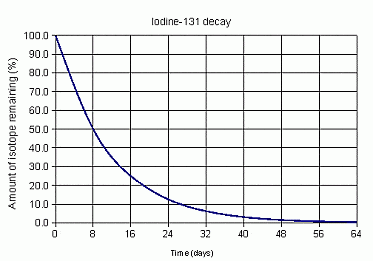
What is the half-life of iodine-131?
1
32 days
2
8 days
3
16 days
4
24 days

42

Multiple Choice

How does absolute age differ from relative age?
1
only absolute dating indicates which rock is older than another
2
only absolute dating finds the age in years
3
only relative dating finds the age in years

43

Multiple Choice

If the half-life of a radioactive group of atoms is 300 years, then how old is the rock if there have been three half-lives?

1

37.5 years

2

100 years

3

600 years

4

900 years

44

Reorder

Put the correct Eras in order of their existence-

Pre-Cambrian

Paleozoic

Mesozoic

Cenozoic

1
2
3
4

45

Multiple Choice

Question image
According to the law of superposition, the oldest fossils are found 
1
At the top of the rock layers
2
Near the bottom of the rock layers
3
In the middle of the rock layers
4
Somewhat near the surface

46

Multiple Choice

Question image
Which rock layer contains the newest fossils?
1
F
2
E
3
B
4
C

47

Multiple Choice

Question image

Which layer is OLDER? Layer M or layer P?

1

layer M

2

layer P

3

cannot be determined

4

both layers are of the same age

48

Multiple Choice

Question image
What are the relative ages of the features in order from oldest to youngest?
1
Limestone, Basalt, Fault, Siltstone
2
Siltstone, Fault, Basalt, Limestone
3
Limestone, Fault, Basalt, Siltstone
4
Limestone, Siltstone, Fault, Basalt

49

Multiple Choice

Question image
Scientist think the Earth is ___ years old.
1
4,500
2
45,000
3
4.5 million
4
4.5 billion

50

Drag and Drop

​ ​
are the longer periods of time, and ​
make them up.
Drag these tiles and drop them in the correct blank above
Eras
Periods
Eons
Milleniums

Discover new features in Lessons!
Finish all phases of “I-do ; We-do ; You-do” with Quizizz

media
media
media
media

​You can also create lessons directly on Google Slides using “Quizizz Extension”.
Read more about it here

Show answer

Auto Play

Slide 1 / 50

SLIDE