
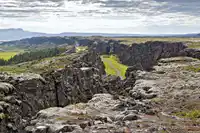
Unit 2 review

Presentation
•
Other
•
9th Grade
•
Hard
+1
Standards-aligned

Jeffrey Clair
Used 1+ times
FREE Resource
20 Slides • 20 Questions
1
Multiple Choice
What process involves tectonic plates moving apart and stretching the Earth's crust?
Subduction
Rifting
Folding
Erosion
2
Rifting is the process where tectonic plates move apart, causing the Earth's crust to stretch and form new geological features like rift valleys. This distinguishes it from subduction, folding, and erosion.
3
Multiple Choice
Why is the Midcontinent Rift considered a failed rift?
It was destroyed by an asteroid
The rifting stopped before an ocean formed
It caused a massive earthquake
It led to a desert formation
4
The Midcontinent Rift is considered a failed rift because the rifting process ceased before it could develop into a full ocean basin, which is a key characteristic of successful rifting.
5
Multiple Choice
What type of rock formed due to volcanic activity in the Midcontinent Rift?
Granite
Limestone
Basalt
Sandstone
6
Basalt is an igneous rock that forms from the rapid cooling of lava at the Earth's surface, making it the correct answer for rocks formed due to volcanic activity in the Midcontinent Rift.
7
Multiple Choice
Which ancient continent was part of the Midcontinent Rift formation?
Pangaea
Laurentia
Gondwana
Rodinia
8
Laurentia is the ancient continent that was part of the Midcontinent Rift formation. It represents the North American craton, which played a significant role in the geological history of the region.
9
Multiple Choice
Which process drives the movement of tectonic plates and causes rifting?
Erosion
Mantle Convection
Sedimentation
Glaciation
10
Mantle convection is the process where heat from the Earth's interior causes the mantle to flow, driving the movement of tectonic plates and leading to rifting, which is the splitting of the Earth's crust.
11
Multiple Choice
If the Midcontinent Rift had continued to develop, what would have likely formed?
A new ocean
A large desert
A mountain range
A river valley
12
If the Midcontinent Rift had continued to develop, it would have likely led to the formation of a new ocean as rifting typically creates ocean basins by pulling apart continental crust.
13
Multiple Choice
What evidence supports the existence of the Midcontinent Rift?
Fossil records
Presence of basalt deposits
Large sand dunes
Coral reefs
14
The presence of basalt deposits is key evidence for the Midcontinent Rift, indicating volcanic activity associated with the rifting process. Other options like fossil records and coral reefs do not directly support this geological feature.
15
Multiple Choice
How does mantle convection influence plate movement?
It erodes mountains
It pushes and pulls tectonic plates
It cools the crust
It stops earthquakes
16
Mantle convection involves the movement of molten rock in the Earth's mantle, which creates forces that push and pull tectonic plates. This process is essential for plate tectonics, leading to the movement of continents and ocean floors.
17
Multiple Choice
What is slab pull?
The sinking force of a heavy plate
The process of new crust forming
The sideways motion of plates
The uplift of mountain ranges
18
Slab pull refers to the sinking force exerted by a heavy tectonic plate as it subducts into the mantle. This process helps drive plate tectonics, making it the correct choice among the options provided.
19
Multiple Choice
Which feature forms at a divergent boundary?
Oceanic trench
Mid-ocean ridge
Folded mountains
Volcano arc
20
At a divergent boundary, tectonic plates move apart, allowing magma to rise and create new oceanic crust, forming a mid-ocean ridge. This feature is characterized by underwater mountain ranges, unlike oceanic trenches or folded mountains.
21
Multiple Choice
What happens to the speed of mantle particles as temperature increases?
It decreases
It increases
It remains constant
It stops entirely
22
As temperature increases, the kinetic energy of mantle particles also increases, causing their speed to increase. Therefore, the correct answer is that the speed of mantle particles increases.
23
Multiple Choice
Which layer of the Earth is involved in mantle convection?
Crust
Mantle
Outer Core
Inner Core
24
The mantle is the layer of the Earth where mantle convection occurs. This process involves the movement of molten rock, which drives plate tectonics and influences geological activity.
25
Multiple Choice
What effect does the failure of a rift have on the surrounding land?
It forms a new ocean
It stabilizes the region
It causes massive earthquakes
It leads to volcanic eruptions
26
The failure of a rift typically leads to stabilization of the region, as the tectonic forces that create rifts are no longer active. This reduces the likelihood of earthquakes and volcanic activity, making the area more stable.
27
Multiple Choice
What is the main driving force behind the movement of tectonic plates?
Wind currents
Mantle convection
Ocean currents
Sunlight
28
The main driving force behind the movement of tectonic plates is mantle convection. This process involves the transfer of heat from the Earth's interior, causing the semi-fluid mantle to circulate and move the plates above.
29
Multiple Choice
In which type of environment does rifting most commonly occur?
Convergent boundary
Divergent boundary
Transform fault
Subduction zone
30
Rifting most commonly occurs at divergent boundaries, where tectonic plates move apart, creating new crust. This process is characterized by the formation of rift valleys and is distinct from convergent or transform boundaries.
31
Multiple Choice
What is the primary material found in the crust at rift zones?
Basalt
Limestone
Sandstone
Granite
32
The primary material found in the crust at rift zones is basalt, which forms from the cooling of magma at divergent boundaries. Limestone, sandstone, and granite are not typically associated with rift zones.
33
Multiple Choice
Which of the following best describes the behavior of particles in a solid mantle layer?
They move freely
They vibrate in place
They flow easily
They are completely stationary
34
In a solid mantle layer, particles are closely packed and cannot move freely. Instead, they vibrate in place, maintaining their positions while still allowing for some movement due to thermal energy.
35
Multiple Choice
What type of motion is observed at a transform boundary?
Plates move apart
Plates slide past each other
Plates collide
Plates sink below one another
36
At a transform boundary, tectonic plates slide past each other horizontally. This lateral movement can cause earthquakes but does not involve plates moving apart, colliding, or sinking below one another.
37
Multiple Choice
What geological feature forms as a result of subduction?
Rift valley
Ocean trench
Mountain ridge
Desert basin
38
An ocean trench forms at subduction zones where one tectonic plate is forced under another, creating deep underwater valleys. This is a direct result of the geological process of subduction.
39
Multiple Choice
What typically happens to the crust at a subduction zone?
It melts and forms magma
It rises and forms new land
It thickens into a mountain range
It remains unchanged
40
At a subduction zone, one tectonic plate is forced under another, causing the crust to melt and form magma. This process is crucial for volcanic activity and the creation of new landforms.
What process involves tectonic plates moving apart and stretching the Earth's crust?
Subduction
Rifting
Folding
Erosion
Show answer
Auto Play
Slide 1 / 40
MULTIPLE CHOICE
Similar Resources on Wayground

35 questions
Chaney Lesson
Presentation
•
KG
40 questions
Present stem changing verbs
Presentation
•
9th Grade
33 questions
Grade 9 General Unit 2 Lesson 7
Presentation
•
9th Grade
33 questions
Propaganda Techniques
Presentation
•
9th Grade
34 questions
WRS 6-12 Review
Presentation
•
9th Grade
33 questions
COSAS EN LA COCINA
Presentation
•
KG
32 questions
Pre-Registration for 10th Grade - Credits
Presentation
•
9th Grade
34 questions
Healthy Food Guidelines
Presentation
•
9th Grade
Popular Resources on Wayground
10 questions
How much do you know about our Portrait of an Eagle?

Quiz
•
10th Grade
10 questions
Fast Food Slogans
Quiz
•
6th - 8th Grade
21 questions
Continents and Oceans
Quiz
•
6th Grade
20 questions
Parts of Speech
Quiz
•
5th Grade
16 questions
Subject & Predicate
Quiz
•
5th Grade
25 questions
Multiplication Facts
Quiz
•
5th Grade
12 questions
Map Skills
Quiz
•
3rd Grade
22 questions
Continents and Oceans
Quiz
•
5th Grade
Discover more resources for Other
20 questions
Brand Labels
Quiz
•
5th - 12th Grade
20 questions
Characteristics of Life
Quiz
•
9th - 10th Grade
20 questions
REGULAR Present tense verbs
Quiz
•
8th - 9th Grade
20 questions
Graphing Inequalities on a Number Line
Quiz
•
6th - 9th Grade
10 questions
Translating Algebraic Expressions
Quiz
•
9th Grade
10 questions
Exploring the 4 Major Macromolecules and Their Functions

Interactive video
•
9th - 12th Grade
20 questions
Exponent Rules
Quiz
•
8th - 9th Grade
20 questions
Position vs. Time Graphs
Quiz
•
9th Grade