
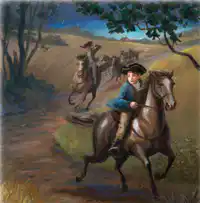
ELA 6.1- A Ride in the Night

Presentation
•
English
•
5th Grade
•
Practice Problem
•
Hard
+14
Standards-aligned

Shawn Millhouse
Used 5+ times
FREE Resource
23 Slides • 6 Questions
1

2


ELA- Unit 6 Lesson 1 Day 2
1.Review “A Ride in the Night”
2. Practice making inferences about “A Ride in the Night”
with table groups
3. Open Classkick: Unit 6 ELA/Reading Workbook
Complete Slide 3
Today is: Tuesday, December 3rd, 2024
3


4


5

Quick Check-In:
What do you remember about the story
we read yesterday?
“A Ride in the Night”
Quizizz
6
Multiple Choice
Why is John Clark unable to deliver the horses to Coleman?
He has injured himself.
He is off fighting in the war.
He died before Will was born.
He does not know Coleman.
7
Multiple Choice
When do Will Clark and York ride to deliver the horses to Coleman's Inn?
in the middle of the night
at noon
early in the evening
at dawn
8
Multiple Choice
Why doesn't Will immediately go to Coleman's Inn when he and York reach it?
He fears they may be lost and might not be in the right place.
He sees that the British have surrounded Coleman's Inn.
He thinks that there may be many people inside rather than just one man.
He believes that they are supposed to wait outside for someone to meet them.
9
Multiple Choice
How is Will finally able to deliver the horses to George Coleman?
He asks to speak with Coleman in private while the British soldiers are finishing their breakfast.
He leaves them behind Coleman's Inn once he finishes his breakfast inside.
He has York go into the inn and pass Coleman a note with the word "Kentucky" on it.
He waits and hides with York until the British soldiers leave, and then he returns to the inn.
10

Today we will be learning about how to
make inferences
11

12

Writers use details to give us information. The details we get are often facts about
people and events in the text. Here, Katharine Wilkie tells us that both of Will’s parents
think Will is too young to deliver the horses.
But details can do more than convey facts. They can also give us hints about
ideas the writer does not state but wants us to understand. In this way, details
can lead us to make inferences.
An inference is a guess that readers make based on the details in a text.
13

Both of Will’s parents say "he’s too young," what inferences can we make about the trip based on the details here?
14

Once we make inferences, we can make sure that they are reasonable or logical.
We do this by returning to the text and looking for additional details which support them.
Here, John Clark’s facial expressions and Ann Clark’s words help us know that this is
a difficult decision for them. They do not want Will to have to deliver the horses.
Why? Because it’s dangerous or difficult and because they love him and are worried
about him. We can point to all these
details as support for our inferences.
15

Let’s look at another part of the text and make another inference based on its
details. Here, Wilkie gives us details that describe Will’s physical appearance. She
tells us that he is tall and broad-shouldered and that he looks older than he is.
Based on these details, we can make an inference. We can infer, for instance,
that Will can handle the difficult job of delivering the horses. Why can we make
that inference?
16

Now let’s double-check that inference. Are there other details in the text that
support the idea that Will can handle the job of delivering the horses?
Will’s own father states that he believes Will can do it. We can point to
John Clark’s words – as well as the descriptions of Will’s physical
appearance – to support or defend our inference.
17

When reading a text pay attention to the facts and details that the writer
gives you. Think also about what those facts and details might suggest.
Consider what inferences you can make based on them. Once you make an
inference, look for as many details as you can find within the text which
support that inference. Know that you can point to all supporting details if
you ever need to justify, defend, or explain an inference you’ve made.
18

You will now work with the people at
your table to practice
making inferences
and finding details which support
them in “A Ride in the Night”
19

Two Readers who will read the questions out loud to
the group
One Recorder who will put the team’s decision into
chat
*ALL STUDENTS ARE EXPECTED TO PARTICPATE IN THIS
GROUP DISCUSSION*
During this Group Work You Will Need:
20

With your Table Mates:
Readers- take turns reading the
question and possible answers
1.
All table mates- Discuss the
question below- FIND TEXT EVIDENCE!
2.
Recorder- Type your table number
and answer in the chat
3.
(ex: Table 1 thinks #1)
You have 2 minutes
21

Correct Answer: 2
Will's behavior and his words in
the passage support that he is
observant and cautious.
22

With your Table Mates:
Read the question and possible answers1.
All table mates- Discuss the question below2.
Recorder- Type your table number and answer in the chat 3.
(ex: Table 1 thinks #1 and 3)
You have 3 minutes
23

Correct Answer: 2 and 3
24

Exit Ticket
Use what we have
learned about
making inferences
today and try the
next one on your
own
25

With your Table Mates:
Readers- take turns reading the passage and
question
1.
All table mates- Discuss the question below2.
Recorder- Type your table number and answer in
the chat (ex: Table 1 thinks #1 )
3.
Let's read this together then you will answer the question on the next slide on your own.
26
Multiple Choice
Based on the details in this passage, what inference can you make about Will Clark?
He should have told the British soldiers the truth about himself.
He is easily frightened and struggles to stay calm.
He is patient and determined to complete his mission.
His actions lead the British soldiers to leave the tavern.
27
Multiple Select
Choose the one that tells your level of understanding of this lesson (making inferences).
1- Reteach
I don't understand this yet
2- Practice
I can do this with some help
3- Independent
I can understand and do this by myself
4- Enrich
I can help and explain this to others
28
29

Open Classkick
Unit 6: ELA Workbook
Slide 3
Show answer
Auto Play
Slide 1 / 29
SLIDE
Similar Resources on Wayground

24 questions
Reading Comprehension
Presentation
•
5th Grade
22 questions
Simple past
Presentation
•
5th Grade
23 questions
Pollution
Presentation
•
5th Grade
20 questions
Comparing and Contrasting Stories in the same genre
Presentation
•
5th Grade
21 questions
Oro A1 Entrance Test
Presentation
•
KG
21 questions
Drawing Conclusion & Making Inferences
Presentation
•
5th - 6th Grade
21 questions
Figurative Language
Presentation
•
4th - 5th Grade
24 questions
Semicolons and Colons
Presentation
•
5th - 6th Grade
Popular Resources on Wayground
10 questions
Safety Day 2026 – Student Review

Quiz
•
9th Grade
21 questions
Continents and Oceans
Quiz
•
6th Grade
20 questions
Parts of Speech
Quiz
•
5th Grade
16 questions
Subject & Predicate
Quiz
•
5th Grade
25 questions
Multiplication Facts
Quiz
•
5th Grade
12 questions
Map Skills
Quiz
•
3rd Grade
22 questions
Continents and Oceans
Quiz
•
5th Grade
15 questions
Rounding Decimals
Quiz
•
5th Grade
Discover more resources for English
20 questions
Parts of Speech
Quiz
•
5th Grade
16 questions
Subject & Predicate
Quiz
•
5th Grade
12 questions
Figurative Language Review

Interactive video
•
5th Grade
20 questions
4 Types of Sentences
Quiz
•
4th - 5th Grade
20 questions
Main Idea and Details
Quiz
•
5th Grade
11 questions
Quiz: Review Simple, Compound, and Complex Sentences
Quiz
•
5th Grade
10 questions
Main Idea and Supporting Details
Quiz
•
3rd - 6th Grade
20 questions
Prepositions and Prepositional Phrases
Quiz
•
5th Grade