Search Header Logo
The Road to Lexington and Concord

The Road to Lexington and Concord

Assessment

Presentation

Social Studies

6th - 8th Grade

Practice Problem

Medium

Created by

Jennifer Jewell

Used 1+ times

FREE Resource

1 Slide • 68 Questions

1
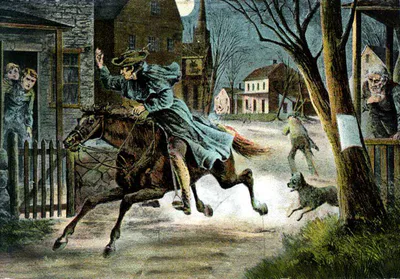
The Road to Lexington and Concord

media

2

Multiple Choice

Question image

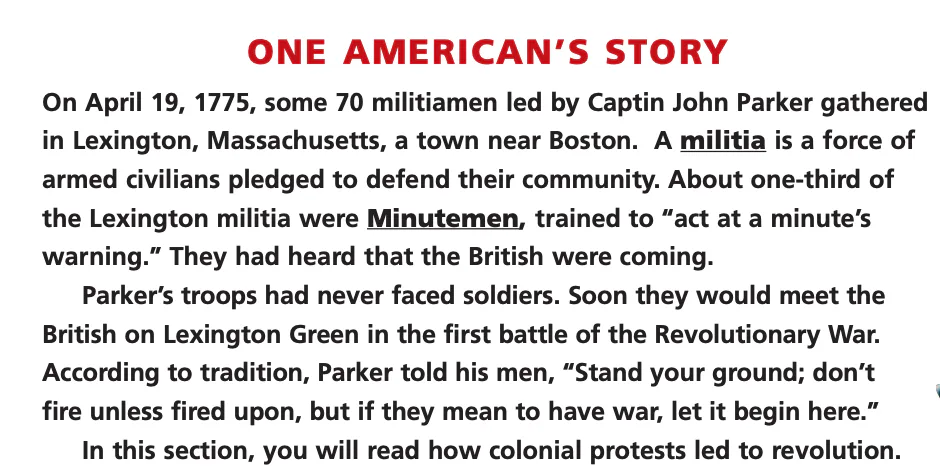
A force of armed civilians pledged to defend their community.

1
police
2
militia
3
army
4
security force

3

Multiple Choice

Question image

What does it mean to be a Minuteman?

1
Minutemen were only responsible for cooking and supplies.
2
Minutemen were civilians who avoided conflict.
3
Minutemen were professional soldiers in the army.
4

Minutemen were trained militia members trained to "act a minute's warning."

4

Multiple Choice

Question image

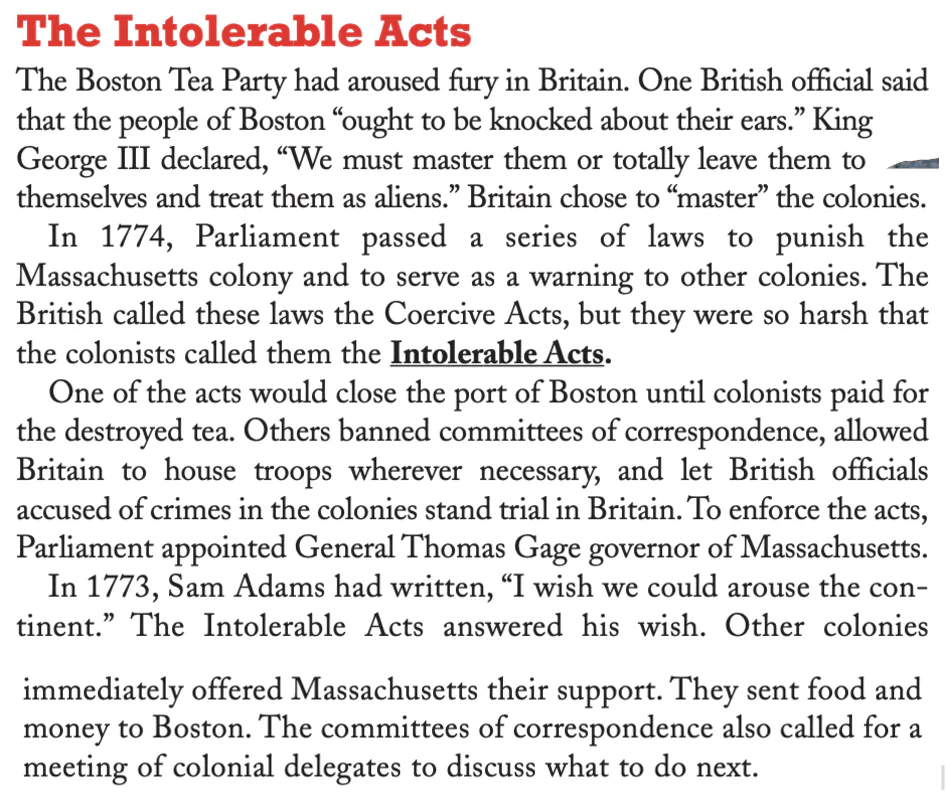
What were the Intolerable Acts meant to do?

1
To reward the Massachusetts colony for loyalty.
2
To promote trade between the colonies and Britain.
3
To establish a new government in Massachusetts.
4
To punish the Massachusetts colony and serve as a warning to other colonies.

5

Multiple Choice

Question image

Which of the following was NOT a consequence of the Intolerable Acts?

1
Increased colonial trade with Britain
2

Allowing colonists to house British troops.

3
Expansion of colonial rights and freedoms
4
Formation of the First Continental Congress

6

Multiple Choice

Question image

Who was appointed as governor of Massachusetts to enforce the Intolerable Acts?

1
General Thomas Gage
2
Benjamin Franklin
3
George Washington
4
John Adams

7

Multiple Choice

Question image

What was one consequence of the Intolerable Acts for the port of Boston?

1
The port of Boston was closed until colonists paid for the destroyed tea.
2
The port of Boston received additional funding from the British government.
3
The port of Boston was expanded to accommodate more ships.
4
The port of Boston was opened to trade with other countries.

8

Multiple Choice

Question image

What were the Intolerable Acts originally called by the British?

1
Punitive Acts
2
Repressive Measures
3
Colonial Restrictions
4
Coercive Acts

9

Fill in the Blanks

The British passed a series of laws in 1774 to punish the Massachusetts colony, which they called the

Acts.

10

Fill in the Blanks

The colonists referred to these laws as the

Acts because they found them to be too harsh.

11

Fill in the Blanks

One of the acts that were passed would close the port of

until the colonists paid for the destroyed tea.

12

Fill in the Blanks

The Intolerable Acts allowed British officials accused of crimes in the colonies to stand trial in

.

13

Fill in the Blanks

o enforce the Intolerable Acts, Parliament appointed General __________ __________ as the governor of Massachusetts.

14

Multiple Choice

Question image

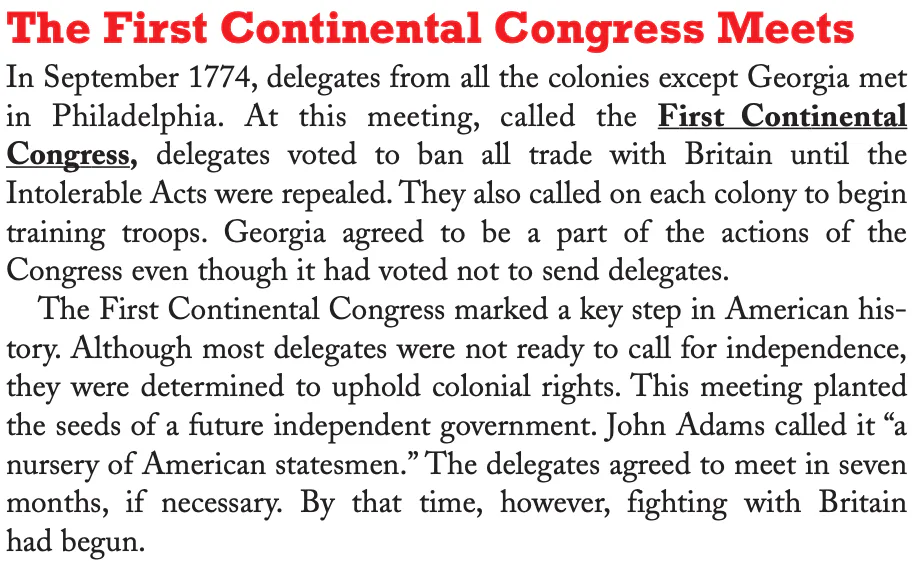
When did the First Continental Congress take place?

1
January 1773
2
March 1776
3
September 1774
4
July 1775

15

Multiple Choice

Question image

Which colony did not send delegates to the First Continental Congress?

1
Georgia
2
New York
3
Virginia
4
Massachusetts

16

Multiple Choice

Question image

What did the delegates of the First Continental Congress vote to do?

1
Ban all trade with Britain until the Intolerable Acts were repealed and begin training troops.
2
Disband all colonial militias
3
Call for immediate independence from Britain
4
Establish a trade agreement with Britain

17

Multiple Choice

Question image

What was the main purpose of the First Continental Congress?

1

To negotiate peace with British officials.

2

To declare independence from Britain immediately.

3

To uphold colonial rights and address grievances.

4
To establish a new government for the colonies.

18

Multiple Choice

Question image

How long did the delegates agree to meet again if necessary

1
two weeks
2
one year
3
seven months
4
three months

19

Fill in the Blanks

In

1774, delegates from all the colonies except Georgia met in Philadelphia.

20

Fill in the Blanks

This meeting was called the First Continental

.

21

Fill in the Blanks

Most delegates were not ready to call for

.

22

Fill in the Blanks

The delegates voted to ban all trade with

until the Intolerable Acts were repealed.

23

Fill in the Blanks

This meeting planted the seeds of a future independent

.

24

Multiple Choice

Question image

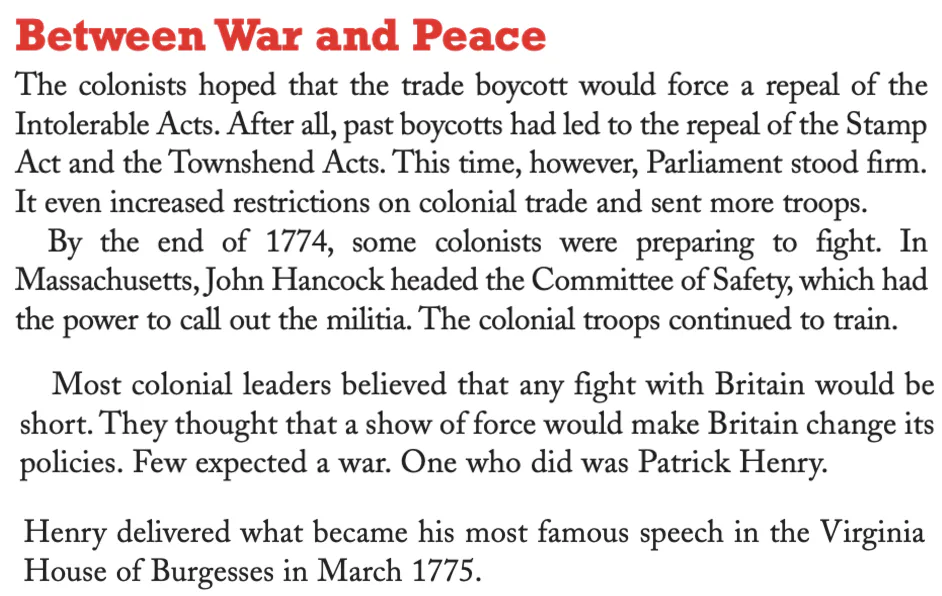
What did the colonists hope would result from the trade boycott?

1
They wanted to increase trade with Britain.
2
They aimed to gain independence immediately.
3
They hoped to strengthen British rule in the colonies.
4
They hoped to force a repeal of the Intolerable Acts.

25

Multiple Choice

Question image

Which past boycotts led to the repeal of British laws?

1
Stamp Act and Townshend Acts
2
Sugar Act and Prohibitory Act
3
Navigation Acts and Quartering Act
4
Tea Act and Intolerable Acts

26

Multiple Choice

Question image

Which past boycotts led to the repeal of British laws?

1
Stamp Act and Townshend Acts
2
Sugar Act and Prohibitory Act
3
Navigation Acts and Quartering Act
4
Tea Act and Intolerable Acts

27

Multiple Choice

Question image

What action did Parliament take in response to the colonists’ boycott?

1
Sent diplomats to negotiate
2
Increased restrictions on trade and sent more troops.
3
Reduced taxes on imports
4
Lifted trade restrictions

28

Multiple Choice

Question image

What did most colonial leaders believe about a potential fight with Britain?

1
They thought it would lead to a long and drawn-out war.
2
They believed Britain would easily defeat the colonies.
3
They expected no change in Britain's policies regardless of the outcome.
4
They believed it would be short and a show of force would change Britain's policies.

29

Fill in the Blanks

The colonists hoped that the trade

would force a repeal of the Intolerable Acts.

30

Fill in the Blanks

Past boycotts had led to the repeal of the

Act and the Townshend Acts.

31

Fill in the Blanks

This time, however, Parliament stood firm and did not repeal the

.

32

Fill in the Blanks

Parliament increased restrictions on colonial

and sent more troops.

33

Fill in the Blanks

The Committee of Safety had the power to call out the

.

34

Multiple Choice

Question image

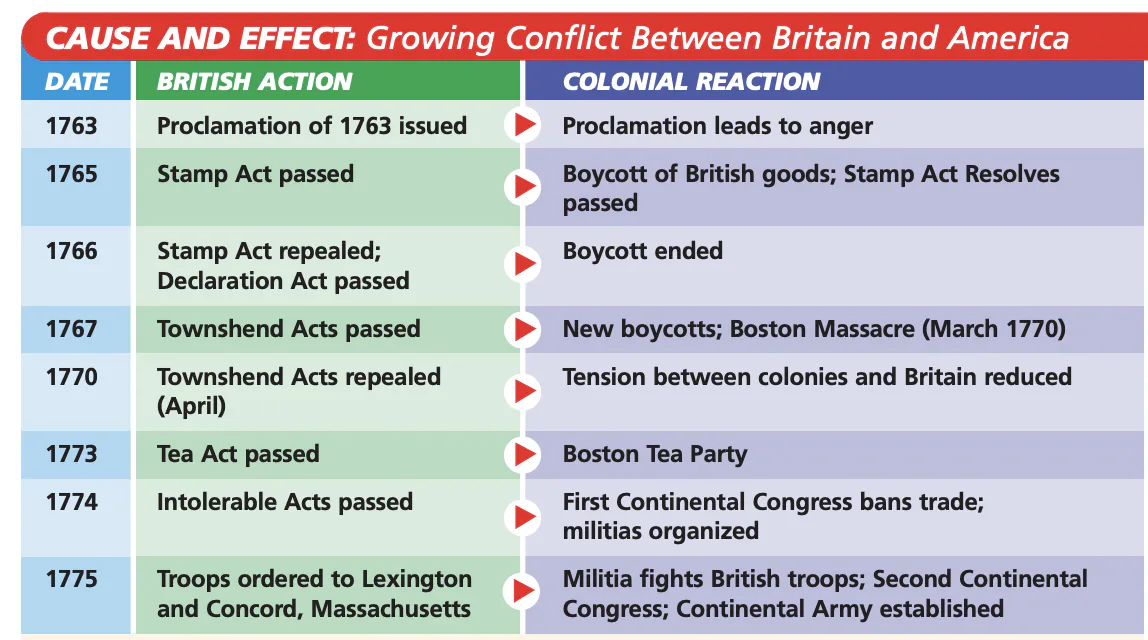
What action did colonists take in response to the Stamp Act in 1765?

1
Petition to the King
2
Support for the Stamp Act
3
Boycott of British goods; Stamp Act Resolves passed
4
Increased trade with Britain

35

Multiple Choice

Question image

Which event occurred as a result of increased tensions in March 1770?

1
Boston Massacre
2
First Continental Congress
3
Intolerable Acts
4
Boston Tea Party

36

Multiple Choice

Question image

What significant act was passed in April 1773?

1
Townshend Acts
2
Intolerable Acts
3
Stamp Act
4
Tea Act

37

Multiple Choice

Question image

What happened in 1775 that marked a significant escalation in conflict?

1
Declaration of Independence signed
2
Boston Tea Party occurs
3
First Continental Congress convenes
4

Militias fought British troops

38

Multiple Choice

Question image

What was established as a result of the Second Continental Congress in 1775?

1
Declaration of Independence signed
2
First Continental Congress convened
3
Treaty of Paris ratified
4
Continental Army established

39

Multiple Choice

Question image

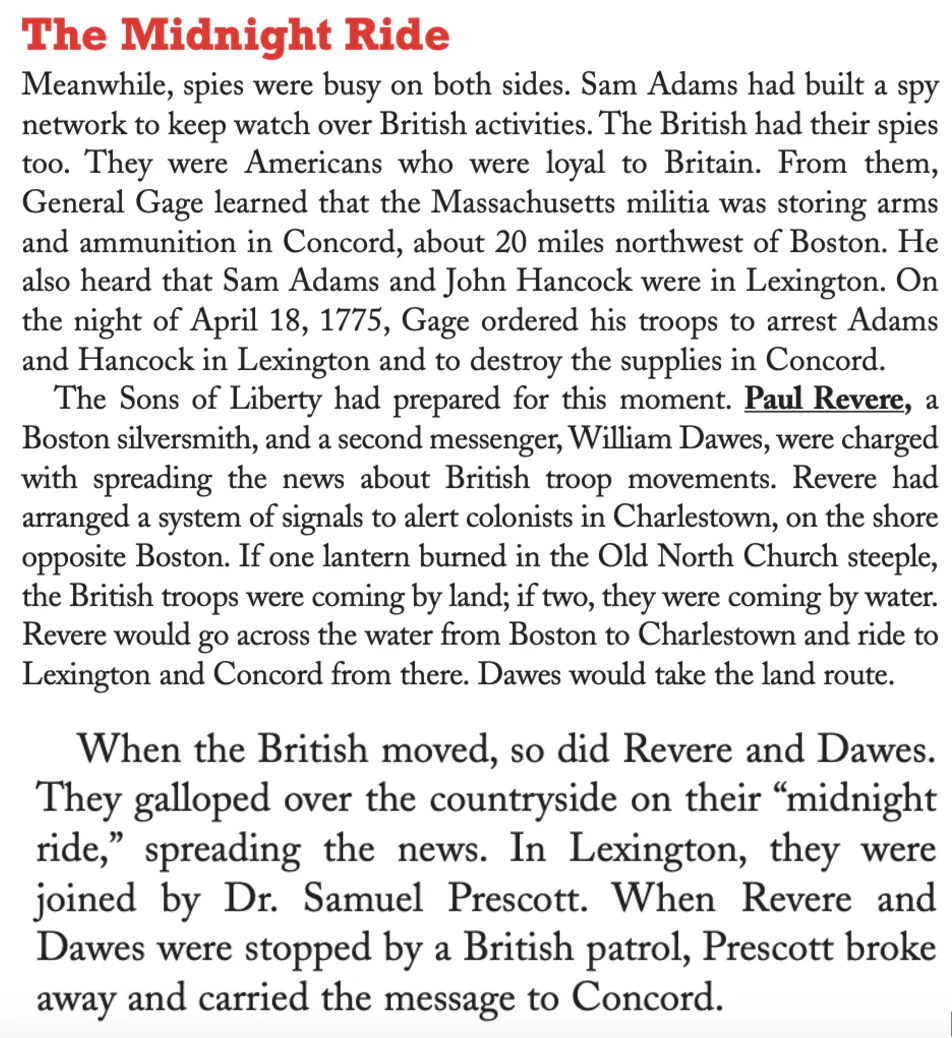
Who built a spy network to keep watch over British activities?

1
Benjamin Franklin
2
Thomas Jefferson
3
Sam Adams
4
George Washington

40

Multiple Choice

Question image

What did Gage order his troops to do on the night of April 18, 1775?

1
Capture Paul Revere and his messengers.
2
Arrest Adams and Hancock and destroy supplies in Concord.
3
Secure the town of Lexington for the British.
4
Disperse the militia in Boston.

41

Multiple Choice

Question image

Who was charged with spreading the news about British troop movements?

1
Dr. Samuel Prescott and Paul Revere
2
George Washington and Thomas Jefferson
3
Samuel Adams and John Hancock
4
Paul Revere and William Dawes

42

Multiple Choice

Question image

What system did Paul Revere arrange to alert colonists?

1

A series of loud bells

2

A smoke signal

3

A system of lanterns

4

A written message

43

Multiple Choice

Question image

Why was the midnight ride important?

1
It was a celebration of American independence.
2
It was a military strategy meeting.
3
It was important for alerting colonists about British troop movements.
4
It was a social gathering for colonists.

44

Fill in the Blanks

Sam Adams built a

network to keep watch over British activities.

45

Fill in the Blanks

General Gage learned that the Massachusetts

was storing arms and ammunition in Concord.

46

Fill in the Blanks

The

had prepared for the British troops to destroy their supplies.

47

Fill in the Blanks

Revere would go across the water from Boston to Charlestown and ride to Lexington and

.

48

Fill in the Blanks

arranged a system of signals using lanterns in the Old North Church steeple.

49

Multiple Choice

Question image

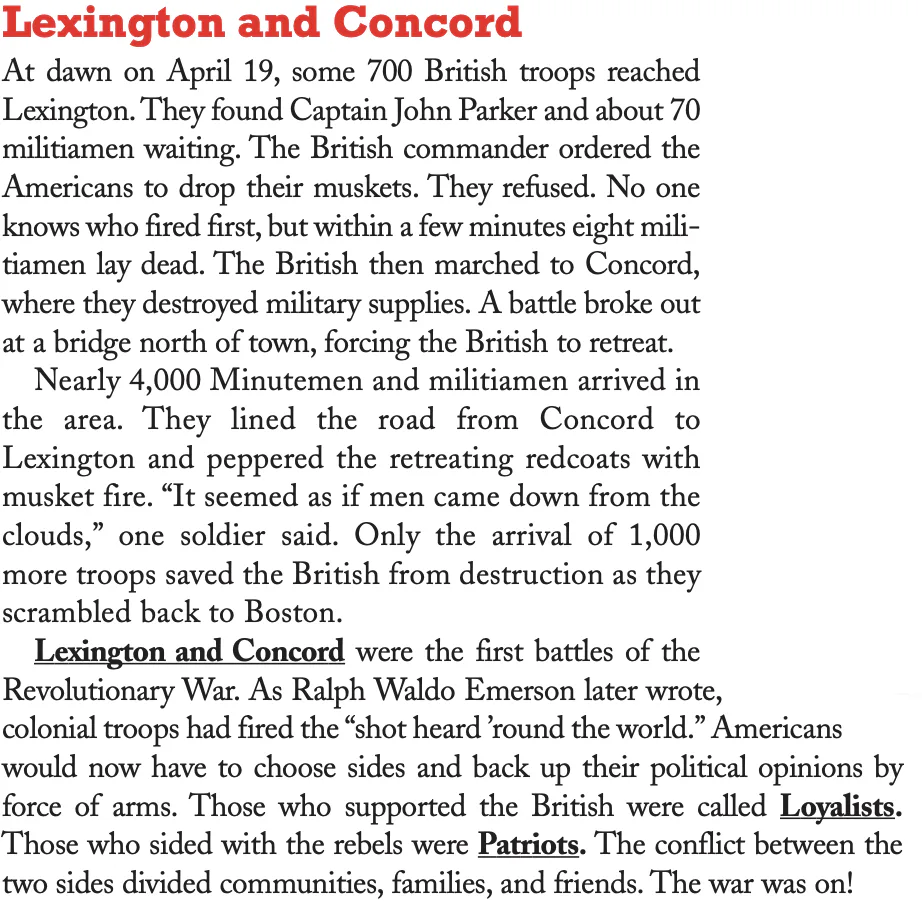
What happened at dawn on April 19?

1
The signing of the Declaration of Independence occurred.
2

Some 700 British troops reached Lexington.

3
The Boston Tea Party took place.
4
The Treaty of Paris was signed.

50

Multiple Choice

Question image

What was the result of the first shots fired at Lexington?

1
The battle ended in a truce.
2
Ten British soldiers were killed.
3
Eight militiamen were killed.
4
No one was injured during the confrontation.

51

Multiple Choice

Question image

What happened during the battle at the bridge north of Concord?

1
The British won the battle and advanced towards Concord.
2
No significant events occurred at the bridge north of Concord.
3
The Americans surrendered at the bridge north of Concord.
4
A battle occurred at the bridge north of Concord, forcing the British to retreat.

52

Multiple Choice

Question image

Where did the British troops march after Lexington?

1
Philadelphia
2
Concord
3
New York
4
Boston

53

Multiple Choice

Question image

What did the British destroy in Concord?

1
military supplies
2
civilian homes
3
military vehicles
4
food supplies

54

Fill in the Blanks

Those who sided with the rebels were called

.

55

Fill in the Blanks

The British then marched to

, where they destroyed military supplies

56

Fill in the Blanks

Lexington and Concord were the first battles of the

War.

57

Fill in the Blanks

Those who supported the British were called

, while those who sided with the rebels were known as Patriots.

58

Fill in the Blanks

At dawn on April 19, some 700 British troops reached

.

59

Multiple Choice

Question image

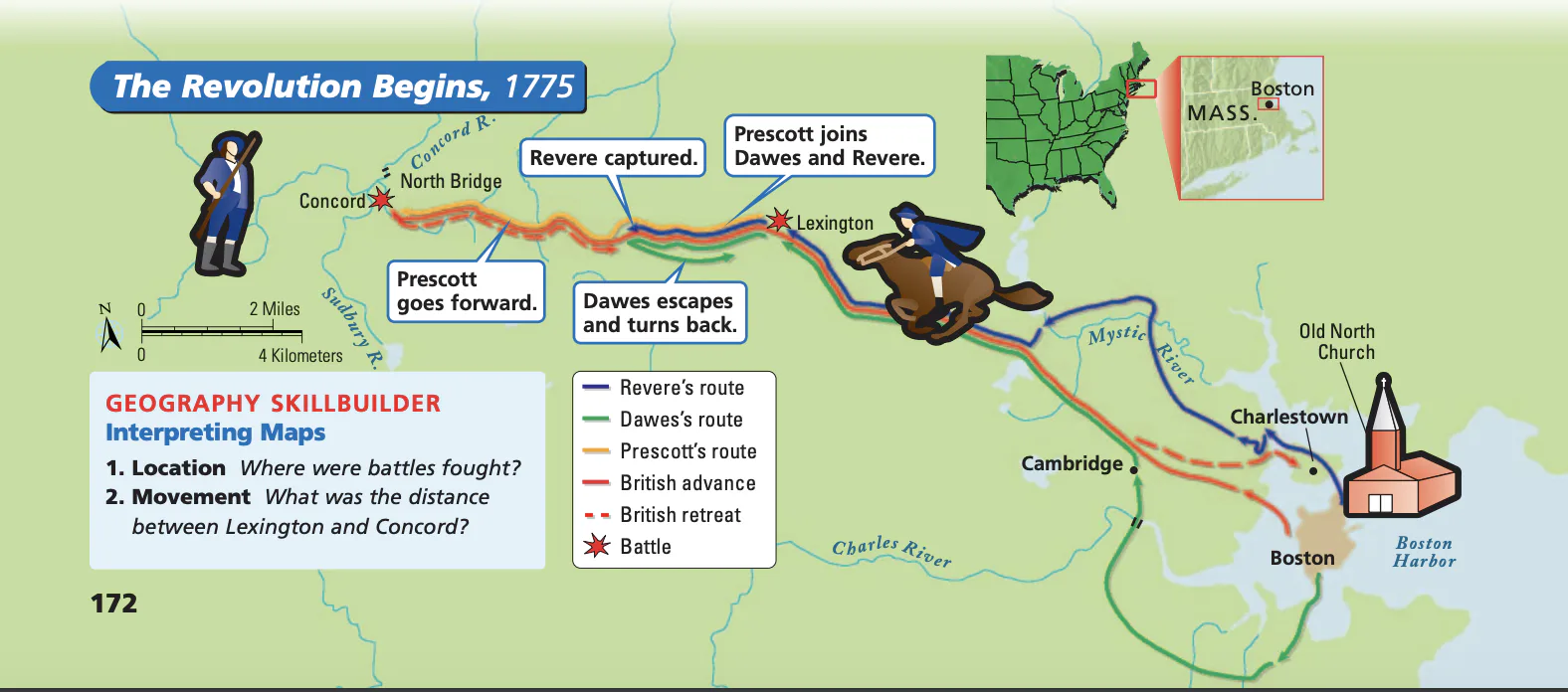
Where does Paul Revere’s Route begin?

1
Boston, Massachusetts
2
Lexington, Massachusetts
3
Charlestown, Massachusetts
4
Concord, Massachusetts

60

Multiple Choice

Question image

Revere was captured by British troops before reaching Concord.

1

true

2

false

61

Multiple Choice

Question image

Where did Revere and Dawes reunite?

1
Boston
2
Concord
3
Cambridge
4
Lexington

62

Fill in the Blanks

The

were laws passed by Parliament punishing Massachusetts for the Boston Tea Party.

63

Fill in the Blanks

A

is a force of armed civilians who pledge to defend their community.

64

Fill in the Blanks

A

is a colonist who could be ready to fight at a minute’s notice.

65

Fill in the Blanks

The

was a meeting held by the colonies in Philadelphia in 1774 to decide how to address the problems with Britain.

66

Fill in the Blanks

A

was a colonist who supported the colonial rebels.

67

Fill in the Blanks

was a patriot who helped warn colonists about British movements.

68

Fill in the Blanks

__________ and __________ are the sites of the first battles of the Revolutionary War.

69

Fill in the Blanks

A

was a colonist who was loyal to Britain.

pattern-tertiary

The Road to Lexington and Concord

media

Show answer

Auto Play

Slide 1 / 69

SLIDE