
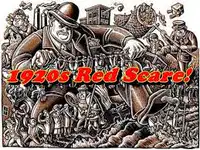
Analyzing the Red Scare

Presentation
•
History
•
11th Grade
•
Practice Problem
•
Hard

Blake Velasquez
Used 1+ times
FREE Resource
10 Slides • 10 Questions
1
In April 1917, American President Woodrow Wilson proclaimed that the United States had to join Great Britain, France, and Russia in their war against the Central Powers in order to "make the world safe for democracy." Wilson wnated to use the power of the United States to change the world into a place that looked and acted more like America. Change is complicated, however, and the same year that the United States entered World War 1 (which had been going on in Europe since 1914), the people of Russia rose up and revolted against the people thier king (Czar/Tsar), Nicolas II.
The Russian people had suffered terrible hardships during the war and many of them were increasingly attracted to small group of revolutionaries called the Bolsheviks, led by Vladimir Lenin and Leon Trotsky. The Bolsheviks, better known as the communists or "reds" (named after the color of the communist flag), promised to give up the war against Germany, The Bolsheviks kept their promise, and this helped them gain the support of many Russians who were sick of the war. The Bolsheviks eventually gained complete control of Russia and began to transform it into a communist state called the Union of Soviet Socialist Republics (the Soviet Union, or U.S.S.R.). Despite the wishes of leaders like President Wilson, Russia (the U.S.S.R.) was now becoming even less like America than it had been before.
2
Open Ended
What was going on in the world at the time that stoked fears in America?
3

Although the United States, along with France and Britain, won the First World War in 1918 by defeating teh Central Power, peace did not come to America immediately. Instead, in 1919 and 1920, the U.S. was shaken by a series of big labor strikes.
The Post World War 1 Labor Struggle
4
The vast majority of American workers who went on strike in 1919 and 1920 did so to try and protect their jobs and the good wages they had earned during the war. Most were not on strike to provoke a revolution. Some Americans who opposed the strikes, however, claimed that the workers were radicals, communist revolutionaries whose real aim in striking was to destroy the American government and create a communist state like the one in the U.S.S.R. These accusations of communist-inspired labor agitation were accompanied by growing fears of terrorism.
5
Open Ended
Why were workers on strike called “radicals”? Were they?
6


In the Summer of 1919, a number of bombs were sent through the mail to influential Americans like J.P. Morgan and John D. Rockefeller. A wave of fear swept across the country. Many Americans became convinced that both the strikes and the terrorist acts were caused by communists in America, under orders from the Soviet leaders Lenin and Trotsky. Although we can look back now and be certain tere was very little chance that a communist revolution would occur in America, many people at that time believed the nation was dangerously on the edge of social and political disintegration.
Bombs Lead to Fears of an Uprising
J.P. Morgan
John D. Rockefeller
7
Open Ended
What do you think they mean by “disintegration”? Why was this a fear?
8
After a bomb blew up in front of U.S. Attorney General A. Mitchell Palmer's home in Washington D.C., he used laws that had been passed during the war to launch a campaign against those people he suspected of being subversives. One of these laws, the Sedition Act (1918), made it a federal crime to criticize the government or Constitution of the United States


General A. Mitchell Palmer & house after bombing
9
- Section 3 of the Sedition Act
"Whoever, when the United States is at war, shall willfully make or convey false reports or false statements with intent to interfere with the operation or success of the military or naval forces of the United States, or to promote the success of its enemies... or incite insubordination, disloyalty, mutiny, or refusal of duty, in the military or naval forces of the United States, or shall willfully obstruct.... the recruiting or enlistment service of the United States, or... shall willfully utter, print, write, or publish any disloyal, profane, scurrilous, or abusive language about the form of government of the United States, or the Constitution of the United States, or the military or naval forces of the United States... or shall willfully display the flag of any foreign enemy, or shall willfully... urge, incite, or advocate any curtailment of production... or advocate, teach, defend, or suggest the doing of any of the acts or things in this section enumerated and whoever shall by word or act support or favor the cause of any country with which the United States is at war or by word or act oppose the cause of the United States therein, shall be punished by a fine of not more than $10,000 or imprisonment for not more than twenty years, or both."
10
Open Ended
What did the Sedition Act do?
11
Although it certainly seems to have been unconstitutional, many people supported Attorney General Palmer's use of the Sedition Act in his campaign to arrest suspected subversives. Palmer targeted labor leaders and outspoken radical intellectuals. His officials, under the direction of Palmer's special assistant, J. Edgar Hoover (later leads the FBI) conducted raids on anarchist organizations, schools, and other gathering places in over thirty cities nationwide. Thousands of people were arrested and jailed. Most were recent immigrants to the United State.
12
Almost 250 were deported back to the Soviet Union, including the outspoken anarchist and feminist activist, Emma Goldman. The Sedition Act empowered Attorney General Palmer to round up people, not for things they had done, but for expressing their thoughts and beliefs. They were arrested because they spoke or wrote words that the government claimed were dangerous. But doesn't this conflict with the right to free speech protected by the First Amendment?

13
Open Ended
What were the Palmer Raids and what happened to many people who were caught in them?
14
The End of the Paranoia & Lasting Impact
By the summer of 1920, the public gradually lost interest in Palmer and his campaign aganist subversives, in the part because he predicted a series of terrorist attacks that failed to occur. The paranoia that had gripped America for over a year passed and Palmer was increasingly criticized for conduction searches without warrants and for denying detainees legal representation.
15
When a bomb went off on Wall Street in New York City in September 1920, most Americans probably considered it the act of a crazy person rather than part of a communist plot against America. Palmer, once considered a possible presidential candidate, was largely forgotten. The Palmer Raids and the Red Scare paranoia did, however, frustrate the labor movement's attempt to increase its influence in the United States. The Red Scare also helped convince many Americans to support a dramatic change in the nation's immigration policy. Until the early 1920s, the United States had very few laws that stopped immigrants from coming here. In 1924, however, America became a "gatekeeping" nation for the first time, closing its doors to most Central and Eastern European immigration.
16
Open Ended
What was the lasting impact of the Red Scare?
17
Multiple Choice

What is the cartoonist trying to say about American steelworkers?
American steelworkers are depicted as Communists
18
Multiple Choice

How do you think this cartoonist feels about the industrial revolution’s effect on America?
19
Multiple Choice

What is this cartoonist calling for and why?
20
Multiple Choice

What is the cartoonist trying to say about labor union strikes?
In April 1917, American President Woodrow Wilson proclaimed that the United States had to join Great Britain, France, and Russia in their war against the Central Powers in order to "make the world safe for democracy." Wilson wnated to use the power of the United States to change the world into a place that looked and acted more like America. Change is complicated, however, and the same year that the United States entered World War 1 (which had been going on in Europe since 1914), the people of Russia rose up and revolted against the people thier king (Czar/Tsar), Nicolas II.
The Russian people had suffered terrible hardships during the war and many of them were increasingly attracted to small group of revolutionaries called the Bolsheviks, led by Vladimir Lenin and Leon Trotsky. The Bolsheviks, better known as the communists or "reds" (named after the color of the communist flag), promised to give up the war against Germany, The Bolsheviks kept their promise, and this helped them gain the support of many Russians who were sick of the war. The Bolsheviks eventually gained complete control of Russia and began to transform it into a communist state called the Union of Soviet Socialist Republics (the Soviet Union, or U.S.S.R.). Despite the wishes of leaders like President Wilson, Russia (the U.S.S.R.) was now becoming even less like America than it had been before.
Show answer
Auto Play
Slide 1 / 20
SLIDE
Similar Resources on Wayground

15 questions
DILATASI
Presentation
•
11th Grade
13 questions
Ilmu Pengetahuan Alam
Presentation
•
KG
16 questions
The End of World War I
Presentation
•
10th - 12th Grade
17 questions
Beginning of the Cold War
Presentation
•
10th Grade
15 questions
Immigration and Monopolies
Presentation
•
11th Grade
15 questions
CONTEMPORARY PHILIPPINE ARTS FROM THE REGIONS
Presentation
•
11th - 12th Grade
14 questions
Solving Rational Equations
Presentation
•
11th Grade
15 questions
The Korean War
Presentation
•
11th Grade
Popular Resources on Wayground
10 questions
Safety Day 2026 – Student Review

Quiz
•
9th Grade
21 questions
Continents and Oceans
Quiz
•
6th Grade
20 questions
Parts of Speech
Quiz
•
5th Grade
16 questions
Subject & Predicate
Quiz
•
5th Grade
25 questions
Multiplication Facts
Quiz
•
5th Grade
12 questions
Map Skills
Quiz
•
3rd Grade
22 questions
Continents and Oceans
Quiz
•
5th Grade
15 questions
Rounding Decimals
Quiz
•
5th Grade
Discover more resources for History
15 questions
The Bill of Rights
Quiz
•
8th - 12th Grade
16 questions
Students of Civics Unit 2: The Constitution
Quiz
•
7th - 11th Grade
52 questions
Greece and Rome Review
Quiz
•
10th - 11th Grade
6 questions
Day 19 USH Do Now - US enters WWI
Quiz
•
11th Grade
21 questions
US History Unit 4 EOC Review
Quiz
•
11th Grade
50 questions
AP World Modern Unit 1: Global Tapestry
Quiz
•
10th - 12th Grade
12 questions
CE 2b Early Documents Review
Quiz
•
7th Grade - University