Search Header Logo
Cycle 2 Grade Recovery

Cycle 2 Grade Recovery

Assessment

Presentation

Biology

9th Grade

Medium

NGSS
HS-LS1-1, HS-LS1-4, HS-LS1-6

+4

Standards-aligned

Created by

Sara Deal

Used 2+ times

FREE Resource

62 Slides • 83 Questions

1

media

2

Multiple Choice

A polymer is made up many:

1

polymer

2

biomolecules

3

proteins

4

monomers

3

media

4

media

5

Multiple Select

The function of a carbohydrate is: Select two answers.

1

Long-term energy storage

2

Short-term energy storage

3

Storing genetic information

4

Acts as an enzyme

5

Component of cell walls (cellulose)

6

media

7

Multiple Choice

Question image

9A A table of four types of carbohydrates is shown.


Which list correctly matches the functions to the types of carbohydrates?

1

Energy: glycogen and starch

Structure: cellulose and chitin

2

Energy: cellulose and chitin

Structure: glycogen and starch

3

Energy: chitin and glycogen

Structure: cellulose and starch

4

Energy: cellulose and starch

Structure: chitin and glycogen

8

media

9

media

10

Multiple Select

The function of a lipid is: Select two answers.

1

Long-term energy storage

2

Short- term energy storage

3

Storing genetic information

4

Component of cell wall in plants

5

Provides insulation in animals

11

media

12

media

13

Multiple Select

The function of a protein is: Select all that apply.

1

Long term energy storage

2

Short-term energy storage

3

Codes for traits

4

Transport molecules across the cell membrane

5

Speeds up reactions (enzyme)

14

media

15

Multiple Choice

The function of a nucleic acid is:

1

Long-term energy storage

2

Short-term energy storage

3

Storing genetic information

4

Speed up reactions

16

media

17

Multiple Choice

9A The differences between two molecules include the type of sugar that forms a section of the molecules and the identity of one of the four nitrogenous bases that make up another section of the molecules. These two molecules are —

1

proteins

2

lipids

3

nucleic acids

4

complex carbohydrates

18

media

19

Multiple Choice

9A Students were given a list of seven elements and asked to identify the four elements that are most abundant in biomolecules. Which table correctly identifies the four most-abundant elements in biomolecules?

1
2
3
4

20

Multiple Select

9A An advertisement for a health supplement for dogs claims to build lean muscle and strengthen tendons and ligaments, as well as provide energy. Which biomolecules must the supplement contain to provide these benefits? Select all that apply

1

Lipids

2

Proteins

3

Nucleic acids

4

Carbohydrates

21

media

22

media

23

Multiple Choice

Question image

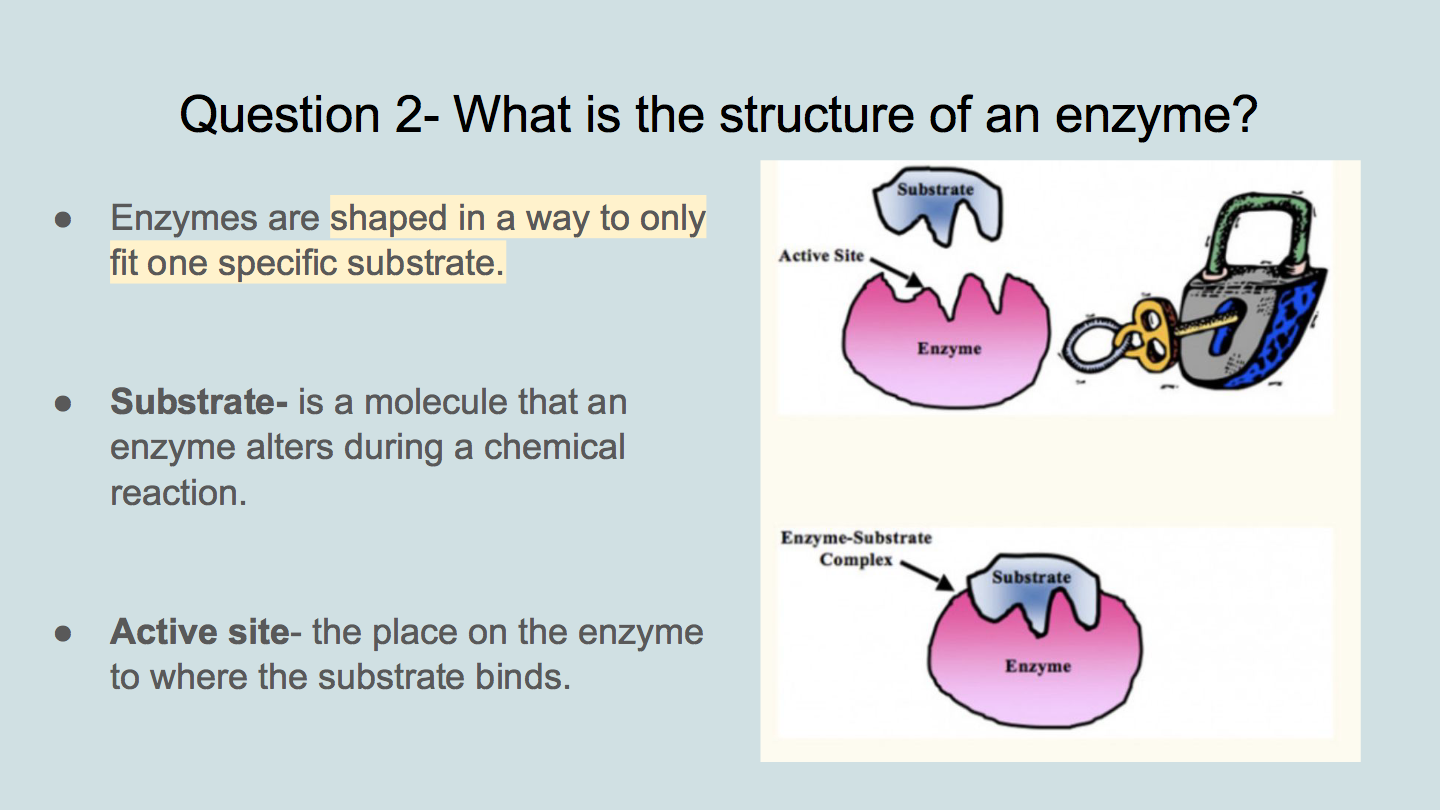
Enzymes are

1

Lipids

2

Protein

3

Carbohydrates

4

Nucleic Acids

24

Multiple Choice

Enzymes are responsible for-

1

Speeding up reactions

2

Giving the body energy

3

Slowing down reactions

25

Multiple Choice

Which of these is most likely an enzyme?  

1

Sucrose

2

Galactose

3

Fructose

4

Amylase

26

media

27

Multiple Choice

Question image

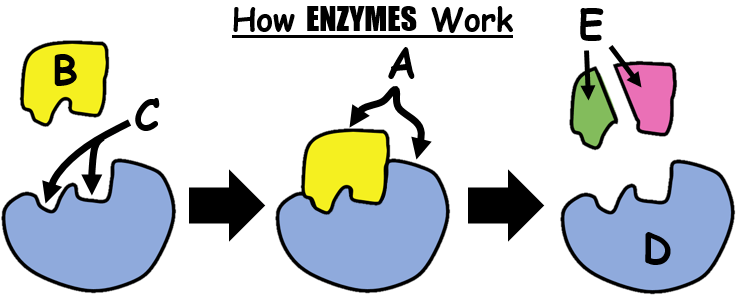
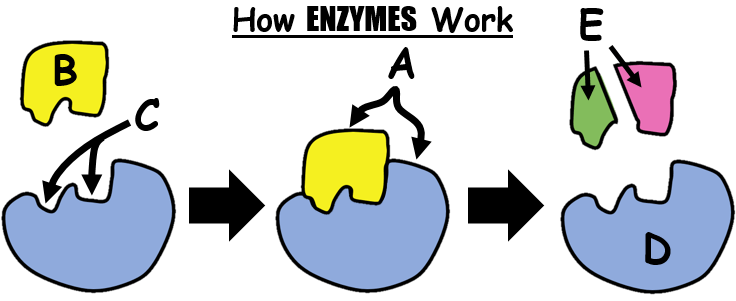
Letter D...

1

active site

2

enzyme

3

substrate

4

products

28

Multiple Choice

Question image

Letter B...

1

active site

2

enzyme

3

substrate

4

products

29

Multiple Choice

Question image

Letter c...

1

active site

2

enzyme

3

substrate

4

products

30

Multiple Choice

Each enzyme only has 1 substrate that will fit its active site.  What is this called?

1

reusablility

2

denaturation

3

specificity

4

fragility

31

media

32

media

33

Multiple Choice

What is a substance called if it speeds up a chemical reaction?

1

reusable

2

catalyst

3

specific

4

fragile

34

media

35

Multiple Choice

An enzyme speeds up a chemical reaction in the cell but can only be used once.  True or False? 

1

true

2

false

36

media

37

Multiple Choice

After the enzyme and substrate bind together and perform the reaction, what does the substrate become?
1
a substrate
2
an enzyme
3
a product
4
an active site

38

media

39

Multiple Choice

What happens when enzymes are heated to a high temperature?

1

The enzymes die.

2

The shapes of the enzyme are altered denature

3

The enzymes' amino acid sequence changes.

4

The enzymes remain the same

40

media

41

Cell Cycle

Hedrick 2021

media

42

The Cell Cycle

  • This the life cycle that ALL cells generally go through.

  • The cell cycle is made of the G0, G1, S, G2, and M phases.

media

43

Poll

What do you think the G in the G phases mean?

Gaining

Growth

Gestation

Gap

44

Multiple Choice

Which stage of the cell cycle do cells spend the most time?

1

Cytokinesis

2

Mitosis

3

Interphase

4

Prophase

45

G0 Phase

This is "resting" phase of the cell cycle. Cells just kinda "hang out" in this phase and don't do any cell division type things.

media

46

G1 Phase (Growth Phase)

This is where the cell does most of its growth. This is also where most of the proteins are made (think transcription and translation going crazy).

media

47

S (Synthesis) Phase

All of the chromosomes are duplicated (copied) in preparation for cell division.

media

48

G2 Phase

The cell checks the copied DNA, checks for any other issues, and grows again.

media

49

M (Mitotic) Phase

This is where the cell actually does its division processes.

media

50

Multiple Choice

In which phase of the cell cycle does the DNA copy itself?

1

G0

2

G1

3

S

4

G2

5

M

51

Multiple Choice

In which phase of the cell cycle does the cell just "hang out"?

1

G0

2

G1

3

M

4

G2

5

S

52

Multiple Choice

In which phase of the cell cycle does the cell grow and synthesize most of its proteins?

1

G0

2

G1

3

S

4

G2

5

M

53

Multiple Choice

In which phase of the cell cycle does the cell divide?

1

G0

2

G1

3

S

4

G2

5

M

54

Multiple Choice

In which phase of the cell cycle does the cell do its final prep and checks for cell division?

1

G0

2

G1

3

S

4

G2

5

M

55

media

56

media
media

​Deoxy - Without Oxygen

RIBOSE -Sugar

57

media

58

Multiple Select

What are the 3 main functions of DNA?

1

Stores genetic information

2

Copies information

3

Transmits information

4

Determines my personality

59

media

60

media

61

Hotspot

Using the picture of a nucleotide, point to the NITROGENOUS base.

62

media

63

media

64

Labelling

Label each letter with an answer:

Base pair

Sugar Phosphate backbone

Drag labels to their correct position on the image

Sugar Phosphate backbone

Base pair

65

media

66

media

67

media
media

68

Fill in the Blank

Question image

Fill in the missing letter (?) below each base pair

69

Fill in the Blank

Question image

Fill in the missing letter (?) below each base pair

70

media

71

Fill in the Blank

Write the complementary base pair: (T-C-G) (A-C-A)

(
-
-
)
(
-
-
)

72

Fill in the Blank

Write the complementary base pair: (A-A-C) (G-T-G) (C-T-T)

(
-
-
)
(
-
-
)
(
-
-
)

73

Fill in the Blank

Write the complementary base pair: (C-G-A) (T-G-T) (A-C-G) (A-T-A)

(
-
-
)
(
-
-
)
(
-
-
)
(
-
-
)

74

RNA & Protein Synthesis

DNA --> RNA --> Protein

media

75

media

76

media

77

Differences between DNA and RNA

  • Sugar: DNA uses deoxyribose while RNA uses ribose

  • Bases: DNA uses thymine (T) while RNA uses uracil (U)

  • Shape: DNA is a double helix while RNA only has one strand

  • Location: DNA is only in the nucleus while RNA can also be in the cytoplasm

78

What does DNA do?

  • DNA is the boss of the cell, holding all of the genes (instructions) that the cell needs.

  • It carries the genetic information.

  • DNA cannot leave the nucleus (except during cell replication).

79

What does RNA do?

  • Since DNA must stay in the nucleus, RNA does all of the jobs for the DNA.

  • RNA carries the information from the DNA.

  • RNA carries the amino acids for proteins.

  • RNA builds the proteins as the DNA instructs, using the amino acids.

80

Multiple Choice

In RNA, uracil takes the place of the DNA nitrogen base...

1

guanine

2

cytosine

3

thymine

4

adenine

81

Multiple Choice

Which of the following statements is true?
1
DNA is single-stranded
2
RNA is single-stranded
3
DNA contains uracil
4
RNA contains deoxyribose

82

Multiple Choice

Question image

What type of sugar is used in RNA?

1

deoxyribose

2

glucose

3

fructose

4

ribose

83

Multiple Choice

Question image

What base does RNA have that DNA does not?

1

uracil

2

thymine

3

cytosine

4

guanine

84

DNA --> RNA --> Protein

The Central Dogma of Biology

85

Central Dogma of Biology

  • DNA controls everything, but it cannot leave the nucleus.

  • DNA is transcribed (copied) into mRNA.

  • mRNA takes the instructions to the ribosomes (rRNA) in the cytoplasm.

  • Ribosomes (rRNA) use transfer RNA (tRNA) to translate (change) the mRNA into proteins.

  • DNA --> RNA --> Proteins

86

Three types of RNA

  • mRNA - Messenger RNA which carries instructions from the DNA

  • rRNA - Ribosomal RNA which builds the proteins

  • tRNA - Transfer RNA which carries amino acids

87

media

88

media

89

Multiple Choice

Which of these is not a type of RNA?

1

mRNA

2

nRNA

3

rRNA

4

tRNA

90

Fill in the Blank

According to the Central Dogma of Biology, DNA --> RNA --> ???

91

Multiple Choice

Which kind of RNA is a messenger that carries the instructions from the DNA to the ribosomes?

1

mRNA

2

rRNA

3

tRNA

92

DNA --> RNA

Transcription

93

Transcription

  • Copies the code from the DNA to mRNA

  • Takes place in the nucleus (with the DNA)

  • Uses complementary base pairing to turn DNA into mRNA

media

94

Note

  • RNA does not use thymine (T)

  • Instead, it uses another base called uracil (U)

  • So adenine bonds with uracil and guanine bonds with cytosine

  • A-U and G-C

95

DNA: TAG CCT AAA GTC

RNA: AUC GGA UUU CAG

Transcription copies by complementary base pairing (notice the U's?)

96

Vocab Time!

  • Codon: A set of three bases (ex. CAG)

  • Anticodon: The complement to a codon, only found on tRNA (ex. GUC)

97

Multiple Select

Which two complementary pairs are correct for RNA?

1

G-C

2

A-T

3

A-U

4

C-T

98

Multiple Choice

What is the complementary mRNA sequence for this DNA codon?

GGA

1

CCU

2

CCT

3

GGT

4

AAC

99

Fill in the Blank

What is the complementary mRNA sequence for this DNA codon? (3 bases long)

TGC

100

Fill in the Blank

What is the complementary mRNA sequence for this DNA codon? (3 bases long)

TAG

101

RNA --> Protein

Translation

102

Translation

  • Changes the mRNA code into a protein

  • Each codon on the mRNA meets the anticodon on the tRNA

  • The codons each have a specific amino acid

media

103

The Codon Table

  • Gives us away to translate mRNA codons into amino acids

  • Find the place where the bases in the codon overlap

  • For example, the codon AUG gives us "Met" (which stands for methionine, an amino acid)

media

104

media

105

The Codon Wheel

  • Like the codon table, gives us a way to translate mRNA codons into amino acids

  • Work from the inside to the outside

  • For example, the codon GAC gives us "Aspartic acid" (an amino acid)

media

106

media

107

Multiple Choice

Question image

What is the amino acid for the mRNA codon UUC?

1

Phe

2

Met

3

Gly

4

Stop

108

Fill in the Blank

Question image

What is the amino acid for the mRNA codon AUG?

109

Multiple Choice

Question image

What is the amino acid for the mRNA codon UAC?

1

Tyrosine

2

Histidine

3

Serine

4

Valine

110

Fill in the Blank

Question image

What is the amino acid for the mRNA codon UGA?

111

Review

  • DNA --> RNA --> Protein

  • DNA is transcribed into mRNA.

  • The mRNA carries the message out of the nucleus to the ribosomes (rRNA) in the cytoplasm.

  • The ribosomes work codon by codon to translate the mRNA into a protein.

  • Each tRNA brings a specific amino acid to add, based on matching its anticodon to the mRNA codon.

112

media

113

Open Ended

Question image

Using everything you have learned here, describe how cells use their DNA to make proteins.

Use as many of these words as you can:

DNA, gene, RNA, mRNA, rRNA, tRNA, codon, anticodon, transcription, translation, amino acid, protein

114

Multiple Choice

Nucleotides are monomers of
1
Carbohydrates
2
Lipids
3
Proteins
4
Nucleic Acids

115

Multiple Choice

DNA and RNA are examples of 
1
Carbohydrates
2
Lipids
3
Proteins
4
Nucleic Acids

116

Multiple Choice

What are the three main parts of a nucleotide?

1

carbon, hydrogen, and oxygen

2

phosphate, sugar, and nitrogen base

3

phosphate, sulfate, and nitrate

4

adenine, thymine, and uracil

117

Labelling

Put each label in the correct location in the Venn Diagram. (Make sure to put answers in DESCENDING number order.)

Drag labels to their correct position on the image

10.Made of Nucleic Acids

9.Double Stranded

8.Single Stranded

7.Uracil

6.Guanine

5.Cytosine

4.Thymine

3.Adenine

2.Sugar: Ribose

1.Sugar: Deoxyribose

118

Labelling

Label the diagram of protein synthesis

Drag labels to their correct position on the image

mRNA

Amino Acid

Codon

Transcription

Anticodon

tRNA

DNA

Translation

Ribosome

Nucleus

119

Drag and Drop

When DNA splits into single strands to act as a template for a new strand of complementary DNA, it is called ​
. ​ The process by which ​ DNA is copied to ​
, which carries the information needed for protein synthesis is called ​
. The mRNA formed in transcription is transported out of the ​
, into the cytoplasm, to the ribosome (the cell's protein synthesis factory). With the help of tRNA the protein chain is assembled in a process known as ​
.
Drag these tiles and drop them in the correct blank above
replication
mRNA
transcription
nucleus
translation

120

Multiple Select

Question image

Which processes occurs in the nucleus? (two answers)

1

DNA replication

2

transcription

3

translation

4

digestion

121

Multiple Choice

If a portion of a mRNA molecule contains the base sequence A-A-U, the corresponding tRNA base sequence is

1

T-T-C

2

G-G-T

3

U-U-A

4

A-A-U

122

Multiple Choice

Question image

The picture shows a nucleotide. What could the green box represent?

1

adenine

2

phosphate

3

deoxyribose

4

ribose

123

Multiple Choice

Question image

Use your codon chart to match the DNA sequence GAA to the correct amino acid

1

VAL

2

TYR

3

LEU

4

PHE

124

Multiple Choice

Question image

Use your codon chart to match the DNA sequence TGA to the correct amino acid.

1

Thr

2

Ala

3

Val

4

Gly

125

Multiple Choice

Question image

The Himalayan rabbit's habitat has cold, snowy winters and mild summers. The body is typically covered in white fur except for the nose, feet, tail, and ears, which are covered in black fur.

A scientist shaved an area of white fur on the back of a Himalayan rabbit and placed an ice pack over the shaved area . The shaved area grew black fur.

Which of these best explains why the hair that grew back where the Ice pack was placed was black and not white?

1

The white hair mutated to black hair as the rabbit's body temperature decreased.

2

The coat color changed from white to black with the age of the rabbit.

3

The genes for black hair were activated by specific temperatures.

4

White hair only grows during certain times of the year.

126

Multiple Choice

Question image
1

A

2

B

3

C

4

D

127

Multiple Choice

Question image
1

F

2

G

3

H

4

J

128

Multiple Choice

Question image
1

A

2

B

3

C

4

D

129

Multiple Choice

Question image

1

A

2

B

3

C

4

D

130

Multiple Choice

Question image

1

F

2

G

3

H

4

J

131

Multiple Choice

Question image
1

A

2

B

3

C

4

D

132

Multiple Choice

Question image
1

A

2

B

3

C

4

D

133

Multiple Choice

Question image
1

F

2

G

3

H

4

J

134

Multiple Choice

Question image
1

F

2

G

3

H

4

J

135

Multiple Choice

Question image

The diagram represents one way an enzyme can be inhibited. Which statement explains the effect of an inhibitor on an enzyme?

1

A substrate will be able to bond with the enzyme.

2

The enzyme will likely be attacked by immune cells

3

The enzyme will be unable to produce more enzymes.

4

A substrate will be unable to attach to the enzyme.

136

Multiple Choice

Which organic macromolecules are composed of chains of amino acids that join to form the structural components of organisms?
1
carbohydrates
2
nucleic acids
3
proteins
4
lipids

137

Multiple Choice

Which of the following is a possible result of a disruption in the cell cycle?
1
cancer
2
photosynthesis
3
cellular respiration
4
protein synthesis

138

Multiple Choice

Question image
This diagram shows the cell cycle.

Which of the following activities occur in the S phase?
1
Replication of the DNA
2
Growth of the cell
3
Formation of the mitotic spindle
4
Breakdown of the nuclear membrane

139

Multiple Choice

Which of the following macromolecules are a prominent part of animal tissues that function in insulation, helping animals conserve heat?
1
Carbohydrates
2
Lipids
3
Proteins
4
Nucleic acids

140

Multiple Choice

The function of this macromolecule is to store and pass on genetic information to offspring.
1
carbohydrates
2
proteins
3
nucleic acids
4
lipids

141

Multiple Choice

All of the following are functions of proteins EXCEPT

1

catalyze/speed up chemical reactions

2

provide quick energy

3

make up muscles, hair, and bones

4

support the immune system

142

Multiple Choice

Question image

5 (A) This model of the cell cycle includes two arrows that each represent a process in the cycle. What do the two arrows represent?

1

Arrow 1 represents prophase, and Arrow 2 represents interphase.

2

Arrow 1 represents mitosis, and Arrow 2 represents meiosis.

3

Arrow 1 represents interphase, and Arrow 2 represents mitosis.

4

Arrow 1 represents meiosis, and Arrow 2 represents prophase.

143

Multiple Choice

5 (C) When cells lose their ability to regulate the cell cycle, they can divide at an accelerated rate and form a mass of cells. This mass of cells is referred to as —

1

A tumor

2

An embryo

3

A gland

4

An organ

144

Multiple Choice

How do enzymes function in biological reactions?

1

Enzymes lower the activation energy barrier for reactions to occur.

2

Enzymes speed up reactions by consuming energy

3

Enzymes have no impact on biological reactions

4

Enzymes increase the activation energy barrier for reactions

145

Multiple Choice

Which group of biomolecules provide quick energy to organisms?
1
proteins
2
carbohydrates
3
lipids
4
nucleic acids
media

Show answer

Auto Play

Slide 1 / 145

SLIDE