
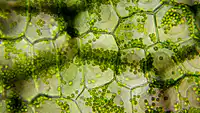
Photosynthesis Day 1

Presentation
•
Biology
•
9th Grade
•
Practice Problem
•
Medium

Desmond Parker
Used 7+ times
FREE Resource
12 Slides • 10 Questions
1


PHOTOSYNTHESIS
Life’s ultimate reaction
2
Fill in the Blanks
What is the primary energy molecule used by cells?
Type answer...
3
Multiple Choice
When a candle burns, energy is released in the form of
carbon dioxide and water
the chemical substance ATP
light and heat
electricity and motion
4


Chemical Energy
In living cells chemical energy is usually
stored and released by the compound
Adenosine Triphosphate (ATP)
Energy is also stored using Adenosine
Diphosphate (ADP). Cells have more
ADP at any given time than ATP
Glucose is another molecule that contains
90x more energy than ATP. Both ATP and
ADP can be generated from it
5


Chemical Energy
Heterotrophs-Obtain food by
eating other living organisms
Autotrophs-Make their own food
through photosynthesis
6
Categorize
Grass
Tree
Algae
Sunflower
Moss
Seaweed
Phytoplankton
Cactus
Lion
Human
Dog
Cat
Bird
Fish
Frog
Snake
Organize the following into the appropriate category
7
8
Open Ended
One of the earliest clues as to how photosynthesis works came from a simple study of plant growth. When a tiny seed grows into a massive tree, where does all its extra mass come from? More than 300 years ago a Flemish physician named Jan van Helmont decided to find out. He planted a young willow tree, with a mass of just 2 kilograms, in a pot with 90 kilograms of dry soil. He watered the plant as needed and allowed it to grow in bright sunlight. Five years later, he carefully removed the tree from the pot and weighed it. It had a mass of 77 kilograms.
Where did the extra 75 kilograms come from?
9

Why should we care about
photosynthesis?
10

Photosynthesis
The definition: A process in which light energy, water and
carbon dioxide are used to create glucose for energy.
Photo= light
Synthesis= to make
All of life stems from this reaction!
11

Photosynthesis
The Chemical Equation
6 CO2 6 H2O C6H12O6 6 O2
light energy
Carbon dioxide + Water
Name: ______________________________________ Date: _____________________ #______
glucose+ oxygen
12


Photosynthesis
◼ Photosynthesis takes place in the
chloroplasts. Only the cells of the
leaf have chloroplasts.
◼ In eukaryotic cells, the
chloroplasts contain specialized
light-absorbing pigments.
Chloroplast
13


Pigments
◼ Chlorophyll A (green) is the most
important photosynthetic pigment.
◼ Other pigments, called antenna or
accessory pigments, are also present in
the leaf.
▪ Chlorophyll B (also green)
▪ Carotenoids (orange / red)
▪ Xanthophylls (yellow / brown)
Chlorophyll is the main pigment- it reflects
green.
14


Pigments- Photosystems
The pigments are embedded in the
membranes of the chloroplast in
groups called photosystems.
PHOTOSYSTEM II
PHOTOSYSTEM I
*Note* Photosystem I was discovered
before Photosystem II, which explains why the order is switched.
15


Chlorophyll
400
500
600
700
Chlorophyll absorbs most of the energy
for the plant.
There are two categories of chlorophyll:
chlorophyll a and chlorophyll b.
Recall the electromagnetic spectrum.
The wavelength of visible light ranges
from 400 nm to ~750 nm.
16
Hotspot
Looking at the line for CHLOROPHYLL A, select the two highest absorbance peaks.
17
Open Ended

What are the approximate wavelengths for both of these peaks from chlorophyll a and what color is associated with both of them?
18
Hotspot
Looking at the line for CHLOROPHYLL B, select the two highest absorbance peaks.
19
Open Ended
What are the approximate wavelengths for both of these peaks from chlorophyll b and what color is associated with both of them?
20
Draw
Circle the area where the least absorbance occurs for chlorophyll a.
21
Draw
Circle the area where the least absorbance occurs for chlorophyll b.
22
Chlorophyll
400
500
600
700
Green light is the least absorbed color of light so it is reflected back to us.
This is why leaves appear green.
PHOTOSYNTHESIS
Life’s ultimate reaction
Show answer
Auto Play
Slide 1 / 22
SLIDE
Similar Resources on Wayground

19 questions
The Chemistry of Life 2.1
Presentation
•
9th Grade
21 questions
Enzymes
Presentation
•
9th Grade
17 questions
Enzymes
Presentation
•
9th Grade
17 questions
Proteins and Nucleic acids
Presentation
•
9th Grade
18 questions
SER VS ESTAR
Presentation
•
9th Grade
17 questions
Viruses
Presentation
•
9th Grade
13 questions
Gene regulation and mutation
Presentation
•
9th Grade
20 questions
Gene Expression
Presentation
•
9th - 10th Grade
Popular Resources on Wayground
10 questions
How much do you know about our Portrait of an Eagle?

Quiz
•
10th Grade
10 questions
Fast Food Slogans
Quiz
•
6th - 8th Grade
21 questions
Continents and Oceans
Quiz
•
6th Grade
20 questions
Parts of Speech
Quiz
•
5th Grade
16 questions
Subject & Predicate
Quiz
•
5th Grade
25 questions
Multiplication Facts
Quiz
•
5th Grade
12 questions
Map Skills
Quiz
•
3rd Grade
22 questions
Continents and Oceans
Quiz
•
5th Grade
Discover more resources for Biology
20 questions
Characteristics of Life
Quiz
•
9th - 10th Grade
10 questions
Exploring the 4 Major Macromolecules and Their Functions

Interactive video
•
9th - 12th Grade
20 questions
Cell Transport
Quiz
•
9th - 12th Grade
25 questions
photosynthesis and cellular respiration
Quiz
•
9th Grade
16 questions
Population Ecology
Quiz
•
9th - 12th Grade
20 questions
Cell Organelles
Quiz
•
9th Grade
18 questions
Water Properties
Quiz
•
9th Grade
36 questions
U3 Review Cell Cycle and Specialization Quiz
Quiz
•
9th Grade