Search Header Logo
  1. Resource Library
  2. Science
  3. Earth & Space Science
  4. Relative Age Dating
  5. Relative Age Dating Connection
Relative Age Dating - Connection

Relative Age Dating - Connection

Assessment

Presentation

Science

9th - 12th Grade

Medium

NGSS
MS-ESS1-4, MS-ESS2-2, MS-LS4-1

+2

Standards-aligned

Created by

Kristy Griffith

Used 2+ times

FREE Resource

2 Slides • 25 Questions

1

media

2

media

3

Multiple Choice

Relative dating of rock layers tells us that the deeper we dig, _______.
1
the younger the rocks get
2
the smellier the rocks get
3
the harder the rocks get
4
the older the rocks get

4

Multiple Choice

Question image
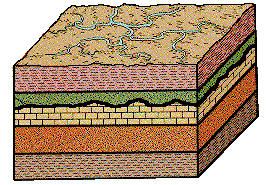
How does sedimentary rock usually form?
1
Vertically
2
Diagonally
3
Folding
4
Horizontally

5

Multiple Choice

Question image

Which law is used to determine that sedimentary layers were originally deposited in a horizontal position?

1

Law of Superposition

2

Law of Cross-Cutting Relationships

3

Law of Original Horizontality

4

Law of Faunal Succession

6

Multiple Choice

Question image

Which law states that in undisturbed layers of rock, the oldest layer is at the bottom and the youngest is at the top?

1

Law of Cross-Cutting Relationships

2

Law of Superposition

3

Law of Original Horizontality

4

Law of Faunal Succession

7

Multiple Choice

Question image

Which of the following events happened most recently? (look at all the options!)

1
A. Deposition of Unit C
2
B. Deposition of Unit B
3
C. Deposition of Unit F
4
D. Tilting of C, D, E, and F

8

Multiple Choice

Traces or remains of organisms that lived long ago
1
Fossil
2
Unconformity
3
Superposition
4
Column

9

Multiple Choice

Question image
Analyze the seashell found in the white layer.  Which statement is true of the rock layer that contains this fossil?
1
It could also contain a fossil from the bottom layer.
2
It is older than the layers below it.
3
It is younger than the layers above it.
4
It is older than the layers above it.

10

Multiple Choice

Question image

The image shows layers of sedimentary rocks with fossils.

A student labels the fossils from 1 to 4. What could be true about the fossils?

1

Fossil 1 is younger than fossil 2.

2

Fossil 1 is older than fossil 4.

3

Fossil 3 is older than fossil 2.

4


Fossil 3 is younger than fossil 4.

11

Multiple Choice

Question image

What does the principle of cross-cutting relationships state?

1

Older rocks are found at the bottom of a sequence

2

Layers of sediment are originally deposited horizontally

3

A fault or intrusion is younger than the rocks it cuts through

4

Fossils succeed each other in a definite order

12

Multiple Choice

Question image

Which event or layer is OLDER?
(look closely at all the options)

1

Intrusion M

2

Layer D

3

Fault J

4

Layer X

13

Multiple Choice

Question image

The diagram shows three sedimentary rock layers and an igneous intrusion.


What is the relative age of igneous intrusion W?

1

Igneous intrusion W is younger than sedimentary rock layers Z and X, but its relative age to layer Y cannot be determined.

2

Igneous intrusion W is younger than sedimentary rock layers Y and Z but older than layer X.

3

Igneous intrusion W is older than sedimentary rock layers Z and X, but its relative age to layer Y cannot be determined.

4

Igneous intrusion W is older than sedimentary rock layers Y and X but younger than layer Z.

14

Multiple Choice

If sedimentary rock layers are tilted, they must have
1
formed at an angle
2
moved after they formed
3
been cross-out by igneous rock
4
formed from deposits on a mountainside

15

Multiple Choice

A break in the geologic record that is made when rock layers are eroded over a long period of time
1
Law of Superposition
2
Law of Crosscutting
3
Relative Dating
4
Unconformity

16

Multiple Choice

Question image

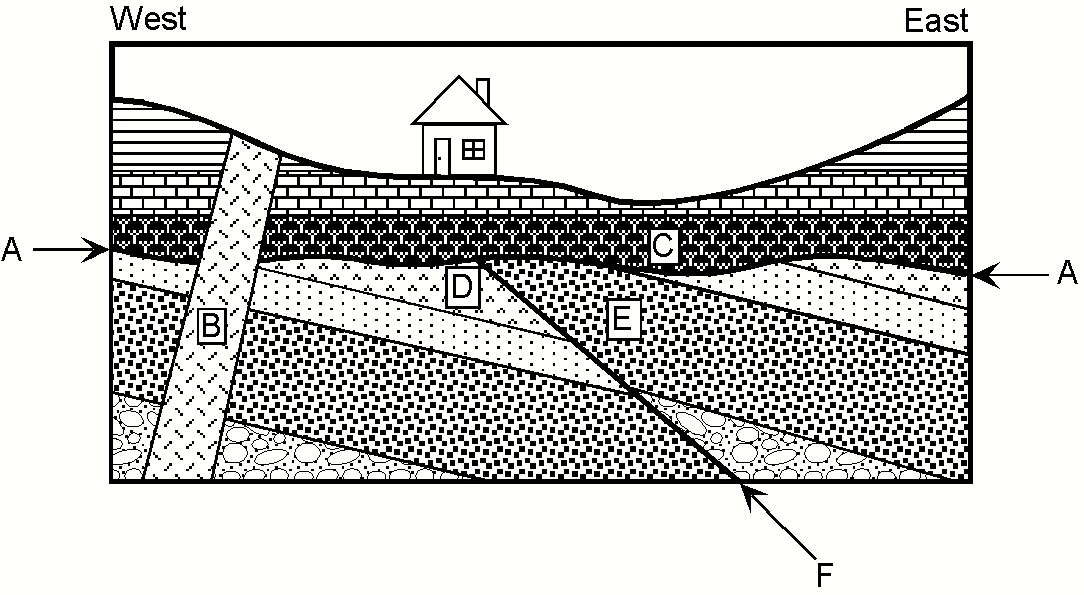
Letter "A" is a/an....

1
inclusion
2
intrusion
3
fault
4
unconformity 

17

Multiple Choice

Question image
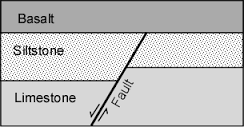
What are the relative ages of the features in order from oldest to youngest?
1
Limestone, Basalt, Fault, Siltstone
2
Siltstone, Fault, Basalt, Limestone
3
Limestone, Fault, Basalt, Siltstone
4
Limestone, Siltstone, Fault, Basalt

18

Multiple Choice

Question image

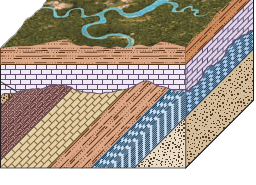
What type of unconformity is shown here?

1

Non-conformity

2

Disconformity

3

Angular unconformity

19

Multiple Choice

Question image

What type of unconformity is shown here?

1

Non-conformity

2

Disconformity

3

Angular unconformity

20

Multiple Choice

Question image

What type of unconformity is shown here?

1

Non-conformity

2

Disconformity

3

Angular unconformity

21

Hotspot

Click the spot that is the oldest layer or event?

22

Hotspot

Click the spot that is the youngest layer or event?

23

Multiple Choice

Question image

Put the layers seen here in order OLDEST to YOUNGEST

1

B-A-D-E-C

2

C-E-D-A-B

3

C-E-D-B-A

4

A-B-C-D-E

24

Multiple Choice

Question image

The diagram shows a geologic cross-section from a region.


What are the relative ages of the rocks from oldest to youngest ?

1

W, V, X, Z, and Y

2

W, Y, V, X, and Z

3

W, V, X, Y, and Z

4

W, V, Y, X, and Z

25

Multiple Choice

Question image
Which of the following orders the rock layers accurately from oldest to youngest?
1
A, B, C, D, E, F, G, H
2
B, F, G, C, D, H, A, E
3
B, G, C, D, E, H, A, F
4
F, A, H, E, D, C, G, B

26

Multiple Choice

Question image

What is the most recent event?

1

E

2

B

3

C

4

D

27

Multiple Choice

Question image

Put the layers/events in the diagram in order from OLDEST to YOUNGEST.

1

B-C-D-A-M-E-F-G-H

2

E-M-A-D-C-B-H-G-F

3

H-G-F-E-M-A-D-C-B

4

H-G-A-D-C-B-F-E-M

media

Show answer

Auto Play

Slide 1 / 27

SLIDE