

01.27.2025 - Small Group - The English Colonies

Presentation
•
History
•
8th Grade
•
Medium

Kimberly Slocum
Used 5+ times
FREE Resource
9 Slides • 16 Questions
1

2

3
Why did immigrant groups settle in the colonies?
Immigrant Groups
In most of the 13 colonies, the majority of colonists came from England. Some colonies, like New York and New Jersey, were exceptions because they were first settled by non-English immigrants. Over time, a large number of people arrived from all over Europe and other parts of the world. Most colonial settlements were established near the Atlantic and the waterways that flowed into it.
4
Wars and religious issues pushed many people out of Europe. They were pulled to America by the opportunities there. The colonies offered religious freedom, land, jobs, and for some, the chance to start a business. Large immigrant groups included Germans, Scots, and French Protestant called Huguenots. Religious unrest and religious persecution in Europe also brought large numbers of Jews to America. Many of the Germans and Scots were farmers. Other Germans had craft and trade skills. Many French immigrants also brought such skills to the colonies.
5
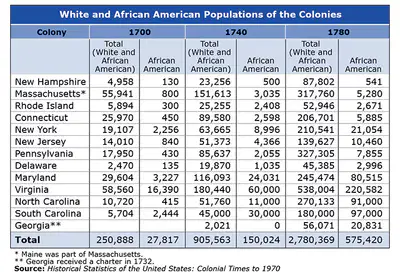
Some people arrived against their will. In the early colonial period, some Europeans enslaved American Indians. The introduction of European diseases, however, killed a large number of them. Europeans then turned to the African slave trade and Africans were brought to the colonies by force to work in the fields, shows, and home of colonists. Slavery existed in every colony. However the Southern Colonies had the largest number of enslaved people. The colonies were different in other ways, too. In fact 3 separate regions of colonies can be identified based on their characteristics and locations.
6
Multiple Choice
Which of these are PUSH factors?
Religious Freedom
Available Jobs
War
Opportunity to acquire land
Religious Persecution
War
Religious Persecution
Religious Freedom
7
Multiple Choice
Which of these are PULL factors
Religious Freedom
Available Jobs
Opportunity to acquire land
War
Opportunity to acquire land
Available Jobs
8
Multiple Choice
Which geographic characteristic did MOST of the English colonies share?
Most established representative government
Most had rich soil and good farmland
Most had their populations concentrated near the coast
Most were located in warm climates
9
The New England Colonies
The New England Colonies included Massachusetts, Rhode Island, Connecticut, and New Hampshire. The ethnic makeup of New England was most English of all the colonies. These colonies developed in ways that were most like life in England. That is one reason the region was called New England.
Shipbuilding, Fishing, and Trade were the main economic activities along the coast. Farther inland, many colonists had small farms. The town was the center of rural life. Families often lived in towns and farmed the land nearby.
10
The most important city in New England was Boston. Its population and good natural harbor made the city a center of business, manufacturing, and trade. Merchants sold lumber, fish, grain, and other products to England and elsewhere in Europe and the West Indies. They also traded with the other colonies.
New England's climate was cold, the land was rocky, and the soil was poor. Most farmers grew only enough to feed their families. Corn and vegetables were the main crops. Many farmers also had orchards and raised livestock to provide wool, milk and meat
11
Multiple Choice
Which of the following BEST describes the colonial economy of New England?
Based on family farms that grew wheat
Dependent on textiles for export to Britain
Based on plantation agriculture and cash crops
Dependent on fishing, shipbuilding, and trade
12
The Middle Colonies
The Middle Colonies lay south of New England. Pennsylvania, New York, New Jersey, and Delaware were Middle Colonies. Many Dutch remained in New York after it became an English colony. Delaware had many Swedish colonists. Besides its English colonists, Pennsylvania attracted large numbers of German settlers. Most belonged to Protestant churches and included Lutherans, Calvinists, and Mennonites.
The middle colonies had better land and a milder climate than New England. Farms were also larger. The most important crop was wheat. Farmers grew enough of it to sell grain and flour to other colonies and in Europe. As a result, New York and Philadelphia became important port cities for trade.
13
Multiple Choice
True or False? The Middle Colonies was the region that had the least ethnic diversity
True
False
14
Multiple Choice
True or False? Wheat was the major crop grown in the Middle Colonies
True
False
15
Many plantations owners were English but most farmers did not own plantations. They lived on small farms, where they grew wheat, vegetables, and a small amount of tobacco for sale. Most of these farms were located inland from the plantations. Many small farmers were English however others were Scots or Scots-Irish.
The plantation system and the South's dependence on growing crops for export discouraged the development of manufacturing and growth of cities. Charleston, South Carolina, had a good natural harbor. It became an important trading port. The South remained the colonies' most rural region. Roads and towns developed slowly.
The Southern Colonies comprised of Maryland, Virginia, North Carolina, South Carolina, and Georgia. As in the Middle Colonies, good soil encouraged agriculture. Tobacco became the most valuable crop because there was a demand for it in Europe. Tobacco's importance caused plantations to develop. In South Carolina, rice was the most important plantation crop. The demand for plantation workers caused the growth of slavery in the South. To obtain these workers, the transatlantic slave trade developed.
Southern Colonies
16
Multiple Choice
True or False? One characteristic of the Southern Colonies was the plantation system that relied on enslaved workers.
True
False
17
Multiple Choice
True or False? - People in the Southern Colonies mostly lived in rural areas, but Charleston, South Carolina, was a major port.
True
False
18
Multiple Choice
This list describes a type of colony
1. Many large farms that grow only one crop
2. Climate is warm and soil is rich
3. Much work is done by enslaved Africans
Southern Colony
Middle Colony
New England Colony
Coastal Colony
19
Multiple Choice
Read each characteristic and select the region that best describes
Short winters, Fertile Soil
New England Colonies
Middle Colonies
20
Multiple Choice
Read each characteristic and then select the region that it best describes
Longer winters, rocky soil
New England Colonies
Middle Colonies
21
Multiple Choice
Read each characteristic and then select the region that it best describes
Economy heavily dependent upon fishing
New England Colonies
Middle Colonies
22
Multiple Choice
Read each characteristic and then select the region that it best describes
Economy heavily dependent upon farming
New England Colonies
Middle Colonies
23
Poll
How confident are you in what you learned?
I'm Confused
I feel okay
I feel pretty confident
I am an expert
24
Poll
How hard did you focus or try?
Not much effort
Some effort
Good effort
My best effort
25
Open Ended
Reflection - Complete one or more of the sentence stems below
I learned...
I had difficulty...
I feel...
Show answer
Auto Play
Slide 1 / 25
SLIDE
Similar Resources on Wayground

19 questions
Civil War
Presentation
•
8th Grade
19 questions
War of 1812- Causes and Effects
Presentation
•
8th Grade
21 questions
Civil War
Presentation
•
8th Grade
17 questions
Chapter 16: Lesson 2
Presentation
•
8th Grade
17 questions
Chapter 15: Lesson 3
Presentation
•
8th Grade
20 questions
Age of Jackson - STAAR Review
Presentation
•
8th Grade
19 questions
North and South Part 3
Presentation
•
8th Grade
19 questions
Middle Ages
Presentation
•
9th Grade
Popular Resources on Wayground
20 questions
Math Review

Quiz
•
3rd Grade
15 questions
Fast food
Quiz
•
7th Grade
20 questions
Context Clues
Quiz
•
6th Grade
20 questions
Inferences
Quiz
•
4th Grade
19 questions
Classifying Quadrilaterals
Quiz
•
3rd Grade
20 questions
Figurative Language Review
Quiz
•
6th Grade
20 questions
Equivalent Fractions
Quiz
•
3rd Grade
10 questions
Identify Fractions, Mixed Numbers & Improper Fractions
Quiz
•
3rd - 4th Grade
Discover more resources for History
20 questions
Unit 9: Civil War
Quiz
•
8th Grade
21 questions
The Cold War
Quiz
•
8th - 11th Grade
50 questions
50 States and Capitals
Quiz
•
8th Grade
27 questions
4th Quarter Benchmark
Quiz
•
8th Grade
10 questions
Exploring the Byzantine Empire: Key Events and Milestones

Interactive video
•
6th - 10th Grade
20 questions
Civil Rights Movement
Quiz
•
8th Grade
10 questions
Exploring the American Civil War: Key Events and Figures
Interactive video
•
6th - 10th Grade
25 questions
US HISTORY REVIEW
Quiz
•
6th - 8th Grade