
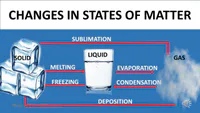
Matter- Changes of State

Presentation
•
Science
•
6th - 8th Grade
•
Easy
+1
Standards-aligned

David Wolf
Used 2+ times
FREE Resource
16 Slides • 27 Questions
1
Multiple Choice
What is the main cause of any change of state?
Gaining thermal energy
Thermal energy stays the same
Gaining or losing thermal energy
Losing thermal energy
2

< Back
Next >
Preview
Main
3
Match
Match the term with the their proper definition
Solid
Liquid
Gas
Fixed shape and volume.
No fixed shape but a fixed volume.
No fixed shape or size
Fixed shape and volume.
No fixed shape but a fixed volume.
No fixed shape or size
4
Multiple Choice
Which property is true of a crystalline solid?
Its particles have a regular, repeated pattern.
Its particles have no pattern.
Its particles are spread out and can flow past each other.
Its particles are so far apart, they can spread in a container.
5
Reorder
Water can occur as liquid water, water vapor, or ice. The water molecules move at different speeds when they are in each state. Reorder them from fastest to slowest.
water vapor
liquid water
ice
6


< Back
Next >
Preview
Main
Melting: Solid to Liquid
•
add heat energy to
sold
•
• melting point- temp.
of change from a
solid to a liquid
Item
Item
Item
7
Multiple Choice
For a solid to change to a liquid, heat must be __________ .
Added
Removed
8
Multiple Choice
9
Multiple Choice

Which number is melting?
8
9
10
11
10


< Back
Next >
Preview
Main
Evaporation
• Evaporation is the change of
state from a liquid to a gas.
•
11
Match
Match the arrangement to the state of matter
Solid
Gas
Liquid
Plasma
Solid
Gas
Liquid
Plasma
12
Multiple Choice
A change of state from a liquid to gas is called....
13
Multiple Choice
When you add or remove heat to an object, you are adding or removing _________.
Mass
Energy
Volume
Matter
14

< Back
Next >
Preview
Main
Freezing: Liquid to Solid
• the change of state
From a liquid to a solid.
• Freezing point- temperature at which
• a liquid changes into a solid
• For a liquid to freeze, energy must be
removed from the liquid to slow the
movement of the particles.
15
Multiple Choice
If you have a sample of water that is 44 °C, what state is it in?
solid
liquid
gas
16
Multiple Choice
17
Multiple Choice
18


< Back
Next >
Preview
Main
Boiling
change of a liquid to a vapor, or gas.
Boiling point - temperature at which this
change happens
Water boils
more easily
if the atmospheric
pressure is lower.
19

< Back
Next >
Preview
Main
Boiling
Point

20

< Back
Next >
Preview
Main
Condensation: Gas to Liquid
energy must be removed to slow the
movement of the particles.
• Condensation and evap. are reverse of each
other.
• condensation point- temp. when gas becomes
liquid.
•

21
Multiple Choice
Which number is condensation?
8
9
10
11
22
Multiple Choice
A change of state from a liquid to a solid is called....
23


< Back
Next >
Preview
Main
Sublimation: Solid directly to Gas
particles must go from being very tightly packed to
being spread far apart.
solid must gain energy for particles to overcome their
attractions.
24
Multiple Choice

Dry ice is an example of what phase change.
freezing
melting
vaporization/boiling
sublimation
25
Multiple Choice
Do particles (or the atoms) in a substance ever stop moving?!
No
Yes
26
Multiple Choice
When a substance changes from a liquid to a solid, this is called...
Melting
Evaporation
Condensation
Freezing
27
Multiple Choice
When surface particles of a solid gain enough energy that they form a gas.
melting point
evaporation
condensation
sublimation
28


< Back
Next >
Preview
Main
Sublimation- Other Examples
Mothball- Napthalene and
camphor - (Vick's vap-o-rub
29


< Back
Next >
Preview
Main
Temperature and Changes of State
• When a substance is undergoing a
change of state, its temperature
does not change until the change of
state is complete.
• E.g. the temp of a water won’t rise
above zero C until all the ice is
melted.
30


< Back
Next >
Preview
Main
31
Multiple Choice
Condensation happens when a gas gets...
hotter
cooler
32
Multiple Choice

On a hot, humid summer day drops of water form on a can of cold soda. What process caused this to happen?
condensation
freezing
vaporization
deposition
33
Multiple Choice
Vaporization that tales place only on the surface of a liquid is called?
evaporation
vaporization
condensation
boiling
34
Multiple Choice
At which number is condensation happening?
8
9
10
11
35
Multiple Choice

What phase of matter exists in part C of the graph?
Gas
Liquid
Solid
Plasma
36
Multiple Choice
What phase of matter exists in part D of the graph?
Gas
Liquid
Solid
Plasma
37


< Back
Next >
Preview
Main
38


< Back
Next >
Preview
Main
39

< Back
Next >
Preview
Main
Specific Heat
the amount of energy required to raise the
temperature of 1 gram of a substance by 1 °
C.
different substances have diff. specific heats
b/c size, mass, attractions, and
arrangements of their atoms or molecules
are different.
40


< Back
Next >
Preview
Main
41
Multiple Choice
Which has a higher specific heat: water or metal?
air
metal
water
wood
42
Multiple Choice
The unit for specific heat is
J
J/gC
g
°C
43


< Back
Next >
Preview
Main
Changes of state- summary
• change of state
• a physical change
• No chemical reaction.
• Changes of state
• melting, freezing, evaporation,
condensation, and sublimation
• All change of state involves gain or loss of
energy
Reversible
What is the main cause of any change of state?
Gaining thermal energy
Thermal energy stays the same
Gaining or losing thermal energy
Losing thermal energy
Show answer
Auto Play
Slide 1 / 43
MULTIPLE CHOICE
Similar Resources on Wayground

37 questions
Elements of the Earth
Presentation
•
5th - 8th Grade
37 questions
Substances and Mixtures
Presentation
•
6th - 9th Grade
36 questions
Levels of Organization - Cells to Biome
Presentation
•
KG
34 questions
Calculating Density
Presentation
•
6th - 8th Grade
38 questions
20.3 Energy in Ecosystems
Presentation
•
6th - 8th Grade
37 questions
Virtual Lab Assignment (Physical and Chemical Changes)
Presentation
•
6th - 8th Grade
36 questions
Ecological Succession & Human Impact on Ground&Surface water
Presentation
•
7th Grade
36 questions
Relationships in the Universe
Presentation
•
6th - 8th Grade
Popular Resources on Wayground
6 questions
PRIDE Always and Everywhere
Presentation
•
12th Grade
20 questions
Lab Safety Quiz

Quiz
•
6th Grade
26 questions
KOR Review Kahoot Questions
Quiz
•
8th Grade
21 questions
Continents and Oceans
Quiz
•
6th Grade
12 questions
Unit Zero lesson 2 cafeteria
Presentation
•
9th - 12th Grade
20 questions
Parts of Speech
Quiz
•
5th Grade
10 questions
Riddles Riddles fun Riddles
Quiz
•
6th - 12th Grade
16 questions
Subject & Predicate
Quiz
•
5th Grade
Discover more resources for Science
20 questions
Lab Safety Quiz
Quiz
•
6th Grade
20 questions
Lab Safety
Quiz
•
5th - 8th Grade
20 questions
Scientific Method and Variables
Quiz
•
8th Grade
20 questions
Scientific method and variables
Quiz
•
8th Grade
27 questions
Counting Atoms - Subscripts
Quiz
•
8th Grade
10 questions
6.6D - Relative Density Review
Quiz
•
6th Grade
10 questions
Scientific Method and Variables
Quiz
•
6th Grade
14 questions
Science Variables
Quiz
•
7th Grade