
US Involvement in WWII

Presentation
•
Social Studies
•
8th Grade
•
Medium

Anna Moore
Used 4+ times
FREE Resource
14 Slides • 6 Questions
1
SS8H9a
I can describe key events leading up to American involvement in World War II, including the Lend-Lease Act and the bombing of Pearl Harbor.


2
The End of WWI
The Treaty of Versailles ended WWI
This angered Germany, Austria & Hungary as it blamed them for starting WWI and they were forced to pay reparations
these reparation payments made economic hardships within these nations worse


3
Open Ended
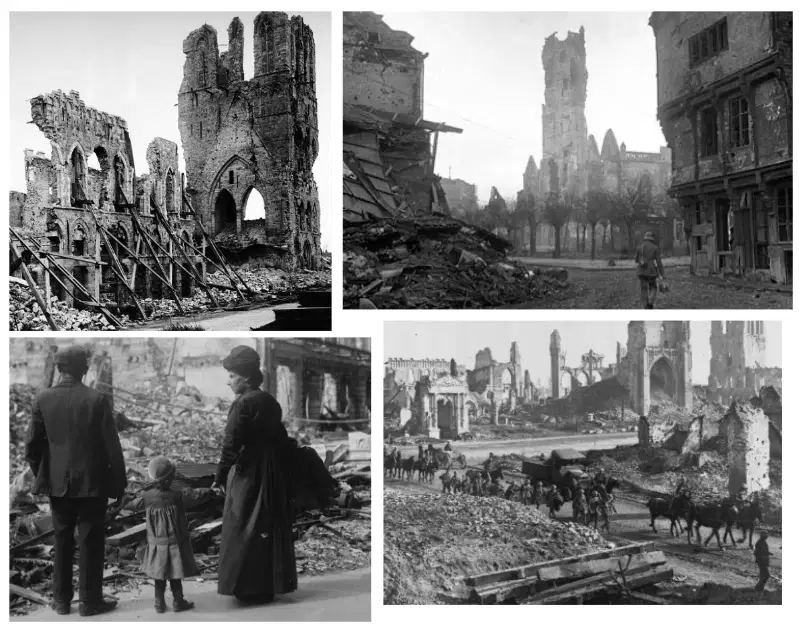
Look at these pictures of Europe after WWI.
What do you notice??
4
The End of WWI
WWI devastated Europe & European nations suffered from
deaths of million of soldiers and civilians
damage and destruction to factories and infrastructure, like roads, railways, airports, & power plants
lack of money to rebuild
Many Europeans were out of work and the production of goods slowed down, which in turn slowed trade


5
Post-WWI
The Great Depression that hit the United States in the 1920s & 1930s also struck Europe hard
banks failed, countries that relied on U.S. loans suffered, and trade declined
European nations were dealing with WWI debt, protectionist policies that were meant to eliminate foreign economic competition, & other political and economic instability
In an attempt to help, many European governments printed more money, which did NOT help!
caused inflation and made the financial situation worse
Japan also suffered economically and blamed the U.S. & European nations


6
Post-WWI
Fascist leaders emerged in Europe & Asia and appealed to the fear of desperate citizens
citizens wanted these leaders to solve their problems and bring their countries out of economic depression
Adolf Hitler in Germany, Benito Mussolini in Italy, Joseph Stalin in the Soviet Union, and Hideki Tojo in Japan
These leaders not only blamed previous government officials for their decisions, but also blamed other nationalities & ethnicities for their current financial crisis
Hitler, Mussolini, & Tojo promoted extreme nationalism, where they held up their own nation's race as superior
led to human rigths violations & leaders used military might & aggression to expand their nation's agenda and power


7
Multiple Choice
Which event did NOT lead to the rise of fascist leaders in Europe and Asia?
global depression caused by economic hardships
citizens blamed fascists for their problems
struggling citizens turned to fascists to solve their problems
fascists convinced citizens that they had the right answers & could help
8
Multiple Choice
How did fascist leaders expand their power?
they promoted nationalism and used military might and aggression
they engaged with people through religion
they had support from other foreign leaders
9
Start of World War II
As fascist leaders came to power & spread their nationalistic beliefs, racial and political tensions increased in Europe and around the world
WWII began on September 1, 1939, when Germany, under Hitler's rule, invaded Poland
The sides of WWII
Axis Powers - Germany, Italy & Japan
Allied Powers - Great Britain, France, Poland, Canada (& later on the Soviet Union and U.S.)
The Soviet Union originally signed an agreement to side with Germany, but when Germany invaded them in 1941, they joined the Allied Powers


10
The U.S. at the start of WWII
At first, the U.S. held the isolationist belief that the war was between foreign nations & was a European problem
As the war grew, the U.S. worked to provide support to the Allies without getting involved itself
However, as the U.S. watched Hitler's military sweep across Europe & invade country after country, it realized it could not remain uninvolved
Great Britain's Prime Minister, Winston Churchill, worried Germany would soon invade Great Britain
he asked the U.S. for needed supplies and to help defend against a German attack


11
Multiple Choice
Did the United States want to get involved in WWII when it first started?
Yes
No
12
The Lend-Lease Act
On March 11. 1941, U.S. Congress passed the Lend-Lease Act
this allowed President Roosevelt to lend and lease weapons, supplies & equipment to any country whose defense was ciritical to U.S. security
gave Britain & the Allied Powers more than $50 billion in supplies, including ammunition, tanks, airplanes & food
Through this aid, Rosevelt hoped to help win the war against the Axis Powers without committing U.S. troops to fight in Europe
Reasons Roosevelt & Congress passed the Act:
to protect trade with European nations
help the Allies win the war
to give the U.S. time to prepare its military & areseal for war


13
Results of the Lend-Lease Act
Churchill and other leaders of the Allied Powers believed they also needed the support of the U.S. military in order to win against the Axis Powers, BUT the U.S. was not ready yet
The Lend-Lease Act bought the U.S. some time to prepare for the war at home, in Europe, and in the Pacific
Preparing for war at home/in the U.S.:
factories converted to produce warplanes and warships
military facilities were built to train new recruits
President Roosevelt established the first peacetime draft
Over 16 million men between the ages of 21 and 35 were required to register for military service


14
Results of the Lend-Lease Act
Preparing for war in Europe:
the United States gave 50 U.S. warships to Great Britain in exchange for permission to build U.S. military bases on several British islands
the United States established bases on Greenland and Iceland to protect U.S. trade ships from German submarine attacks
the United States gave U.S. ships permission to fire if threatened by German submarines
Preparing for war in the Pacific:
the U.S. helped China in its struggle against Japan
the U.S. stopped selling war materials such as iron, steel, and oil to Japan
the U.S. sent more troops to U.S. military bases in the Philippines
the U.S. established a navy in the Pacific and positioned its naval base at Pearl Harbor in Hawaii


15
Multiple Choice
Which is NOT true of the Lend-Lease Act?
it helped to send weapons, supplies & equipment to Great Britain
Roosevelt hoped it would prevent U.S. troops from having to fight in Europe
it helped to give the U.S. more time to prepare for the possibility of entering WWII
it was meant to provide aid to the Axis Powers, specifically Japan & Germany
16
Japan Attacks Pearl Harbor
The U.S. and Japan had ongoing tensions due to their rivalry over control of the Pacific Islands & the U.S. trying to help China by sending them aid and putting embargoes on Japan
In the early years of WWII, Roosevelt decided to move the U.S. Navy's Pacific Fleet to the Pearl Harbor naval base
this caused Japan to feel threatened
even though the U.S. was still neutral, since it had more resources & manpower, Japan planned to strike quickly and without warning
On December 7, 1941, Japanese bombers attacked Pearl Harbor
more than 2,000 American were killed & the military lost 8 battleships, 13 other ships & 188 airplanes


17
Japan Attacks Pearl Harbor
After the attack on Pearl Harbor, most Americans were united in support of going to war and no longer saw the war as a European problem.
On December 8th, 1941, one day after the bombing of Pearl Harbor, President Franklin D. Roosevelt made a speech to both houses of Congress in which he called Pearl Harbor an attack that “will live in infamy.”
In that speech, as a direct result of the attack, President Roosevelt asked Congress to declare war on Japan, which it did.
The U.S. was no longer neutral!
On December 11th, 1941, four days after the attack, Germany and Italy declared war on the U.S.
Isolationism had not worked—the U.S. was at war in both Europe and Asia.

18
Multiple Choice
What event led to the U.S. entering WWII?
the Treaty of Versailles
the passing of the Lend-Lease Act
some Europeans nations had fascist leaders or dictators
the bombing of Pearl Harbor
19
The U.S. Enters WWII
After joining the war in 1941, the U.S. sent troops to fight the war on both the Atlantic & Pacific Fronts
The leaders of the United Kingdom, the United States, and the Soviet Union became the leaders of the Allied Powers and were known as the “Big Three.”
Those leaders included President Franklin D. Roosevelt and later President Harry Truman of the U.S.; Prime Minister Winston Churchill of Great Britain; and General Secretary Joseph Stalin of the Soviet Union.
The Axis Powers had been winning before the Soviet Union and the U.S. joined the war, but soon the Allied Powers, led by the “Big Three” turned the tide.


20
The U.S. Enters WWII
Every person in the U.S. was impacted by WWII & was aksed to sacrifice resources, goods, and services in the name of the war effort
men ages 21-35 were required to register for the draft to help fight
women took wartime jobs in factories, volunteered with the Red Cross & many signed up for military service even though they could not see combat
most faced scarcity as factories stopped normal productions to focus on supplies to help the military instead


SS8H9a
I can describe key events leading up to American involvement in World War II, including the Lend-Lease Act and the bombing of Pearl Harbor.
Show answer
Auto Play
Slide 1 / 20
SLIDE
Similar Resources on Wayground

16 questions
When People Rebel
Presentation
•
8th Grade
13 questions
Lesson 2.5.2 - Life During the Civil War
Presentation
•
8th - 9th Grade
13 questions
5 Themes of Geography
Presentation
•
7th - 8th Grade
14 questions
Freedom Week
Presentation
•
8th Grade
18 questions
March on Washington and Lester Maddox
Presentation
•
8th Grade
14 questions
Ancient Greece Democracy
Presentation
•
8th Grade
18 questions
New South - Tom Watson and Populist Party
Presentation
•
8th Grade
18 questions
Early Republic and Jackson Review
Presentation
•
8th Grade
Popular Resources on Wayground
21 questions
Continents and Oceans

Quiz
•
6th Grade
20 questions
Parts of Speech
Quiz
•
5th Grade
16 questions
Subject & Predicate
Quiz
•
5th Grade
25 questions
Multiplication Facts
Quiz
•
5th Grade
12 questions
Map Skills
Quiz
•
3rd Grade
22 questions
Continents and Oceans
Quiz
•
5th Grade
15 questions
Rounding Decimals
Quiz
•
5th Grade
20 questions
Brand Labels
Quiz
•
5th - 12th Grade
Discover more resources for Social Studies
10 questions
Exploring the Age of Exploration: Key Events and Figures

Interactive video
•
6th - 10th Grade
10 questions
Causes of the American Revolution
Quiz
•
8th Grade
15 questions
Historical Inquiry Vocab Quiz
Quiz
•
6th - 8th Grade
19 questions
Influencing Govt (Interest Groups-Media)
Quiz
•
6th - 8th Grade
10 questions
Declaration of Independence
Presentation
•
8th Grade
5 questions
Articles of Confederation Video
Interactive video
•
8th Grade
8 questions
Notes: Argumentative Writing
Presentation
•
7th - 8th Grade
13 questions
American Revolution Review
Quiz
•
8th Grade