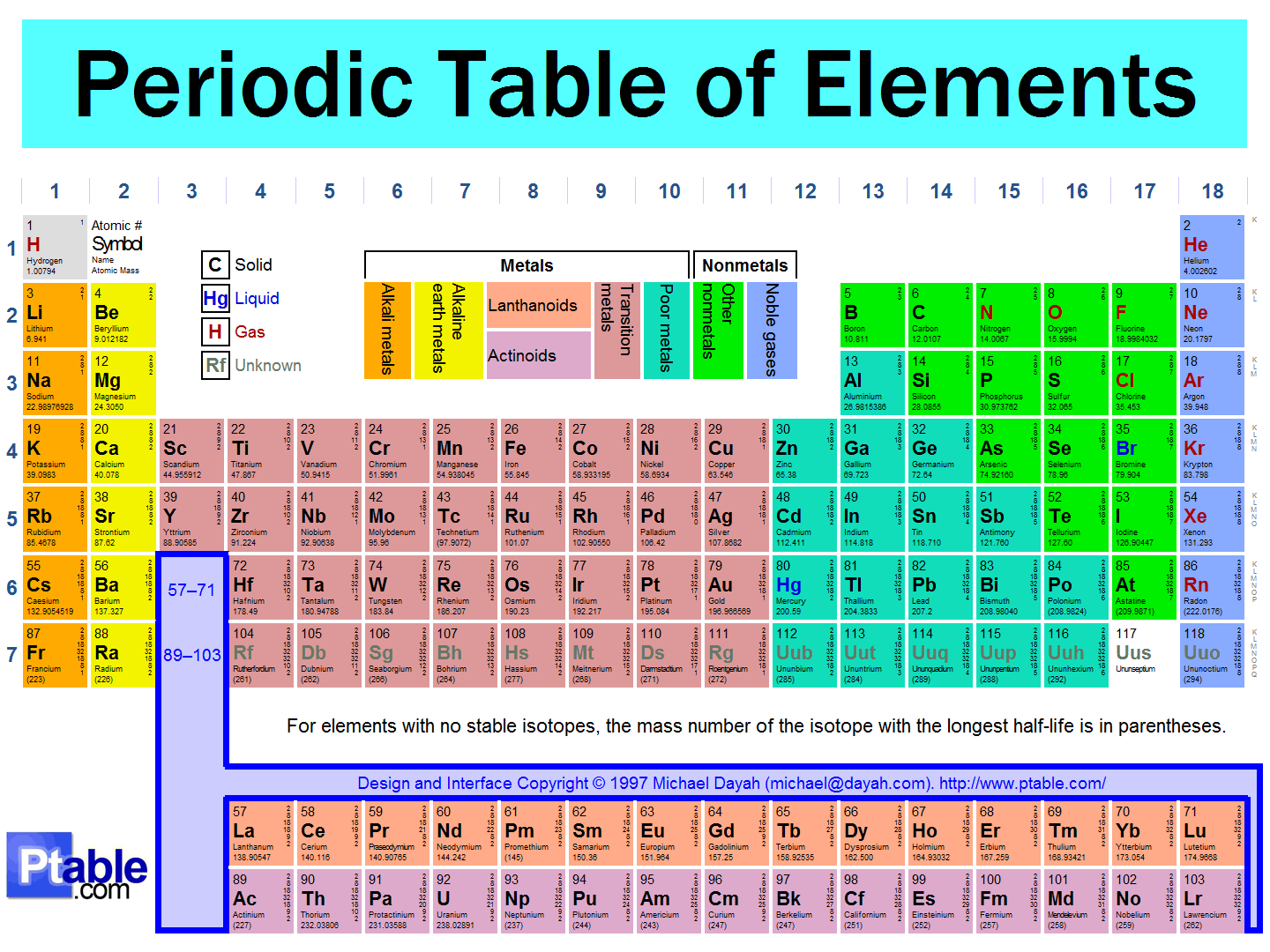
HISTORY OF THE PERIODIC TABLE
Presentation
•
Chemistry
•
7th Grade
•
Medium
+3
Standards-aligned

Janice Taylor
Used 3+ times
FREE Resource
28 Slides • 51 Questions
1
2
3
4
5
6
7
Multiple Choice
8
Multiple Choice
The idea of "triads" of elements with similar properties was due to
John Newlands
Johann Dobereiner
Dmitri Mendeleev
Henry Moseley
9
Multiple Choice
In a chemical "triad", the masses of the three elements were related by the fact that
the masses of the three were all the same
their masses added up to 100%
the average of the masses of the outer two equaled the middle one
their masses were all unknown
10
Multiple Choice
Which of the following groups of elements could NOT be a triad?
Cl, Br, I
C, N, O
Li, Na, K
Ca, Ba, Sr
11
Multiple Choice
The "Law of Octaves" was the brainchild of
Glenn Seaborg
Lothar Meyer
Johann Dobereiner
John Newlands
12
Multiple Choice
The "Law of Octaves" stated that
The properties of the elements repeated every eighth element when arranged by their atomic mass
Elements could be classified in groups of three based on their mass and properties
The properties of the elements repeated of a regular basis when arranged by their atomic number
doubling the frequency of a tone raises its pitch by an octave
13
Multiple Choice
Which of the following is NOT a reason that the law of octaves failed?
It didn't work for elements past calcium
There was no provision for undiscovered elements
It didn't explain similar properties of any elements
Elements with very dissimilar properties were put into the same column
14
15
16
17
18
19
20
21
22
Multiple Choice
23
Multiple Choice
24
Multiple Choice
25
Multiple Choice
26
Multiple Choice
The first usable modern periodic table was developed by
Dmitri Mendeleev
Glenn Seaborg
John Newlands
Johan Dobereiner
27
Multiple Choice
Which of the following was NOT a reason that Mendeleev was given credit for the first periodic table rather than Lothar Meyer?
Mendeleev published first
Meyer didn't leave spaces for undiscovered elements
Mendeleev corrected the mass of many elements
Mendeleev classified anomalous elements by their properties rather than their mass
28
29
30
31
32
Multiple Choice
33
Multiple Choice
Why was Henry Moseley responsible for solving the mystery of the anomalous elements on the periodic table?
He corrected the mass of those elements
He corrected the properties of those elements
He discovered the electron
He discovered atomic number
34
Multiple Choice
Who proposed the Law of Octaves?
Lothar Meyer
Henry Moseley
John Newlands
Dmitri Mendeleev
J.J. Thomson
35
Multiple Choice
Which scientist organized the periodic table by atomic number?
Mendeleev
Moseley
Dobereiner
Seaborg
Dalton
36
Multiple Choice
Which scientist is known for the Law of Triads?
Mendeleev
Moseley
Dobereiner
Seaborg
Rutherford
37
Multiple Choice
Who is the Father of Periodic Table of Elements?
Lothar Meyer
Dmitri Mendeleev
John Newlands
Henry Moseley
38
Multiple Choice
Who discovered the Law of Octaves?
Henry Moseley
Lothar Meyer
Antoine Lavoisier
John Newlands
39
Multiple Choice
He published a table of the elements organized by increasing atomic mass.
Dmitri Mendeleev
Lothar Meyer
John Newlands
Henry Moseley
40
Multiple Choice
Why were there blank spaces left in Mendeleev's periodic table?
He didn't know what to put there.
Undiscovered elements not yet known.
Multiple elements could have fit
He forgot to add the elements in
41
Multiple Choice
Dmitri Mendeleev arranged the 63 known elements at the time by __________________.
atomic number
atomic mass
neutron number
none of the above
42
Multiple Choice
What significant change did Glenn Seaborg propose for the Periodic Table?
Introducing the Actinide series
Removing the Lanthanide series
Rearranging the transition metals
Adding a new group for noble gases
43
Multiple Choice
Which element is the first after Actinium in the Actinide series?
Thorium (Th)
Protactinium (Pa)
Uranium (U)
Neptunium (Np)
44
Multiple Choice
Who is credited with the formulation of the modern periodic law?
Henry Moseley
Lothar Meyer
John Newlands
Dmitri Mendeleev
45
Multiple Choice
A) Ernest Rutherford
B) J.J. Thomson
C) John Dalton
46
47
48
49
50
51
52
53
54
55
Multiple Choice
56
Multiple Choice
In the modern periodic table elements are arranged by:
atomic mass
atomic number
valence electrons
number of isotopes
57
Multiple Choice
A row in the periodic table is called a _________
Period
Group
Element
Pillar
58
Multiple Choice
A column in the periodic table is called a _________
Period
Group
Element
Pillar
59
Multiple Choice
Each box in the periodic table represents _________________
An isotope
An ion
A period
An element
60
Multiple Choice
The "properties" of a material are...
...its characteristics, features, and behaviour.
...what the material owns.
...only what it looks like.
...only how it behaves in certain situations.
61
Multiple Choice
A _____________ property is how a substance behaves when it undergoes a chemical change, e.g. its flammability or pH.
physical
major
chemical
periodic
62
Multiple Choice
A _______________ property is how a substance behaves when it undergoes a physical change, e.g. its density or boiling point.
physical
chemical
major
periodic
63
Multiple Choice
The mass number (or "atomic weight") is sometimes called the _________________ (they are the same thing!).
weight number
heavy number
relative number
relative atomic mass
64
Multiple Select
The atomic number is...
(you can tick more than one)
the number of protons
the number of electrons
the number of neutrons
the number of atoms
65
Multiple Choice
66
Multiple Choice
The modern periodic table is arranged by ____
atomic mass
atomic number
ion charges
number of isotopes
67
Multiple Choice
The vertical (up and down) columns in the periodic table are called
groups
towers
periods
atomic numbers
68
Multiple Choice
The horizontal (side to side) rows in the periodic table are called
groups
families
periods
atomic numbers
69
Multiple Choice
Which two elements are in the same period?
boron (B) and lithium (Li)
beryllium (Be) and calcium (Ca)
phosphorus (P) and oxygen(O)
boron (B) and phosphorus (P)
70
Multiple Choice
The scientist ____ is credited with the idea of arranging the elements in the periodic table according to their physical and chemical properties.
Mendeleev
Dobereiner
Newlands
Dalton
71
Multiple Choice
Mendeleev predicted that the empty spaces in his periodic table represented ____.
isotopes
radioactive elements
permanent gaps
undiscovered elements
72
Multiple Choice
Why did Dmitri Mendeleev leave spaces i his periodic table?
He left spaces for undiscovered elements.
He left spaces for discovered elements.
He left spaces to be more organized.
none of the above
73
Multiple Choice
The modern periodic table is organized by the number of __________ atomic number.
decreasing
increasing
constant
74
Multiple Choice
According to Newlands' arrangement, which element is listed 8th?
Oxygen (O)
Fluorine (F)
Sodium (Na)
Magnesium (Mg)
75
Multiple Choice
What pattern did Newlands observe in the properties of elements?
They were random
They repeated every 8th element
They increased linearly
They decreased exponentially
76
Multiple Choice
How did Lothar Meyer's periodic table differ from Mendeleev's?
It included noble gases
It was arranged alphabetically
It was based on atomic volumes
It was based on atomic numbers
77
Multiple Choice
What was Henry Moseley's major contribution to the Periodic Table?
He arranged elements by atomic number instead of atomic mass
He introduced the concept of electron shells
He discovered the noble gases
He proposed the Actinide series
78
Multiple Choice
What is the atomic weight of Beryllium (Be) according to Mendeleev's Periodic Table?
9.4
10
11
12
79
Show answer
Auto Play
Slide 1 / 79
SLIDE

Similar Resources on Wayground
72 questions
Louisiana Territorial Period & Statehood
Presentation
•
7th Grade
72 questions
English 7 - Term 2
Presentation
•
7th Grade
76 questions
Math Expression Equations and Inequalities
Presentation
•
7th Grade
74 questions
A Trip Through Earth's History - Recap
Presentation
•
6th - 8th Grade
71 questions
The earth
Presentation
•
7th Grade
75 questions
SS6CG3: European Governments
Presentation
•
6th Grade
75 questions
Unit 1 Test Review - Piecewise Functions
Presentation
•
KG
72 questions
30% Evaluation
Presentation
•
7th Grade
Popular Resources on Wayground
20 questions
Math Review
Quiz
•
3rd Grade
15 questions
Fast food
Quiz
•
7th Grade
20 questions
Context Clues
Quiz
•
6th Grade
20 questions
Inferences
Quiz
•
4th Grade
19 questions
Classifying Quadrilaterals
Quiz
•
3rd Grade
20 questions
Figurative Language Review
Quiz
•
6th Grade
20 questions
Equivalent Fractions
Quiz
•
3rd Grade
10 questions
Identify Fractions, Mixed Numbers & Improper Fractions
Quiz
•
3rd - 4th Grade
Discover more resources for Chemistry
15 questions
Fast food
Quiz
•
7th Grade
10 questions
Candy
Quiz
•
4th - 8th Grade
10 questions
Fact Check Ice Breaker: Two truths and a lie
Quiz
•
5th - 12th Grade
10 questions
Memorial Day History and Traditions
Interactive video
•
5th - 8th Grade
14 questions
Volume of rectangular prisms
Quiz
•
7th Grade
15 questions
Middle School Fun Trivia Questions
Quiz
•
7th - 8th Grade
22 questions
Simple Probability
Quiz
•
7th Grade
10 questions
Video Games
Quiz
•
6th - 12th Grade