

THUSDAY_Jan.30_Structures and functions of organisms

Presentation
•
Science
•
4th Grade
•
Practice Problem
•
Hard
+5
Standards-aligned

Jamie Jackson
FREE Resource
21 Slides • 0 Questions
1


1
Do Now
Scientists working in a cold, arctic
environment find fossils of plant
leaves. The leaves are similar to
the palm trees we see on Earth
today. How was this environment
probably different in the past than
it is now? Explain your reasoning.
2


2
Interactions in Ecosystems
LO: SWBAT use fossils to describe
the relationship between the structures
and functions of organisms and the
organisms' past environments.
DOL: Given scenarios, SW correctly use fossils to describe
the relationship between the structures and functions of
organisms and the organisms' past environments in at
least 4 of 5 questions.
SCI.4.12C Identify and describe past environments based on fossil evidence, including common Texas fossils.
SEPs 4.3A
RTCs 4.5A, 4.5B
3

3
Lesson Vocabulary
fossil
imprint
paleontologist
4


4
Fossil
The remains of an
organism, plant, or
animal, that lived long
ago
Image by TheUjulala from Pixabay
5


5
Imprint
A mark made by
pressing on a surface
6


6
Paleontologist
A scientists who
studies fossils to learn
about the history of life
on Earth
7


4th Grade Science
Interactions in Ecosystems
Lesson 9
January 29, 2025
8

8
Essential Understandings &
Guiding Questions
What can fossils tell us about the past?
9


9
Imagine you are a scientist who discovered a fossilized
shark tooth in a desert.
What does that tell you about the desert’s past?
10


10
How do fossils provide clues to the past?
Predict how scientists use fossils to learn
about life long ago.
As you read, look for information about
how fossils form and what we learn from
studying fossils.
Explain why fossils are sometimes found
in environments that are different from
where the organisms once lived.
11


Copyright © Savvas Learning Company LLC. All Rights Reserved. Savvas is not responsible for any modifications made by end users to the content posted in its original format.
Which environment did these organisms probably live in?
a rainforest
an ocean
a desert
Fossils
12


Copyright © Savvas Learning Company LLC. All Rights Reserved. Savvas is not responsible for any modifications made by end users to the content posted in its original format.
Compare and contrast the two examples of fossils.
A fossil is the preserved remains of a living thing from long ago. Fossils
can form from an imprint, or a mark made by pressing on a surface.
Photo credit: Nuntiya/Shutterstock; Michal Ninger/Shutterstock
13



Copyright © Savvas Learning Company LLC. All Rights Reserved. Savvas is not responsible for any modifications made by end users to the content posted in its original format.
Remains of Living Things
This is a fossil of ichthyosaurus, which
no longer exists on Earth. What are
some questions you would ask about
this animal and where it lived?
Sample questions:
Did this animal live in water?
Did this animal live on land?
What did this animal eat?
When did this animal exist?
Photo credit: frantic00/Shutterstock
14


14
Organism structures and functions
Organisms have specific structures that allow them to survive in their environment.
This is also true for organisms that lived in the past.
Fossil structures are directly related to the
functions that helped the organism survive. This
provides clues on what the environment was like in
the past and how it may have changed over time.
If a fern fossil is found in a desert, what
can it tell us about the past environment?
15


Copyright © Savvas Learning Company LLC. All Rights Reserved. Savvas is not responsible for any modifications made by end users to the content posted in its original format.
What do fossils tell us about past organisms?
Studying fossils helps scientists
understand how organisms lived and
interacted with each other and their
environment.
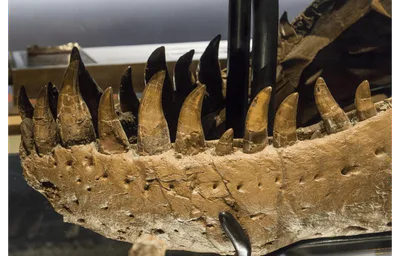
Fossils can show what organisms’
body parts may have looked like.
Photo credit: Jeff Lepore/Science Source
16




Copyright © Savvas Learning Company LLC. All Rights Reserved. Savvas is not responsible for any modifications made by end users to the content posted in its original format.
Past Organisms
Teeth fossils tell us about the type of food
past organisms ate.
●Predict which organism ate plants and
which ate animals.
●Explain your reasoning.
Organism A ate plants because the flat
teeth look like they are good for chewing
and grinding down grass and other plants.
Organism B ate meat because the teeth
are sharp and can be used for capturing
prey and tearing the food.
A
B
Photo credit: Bascar/Shutterstock; Gabbro/Alamy Stock Photo
17


17
Imagine you are a scientist who discovered a fossilized
shark tooth in a desert.
What does that tell you about the desert’s past?
18


18
A fossilized skeleton of an animal has sharp claws and sharp teeth. Did this
animal likely eat mostly plants or mostly animals? Explain your reasoning.
Past environments
19


19
Analyze Fossils
Look at the fossilized remains of each organism. Match each organism to the choice
that best describes it.
1
2
3
walked on land
climbed trees
swam in the ocean
20

20
DOL: Given scenarios,
SW correctly use
fossils to describe the
relationship between
the structures and
functions of
organisms and the
organisms' past
environments in at
least 4 of 5 questions.
Demonstration of Learning
21

●Some images used in this lesson are taken from Adobe Stock. Adobe Stock
https://stock.adobe.com
●Some images used in this lesson are taken from Great Minds. Great Minds
https://digital.greatminds.org
●Some images used in this lesson are taken from SAVVAS realize. SAVVAS
realize https://www.savvasrealize.com
21
Copyright for Reference
1
Do Now
Scientists working in a cold, arctic
environment find fossils of plant
leaves. The leaves are similar to
the palm trees we see on Earth
today. How was this environment
probably different in the past than
it is now? Explain your reasoning.
Show answer
Auto Play
Slide 1 / 21
SLIDE
Similar Resources on Wayground

15 questions
Resources
Presentation
•
4th - 5th Grade
16 questions
Properties of Matter
Presentation
•
4th Grade
16 questions
The Theory of Evolution
Presentation
•
8th Grade
17 questions
Constellation & Tools
Presentation
•
4th Grade
14 questions
THE SOLAR SYSTEM
Presentation
•
4th Grade
14 questions
Landforms
Presentation
•
4th Grade
18 questions
The Solar System
Presentation
•
4th Grade
15 questions
5th Grade Earth Science Standards Review
Presentation
•
4th - 5th Grade
Popular Resources on Wayground
10 questions
How much do you know about our Portrait of an Eagle?

Quiz
•
10th Grade
10 questions
Fast Food Slogans
Quiz
•
6th - 8th Grade
21 questions
Continents and Oceans
Quiz
•
6th Grade
20 questions
Parts of Speech
Quiz
•
5th Grade
16 questions
Subject & Predicate
Quiz
•
5th Grade
25 questions
Multiplication Facts
Quiz
•
5th Grade
12 questions
Map Skills
Quiz
•
3rd Grade
22 questions
Continents and Oceans
Quiz
•
5th Grade
Discover more resources for Science
10 questions
Mixtures and Solutions
Quiz
•
4th Grade
20 questions
Force and Motion
Quiz
•
3rd - 4th Grade
14 questions
Scientific Method
Quiz
•
4th Grade
10 questions
Mixtures and Solutions
Quiz
•
4th Grade
10 questions
Identifying Physical and Chemical Changes

Interactive video
•
1st - 5th Grade
22 questions
Properties of Matter
Quiz
•
4th Grade
11 questions
Energy Transferring
Quiz
•
4th Grade
10 questions
Discovering the Properties of Matter
Interactive video
•
1st - 5th Grade