

Structure and bonding

Presentation
•
Other
•
KG
•
Practice Problem
•
Hard

Sadri Abdullah Said
FREE Resource
28 Slides • 0 Questions
1

Atomic structure and bonding
2

Learning outcomes
• At the end of this session the student shall be able to:
• Define organic chemistry
• Recognize sigma and pi bonds
• Draw Lewis and Kekule structures
• Describe structure of alkane, alkenes and alkynes based on
valence bond theory and molecular orbital theory
3

Atomic structure
• What is an atom?
• Atomic number?
• Mass number?
• What is an ion?
4

Atomic bonding
• Noble gas?
• Octet of electron?
• Valence shell/valence electrons?
• Ionic bonding?
• Covalent bonding?
• What is a bond? – (sharing of 2 electrons)
• What is valency?
• Double bond/triple bond?
5


Orbitals
• Quantum mechanics: consider electron as
a wave
• The wave equation give wave function
(Ψ) or Orbitals that represent the space
where electron spend most (~ 95%) of its
time
• Some of the orbitals are s, p, d, f, …..
• The shape of orbitals depends on energy
level
• s is spherical
• p have a dumbbell shape – (px, py and pz)
• Different shells have different numbers
and kinds of orbitals (Remember n, l, ml,
and ms)
6


Electronic configuration
• How do we find the ground state electron
configuration?
• Aufbau principle
• Pauli exclusion principle
• Hund’s rule
• Examples?
7


Electronic configuration
8

Chemical bonding
• Why atoms combine?
• Ionic bonding?
• Ionization energy? – electron affinity?
• Covalent bonding form molecules
Indicated by:
• Lewis (electrons dot) structures
• Kekule structure or line-bond structure
9


Covalent Bonds – valence bond theory
• Atomic orbitals overlap to form
molecular orbitals
• energy is released = bond strength
(H2 = 104 kcal/mol)
• distance for optimal overlap =
bond length (H2 = 0.74 A)
10


Sigma (σ) bonds
• Head-on overlap of s orbitals give
a bond with circular cross-section
• Such bond is called sigma ()
bond
11


pi (π) bonds
• The p orbital can achieve
• head-on overlap to form sigma bond
• OR sideway overlap to form a pi (π) bond
12


Structure of alkanes - sp3 hybridization
• Bonding in alkanes involves sp3hybrid orbitals
• combining an s orbital and three p orbitals give four degenerate sp3hybrid
orbitals
• They are oriented towards the corners of a tetrahedron
13

Representation of tetrahedral carbon
14

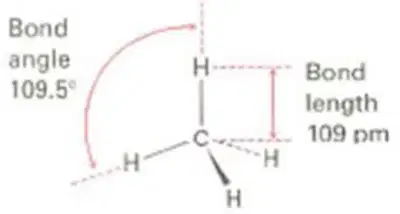
Structure of methane
• All four bond in methane are
identical
• Bond energy = 104 kcal/mol
• Bond length = 1.10 A (109 pm)
• Bond angle = 109.5o
(tetrahedral angle)
15


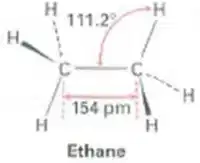
Structure of ethane
• Bonding involves
sp3hybrid orbitals
• C-H bonds = 98
kcal/mol
• C-C bond = 1.54 A
(154 pm) and 88
kcal/mol
• bond angle = 109.5o.
16


Structure of alkenes – sp2 hybridization
• Combination of s orbital with only 2 of the p orbitals gives three
degenerate sp2hybrids orbitals
• These orbitals lie in a plane at 120oto each other
• One 2p orbital remains unhybridized and lies perpendicular to the
sp2plane
17

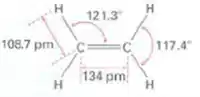
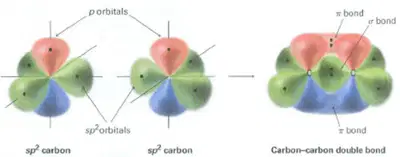
Structure of ethylene
• A double bond in
ethene is constituted of
a sigma bond due to
head-on overlap of sp2
orbitals and a pi bond
due to sideway overlap
of unhybridized p
orbitals
• Four hydrogen atoms
form sigma bonds with
the remaining four sp2
orbitals
18


Structure of alkynes – sp hybridization
• Combination of only one 2p orbital with the 2s orbital form two
degenerate sp hybrid orbitals
• The two sp orbitals are linear (180o) – the remaining 2p unhybridized
orbitals are perpendicular to the sp orbital
19


Structure of acetylene
• A triple bond in acetylene is composed of two pi bonds due to sideway
overlap of the unhybridized p orbitals and a head-on overlap of sp hybrid
orbitals.
• Two hydrogen atoms form sigma bonds with the remaining two sp orbitals
20

Comparison of bond length and strength
Molecule
Bond
Bond strength
(kcal/mol)
Bond length (Å)
Bond length
(pm)
Methane CH4
(sp3) C – H
104 (436 kJ/mol)
1.10
109
Ethane CH3CH3
(sp3) C – C
90 (376)
1.54
154
(sp3) C – H
101 (423)
1.10
109
Ethylene
H2C=CH2
(sp2) C = C
174 (728)
1.33
134
(sp2) C – H
111 (465)
1.076
109
Acetylene HC≡CH
(sp) C≡C
231 (965)
1.20
120
(sp) C– H
133 (556)
1.06
106
21


Hybridization of N, O, P and S
• In most cases they are sp3hybridized.
• Note P and S can form more than the typical number of covalent bonds
22


23


Molecular orbital theory
• Combination of two s-atomic orbitals results in formation of a pair of -
molecular orbitals
• One lower in energy – bonding MO
• The other is in higher energy – * antibonding MO
24

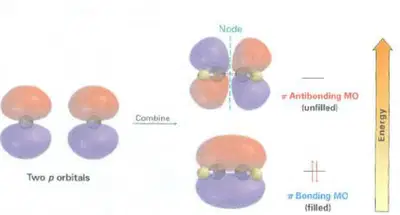
Molecular orbital theory
• Combination of two p-atomic orbitals results in the formation of
two π-molecular orbitals
25

Molecular representation
26


Molecular representations
• In organic chemistry molecules
are represented using
1.
Lewis (electron dot) structure
2.
Kekule (line bond) structure
• A correct representation shows
all valence electrons:
• In Lewis structures the e-s are
represented by dot while in
Kekule the bonded electrons
are represented by a line
(bond).
27

Molecular representations
• For a neat and tidy representation, we also
represent structures of organic compounds
using
1.
Condensed structure:
C-H and C-C bonds are not shown
2.
Skeletal structure:
• at each intersection of two lines and at the end of each line
there is carbon
• Hydrogen are mentally supplied to fill the valence of each
carbon
• All atoms other than carbon and hydrogen are indicated
28
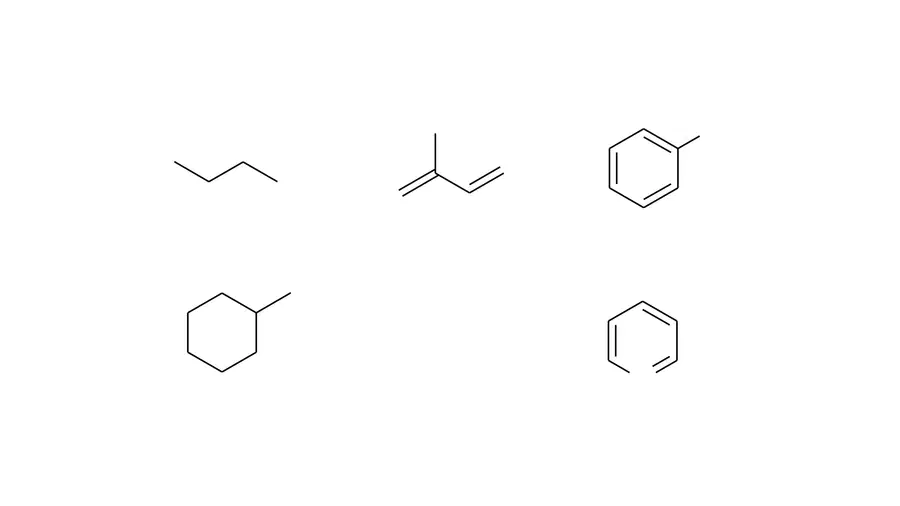
Skeletal structure examples
OH
N
butane
isoprene
Methylcyclohexane
Phenol
Pyridine
Atomic structure and bonding
Show answer
Auto Play
Slide 1 / 28
SLIDE
Similar Resources on Wayground

21 questions
The Nervous System
Presentation
•
7th Grade
21 questions
Reaction Rates
Presentation
•
9th - 12th Grade
21 questions
Editing and Omission
Presentation
•
7th - 8th Grade
21 questions
The Medicine Bag: Analyze Craft & Structure and Language
Presentation
•
8th Grade
22 questions
Paraphrasing
Presentation
•
10th Grade
22 questions
Skeletal and Muscular System
Presentation
•
6th - 8th Grade
20 questions
CORRELATIVE CONJUNCTIONS
Presentation
•
7th Grade - University
21 questions
Structures in Poetry & Drama
Presentation
•
6th - 8th Grade
Popular Resources on Wayground
10 questions
How much do you know about our Portrait of an Eagle?

Quiz
•
10th Grade
10 questions
Fast Food Slogans
Quiz
•
6th - 8th Grade
21 questions
Continents and Oceans
Quiz
•
6th Grade
20 questions
Parts of Speech
Quiz
•
5th Grade
16 questions
Subject & Predicate
Quiz
•
5th Grade
25 questions
Multiplication Facts
Quiz
•
5th Grade
12 questions
Map Skills
Quiz
•
3rd Grade
22 questions
Continents and Oceans
Quiz
•
5th Grade
Discover more resources for Other
10 questions
Movie Trivia
Quiz
•
KG - 2nd Grade
10 questions
Who is that Character?
Quiz
•
KG - 5th Grade
20 questions
Place Value
Quiz
•
KG - 3rd Grade
11 questions
NFL Football logos
Quiz
•
KG - Professional Dev...
11 questions
Seasons
Quiz
•
KG - 1st Grade
10 questions
Identifying equations
Quiz
•
KG - University
20 questions
Disney Characters
Quiz
•
KG
11 questions
Colors in Spanish - Los Colores
Quiz
•
KG - 2nd Grade