

ATAL_FDP_HPC_S6_OpenMP

Presentation
•
Computers
•
University
•
Practice Problem
•
Medium

Pushpendra Pateriya
Used 2+ times
FREE Resource
49 Slides • 5 Questions
1

Pushpendra Kumar Pateriya
Assistant Professor, Head of System Programming
School of Computer Science and Technology,
Lovely Professional University
2
Multiple Choice
Why is parallel programming needed in modern computing?
To replace all sequential programs
3

4
Moore's Law.
The chart tracks the progress of transistor integration, for Intel's devices, from 1960 to 2010.

5
Computer Architecture and the Power Wall

6
Partial solution: simple low power cores

7
Power calculation for analysis

8
Power consumption Analysis

9
Microprocessor trends

10
Concurrency vs. Parallelism
Concurrency: A condition of a system in which multiple tasks are logically active at one time.
Parallelism: A condition of a system in which multiple tasks are actually active at one time.

11
Concurrency vs. Parallelism

12
Multiple Choice
What is the key difference between parallel and concurrent execution?
Parallel execution happens simultaneously, while concurrent execution involves task switching.
Concurrent execution requires multiple processors.
13
The Parallel programming process:
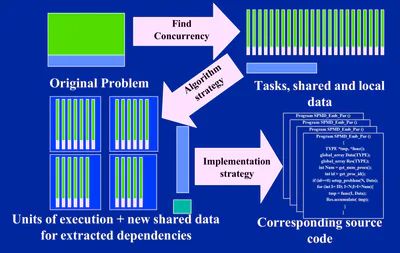
14
OpenMP Overview
Definition: OpenMP (Open Multi-Processing) is an API for parallel programming in C, C++, and Fortran.
Purpose: Enables shared-memory multiprocessing on multi-core and multi-threaded processors.
Components:
Compiler directives (#pragma omp ...)
Runtime library routines
Environment variables
Advantages:
Simplicity: Uses directives instead of rewriting code
Scalability: Works on multi-core architectures
Portability: Supported by most modern compilers
15
OpenMP Limitations
Works only for shared-memory architectures
Manual tuning required for performance optimization
Not suitable for all types of parallelism (e.g., distributed memory systems)
16
OpenMP Solution Stack

17
Single and Multithreaded Process

18
Programming shared memory computers

19
Programming shared memory computers

20
Multiple Choice
Which of the following statements is true regarding the stack, heap, text, and data segments in the context of threads?
21
A shared memory program
An instance of a program:
One process, multiple threads sharing a common address space.
Threads interact via shared memory using reads/writes.
OS scheduler interleaves thread execution for fairness.
Synchronization ensures correctness across all execution orders.

22
What will be the output of the following code?
int main()
{
int ID = 0;
printf(“ hello(%d) ”, ID);
printf(“ world(%d) \n”, ID);
}
23
Open Ended
What will be the output of following C program?
int main()
{
int ID = 0;
printf(“ hello(%d) ”, ID);
printf(“ world(%d) \n”, ID);
}
24
Modified Code

25
A multi-threaded “Hello world” program

26
Memory access time varies depending on the location of the data.
Memory is divided into "Near" and "Far" regions, where access to local (near) memory is faster than remote (far) memory.
Example: AMD EPYC processors with multiple interconnected memory regions.
Non-Uniform Memory Access (NUMA)
All processors have equal access time to the shared memory.
The operating system treats all processors identically.
Example: Intel Xeon-based servers with multiple CPUs sharing the same memory.
Symmetric Multiprocessor (SMP)
27
OpenMP Programming Model
Fork-Join Parallelism:
Master thread spawns a team of threads as needed.
Parallelism added incrementally until performance goals are met: i.e. the sequential program evolves into a parallel program.

28
Thread Creation: Parallel Regions
For example, To create a 4 thread Parallel region

29
Thread Creation: Parallel Regions

30
Exercise

31
Serial pi program

32
Write a parallel program
Create a parallel version of the pi program using a parallel construct.
Pay close attention to shared versus private variables.
In addition to a parallel construct, you will need the runtime library routines
int omp_get_num_threads(); // Number of threads in the team
int omp_get_thread_num(); //Thread ID or rank
double omp_get_wtime(); //Time in Seconds since a fixed point in the past
33
A simple Parallel pi program

34
Results

35
False sharing

36
Eliminate False sharing by padding the sum array

37
Results: pi program padded accumulator

38
Do we really need to pad our arrays?
Padding arrays requires a good understanding of how the cache works. If you switch to a computer with a different cache size, your program's performance may drop significantly.
39
How do threads interact?
OpenMP is a multi-threading, shared address model.
Threads communicate by sharing variables.
Unintended sharing of data causes race conditions:
race condition: when the program’s outcome changes as the threads are scheduled differently.
To control race conditions:
Use synchronization to protect data conflicts.
Synchronization is expensive so:
Change how data is accessed to minimize the need for synchronization.
40
Synchronization
Synchronization: bringing one or more threads to a well defined and known point in their execution.
The two most common forms of synchronization are:


41
Synchronization
High level synchronization:
critical
atomic
barrier
ordered
Low level synchronization:
flush
locks (both simple and nested)
42
Synchronization: Barrier
Barrier: Each thread waits until all threads arrive.

43
Synchronization: critical
Mutual exclusion: Only one thread at a time can enter a critical region.

44
Synchronization: Atomic
Atomic provides mutual exclusion but only applies to the update of a memory location (the update of X in the following example)

45
Pi program with false sharing
Original Serial pi program with 100000000 steps ran in 1.83 seconds.

46
Using a critical section to remove impact of false sharing

47
Using a critical section to remove impact of false sharing

48
Open Ended
Any Question till now?
49
The loop worksharing Constructs
The loop worksharing construct splits up loop iterations among the threads in a team

50
Loop worksharing Constructs

51
Both are equivalent
Put the “parallel” and the worksharing directive on the same line

52
collapse clause
Will form a single loop of length NxM and then parallelize that.
Useful if N is O(no. of threads) so parallelizing the outer loop makes balancing the load difficult.

53
Reduction
OpenMP reduction clause: reduction (op : list)
Inside a parallel or a work-sharing construct:
A local copy of each list variable is made and initialized depending on the “op” (e.g. 0 for “+”).
Updates occur on the local copy.
Local copies are reduced into a single value and combined with the original global value.
The variables in “list” must be shared in the enclosing parallel region.


54
-- Pushpendra Kumar Pateriya
"Thank you everyone"

Pushpendra Kumar Pateriya
Assistant Professor, Head of System Programming
School of Computer Science and Technology,
Lovely Professional University
Show answer
Auto Play
Slide 1 / 54
SLIDE
Similar Resources on Wayground

51 questions
Module 6 - Data Link Layer
Presentation
•
University
49 questions
Unit 2: Functions Review
Presentation
•
8th Grade
50 questions
L1: Flowcharts-and-pseudoco
Presentation
•
12th Grade
49 questions
Лекција 70.71.72. ОРС
Presentation
•
12th Grade
45 questions
Software
Presentation
•
Professional Development
49 questions
Utility Program
Presentation
•
University
48 questions
Final Grammar Review Book 5 Q3
Presentation
•
University
50 questions
02/26/2025 Shifters of Demand and Supply
Presentation
•
12th Grade - University
Popular Resources on Wayground
10 questions
Safety Day 2026 – Student Review

Quiz
•
9th Grade
21 questions
Continents and Oceans
Quiz
•
6th Grade
20 questions
Parts of Speech
Quiz
•
5th Grade
16 questions
Subject & Predicate
Quiz
•
5th Grade
25 questions
Multiplication Facts
Quiz
•
5th Grade
12 questions
Map Skills
Quiz
•
3rd Grade
22 questions
Continents and Oceans
Quiz
•
5th Grade
15 questions
Rounding Decimals
Quiz
•
5th Grade
Discover more resources for Computers
20 questions
Disney Trivia
Quiz
•
University
10 questions
Spanish Greetings and Goodbyes!
Presentation
•
6th Grade - University
20 questions
Physical or Chemical Change/Phases
Quiz
•
8th Grade - University
39 questions
Unit 7 Key Terms
Quiz
•
11th Grade - University
25 questions
SER and Subject Pronouns
Quiz
•
8th Grade - University
38 questions
Unit 6 Key Terms
Quiz
•
11th Grade - University
19 questions
Key Concepts in Buddhism
Quiz
•
University
0 questions
Cell Domain Basic Review (Biology)
Quiz
•
University