Search Header Logo
Cell Membrane & Transport

Cell Membrane & Transport

Assessment

Presentation

Biology

9th - 12th Grade

Easy

NGSS
HS-LS1-3, MS-LS1-2, HS-ESS2-5

+9

Standards-aligned

Created by

Amy Kirkwood

Used 9+ times

FREE Resource

49 Slides • 119 Questions

1

media

2

media

3

media

4

media

5

media

6

Multiple Choice

Permeable means
1
things can pass through
2
the concentration levels are different
3
it is permanent
4
things are stuck

7

media

8

Phospholipid

  • Main component of membrane

  • Double layer

  • Has 3 main components

    • Phosphate

    • Glycerol

    • Fatty Acid Chains

media

9

Multiple Select

Which of the following are components of a phospholipid. Select all correct answers.

1

Phosphate

2

Protein

3

Glycerol

4

Fatty Acid Tails

5

Nitrogen

10

Multiple Choice

What type of biomolecule is found in the highest amounts of the cell membrane?

1

Lipid

2

Carbohydrates

3

Phospholipid

4

Nucleic Acids

11

media

12

media

13

Oil and Water

  • Oil and water DON'T mix

  • Oil molecules are hydrophobic they "don't like" water. Hydro - water

  • Phobic - Think of a phobia!

  • Parts of the cell membrane are hydrophobic. This is part of what protects the cell.

14

Multiple Choice

What happens when we mix oil and water? (Watch the video if you are unsure)

1

They mix together

2

They stay separate

3

It explodes

15

Multiple Choice

What is the outer covering of all cells called?

1

cell membrane

2

cytoplasm

3

nucleus

16

Multiple Choice

What is the purpose of the cell membrane?

1

It only serves as protection

2

It decides what comes in and out of the cell

3

its the jelly substance found in cells

17

Multiple Choice

The cell membrane is sometimes referred to as the plasma membrane or

1

cytoplasm

2

phospholipid bilayer

18

media

19

media

20

media

21

Multiple Choice

There are two parts of the cell membrane. What is the head made out of?

1

phosphate

2

lipids

22

Multiple Choice

There are two parts of the cell membrane. What is the tail made out of?

1

phosphate

2

lipids

23

Multiple Choice

Is the phosphate head hydrophilic or hydrophobic?

1

hydrophilic

2

hydrophobic

24

Multiple Choice

Is the lipid tail hydrophilic or hydrophobic?

1

hydrophilic

2

hydrophobic

25

media

26

media

Cholesterol: Helps keep the membrane fluid/flexible and cohesive/together

​Integral Protein: through the membrane
Peripheral Protein: on one side

27

media

28

media

29

Match

Match the macromolecule to the part of the plasma membrane

proteins

Lipids

carbohydrates

transport channel

two layers of phospholipids

identification tags

30

Multiple Choice

Why is the cell membrane called a fluid mosaic model?

1

it stores energy

2

it is made of two layers of phospholipids, making the membrane fluid with proteins embedded.

3

It falls apart easily and is only made of carbohydrates

4

it is only made of proteins

31

Multiple Choice

What is the cell membrane's job?

1

it holds DNA

2

it keeps everything out

3

to regulate what enters the cell and what leaves the cell. It is selectively permeable.

4

It allows everything in.

32

Labelling

Label the following picture

Drag labels to their correct position on the image

carbohydrate

peripheral protein

hydrophilic head

integral protein

hydrophobic tail

33

Multiple Select

Select all components of the cell membrane that makes it a "mosaic"

1

Phospholipids

2

Proteins

3

Carbohydrates

4

Cholesterol

5

Nitrogen

34

Multiple Choice

What is the purpose of cholesterol molecules in the cell membrane?

1

Structure, Support, Flexibility

2

Transport Molecules

3

Cell Identification

4

Ward off "invaders"

35

Match

Match the part of the cell membrane to its function.

carbohydrate chain

phospholipid bilayer

transport proteins

cholesterol

helps stabilize and identify cells

makes up the cell membrane

transport molecules across the membrane

stabilize the cell membrane

36

media

37

Multiple Choice

What does homeostasis mean?

1

balance

2

cell wall

3

transport

4

staying still

38

media

39

Multiple Choice

What are the two main types of transport?

1

active and passive

2

passive and transfer

40

media

41

Multiple Choice

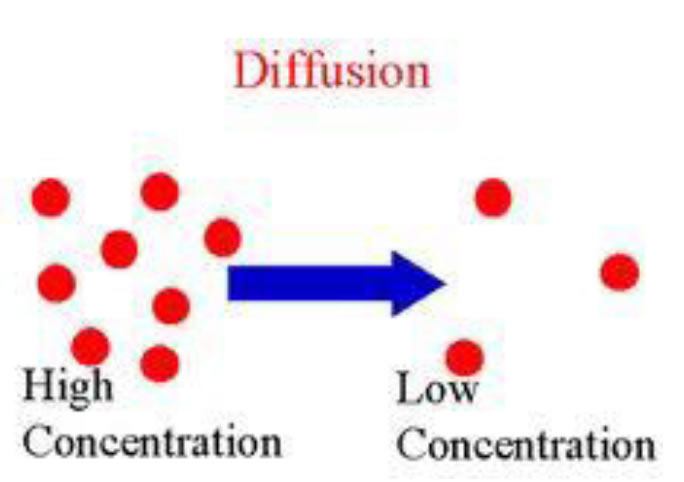
Molecules always move down a concentration gradient in what direction?

1

high to low

2

low to high

42

Multiple Choice

What does the word concentration mean?

1

when a solute is more in one area than another.

2

the amount of substance in a given space

43

Multiple Choice

When does a concentration gradient occur?

1

when a solute is equally concentrated in an area

2

when a solute is more concentrated in one area than another

44

media

The movement of substances across the cell membrane without using energy from the cell.

​Examples:

  1. diffusion

  2. facilitated diffusion

  3. osmosis.

​​

​(does not require energy​)

​​Passive Transport

45

media

46

media

47

media

48

media

49

media

50

media

Small molecules that can diffuse across the membrane without use of energy include:

  • H2O (water)

  • CO2 (carbon dioxide)

  • O2​ (oxygen)

Passive Transport: Diffusion

51

Multiple Choice

Most of the cell membrane is made of...
1
Lipids
2
Carbs
3
Proteins
4
Nucleic acids

52

Multiple Select

Examples of molecules that are small enough to diffuse through the cell membrane using passive transport are (choose 3)

1

water

2

DNA

3

oxygen

4

carbon dioxide

5

carbohydrate

53

media

54

Multiple Choice

When the molecules are even throughout a space, it is called :

1

balanced

2

equilibrium

55

Multiple Choice

The cell membrane is selectively permeable, which means...
1
All materials can enter and leave the cell
2
Certain things can enter while others cannot
3
The cell manually sorts through all materials
4
Only certain cells can interact with the cell.

56

Multiple Choice

How many layers is the lipid bilayer?
1
1
2
2
3
3
4
4

57

Multiple Choice

When molecules like O2 spread from areas of high concentration, to areas of low concentration this if referred to as:

1

diffusion

2

osmosis

58

media

59

media

60

Examples of diffusion in everyday life:​

  1. The smell of perfumes or incense sticks.

  2. Opening the soda or cold drinks bottle and the CO2 diffuses in the air.

  3. Dipping the tea bags in hot water will diffuse the tea in hot water.

  4. Small dust particles or smoke diffuse into the air and cause air pollution.

  5. Breathing and taking oxygen into the body and diffuses in our blood.

61

Examples of diffusion in everyday life:​

  1. Transport of Biomolecules and Minerals in Plants and Animals.

  2. Sugar gets dissolved evenly and sweetens the water without having to stir it.

  3. Removal of Waste Substances and Toxins from our Body.

  4. Gas exchange in the lungs.

  5. Diffusion of waste products, salt, and water in the kidneys

62

Multiple Select

Which of the following are examples of diffusion? (select all that apply

1

oxygen is moved into the cell

2

carbon dioxide is moved out the cell

3

perfume is sprayed and the scent fills the room

4

glucose travels through a protein in the cell membrane

63

Multiple Choice

Question image

This is an example of which method of getting molecules across a cell membrane?

1

facilitated diffusion

2

active transport

3

simple diffusion

4

bulk transport

64

Multiple Choice

Question image

What does the purple part of this picture represent?

1

glycoprotein

2

phospholipid

3

cell wall

4

channel protein

65

Multiple Choice

Which of the following is NOT a function of the cell membrane?

1

active transport

2

protection

3

protein production

4

recognition of chemical signals

66

Multiple Choice

Question image

What is the name of the yellow portion of this picture?

1

glycoproteins

2

phospholipid bilayer

3

carrier protein

4

cell wall

67

Fill in the Blank

The process of how things move in and out of the cell through the cell membrane is ............

68

Multiple Select

The two broad categories of cell transport are ...........

(select all correct answers)

1

passive transport

2

road transport

3

food transport

4

active transport

69

Multiple Choice

In passive transport, .............

1

energy is required

2

energy is not required

70

Fill in the Blank

Passive transport ____ ___ require energy.

71

Fill in the Blank

Passive transport moves molecules from ____ __ ___ concentrations.

72

media

73

Osmosis

3 Solution Types

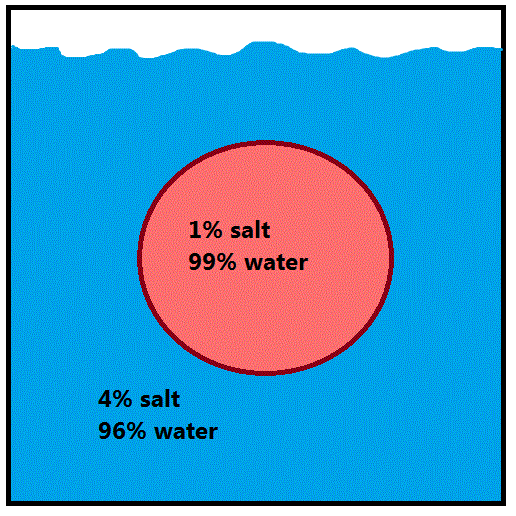
  • Hypotonic (Pure Water - No Solute)--More water flows INTO the cell

  • Hypertonic (Concentrated Solute)--More water OUT of cell

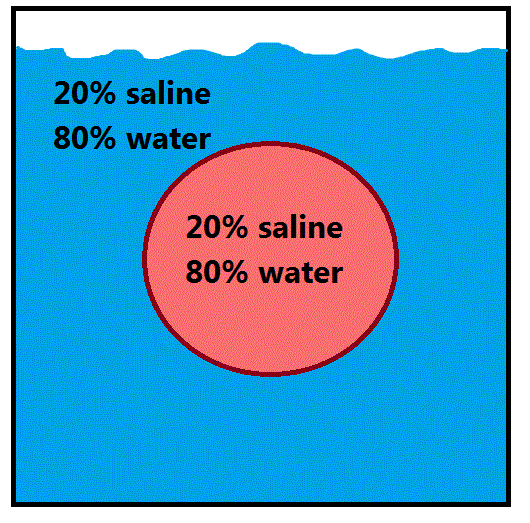
  • Isotonic (Same concentration & solute)--Equal water flow in & out of cell

media

74

media

75

media

76

Multiple Choice

A mixture that forms when one substance dissolves another.

1

concentration gradient

2

solution

3

solute

4

solvent

77

Multiple Choice

Question image

When making a glass of Tang, the solute is the

1

water

2

Tang

78

Multiple Choice

In the ocean, the solvent is the

1

water

2

salt

79

Multiple Choice

What direction does water move down the concentration gradient in osmosis?

1

high to low

2

low to high

80

Multiple Choice

Is osmosis active or passive transport?

1

active

2

passive

81

Multiple Choice

Is osmosis a type of diffusion?

1

yes

2

no

82

Multiple Choice

What is osmosis?

1

The diffusion of water across a membrane

2

The diffusion of gas across a memembrane

83

Multiple Choice

What process occurs when WATER diffuses across a membrane?
1

endocytosis

2

mitosis

3

osmosis

4

nuclear fission 

84

Multiple Choice

Why is diffusion and osmosis important to cells?
1

It allows them to take in materials without using energy.

2

It allows them to reproduce.

3

It allows them to absorb sunlight.

4

It allows cells to use all energy.

85

Multiple Choice

During osmosis
1

water moves from high to low concentration

2

large or oddly shaped molecules move across a cell membrane

3

water moves when energy is used

4

proteins are built

86

Multiple Choice

When the water is moving into and out of the cell at equal amounts, the solution is considered....?

1

Isotonic

2

Hypotonic

3

Hypertonic

4

Hypothesis

87

Multiple Choice

When the water is moving into the cell at a higher rate than out, the solution is considered....?

1

Isotonic

2

Hypotonic

3

Hypertonic

4

Hypothesis

88

Multiple Choice

You take a stalk (piece) of celery that is wilting and place it into a cup of water. Where will the water flow?

1

Into the celery

2

Out of the celery

3

Not at all

4

Turns into a gas and evaporates

89

Multiple Choice

When both inside and outside of a cell have the same amount of water it is said that the cell has reached a state of
1
Osmosis
2
Diffusion
3
Equilibrium

90

Multiple Choice

A person should never drink salty water because their cells would
1
shrink
2
expand

91

Multiple Choice

Ideally, your cells should be in a(n) _______ solution
1
Hypertonic
2
Hypotonic
3
Isotonic
4
Cola

92

Multiple Choice

Question image
Which cell is placed into a hypotonic environment? 
1
A
2
B
3
C
4
D

93

Multiple Choice

You are a doctor. A patient comes in dehydrated. What type of solution would be best to place into their IV?

1

A hypotonic solution to allow the cells to rehydrate.

2

A slightly hypertonic solution to allow the cells to rehydrate.

3

An isotonic solution to increase fluid in the body without causing harm to the cells.

4

An isotonic solution to decrease fluid in the body without causing harm to the cells.

94

Multiple Choice

Question image

Which red blood cell is in an isotonic solution?

1

The one on the left

2

The one on the right

3

The one in the middle

4

Each solution is isotonic

95

Multiple Choice

Question image

Which cell is in a hypotonic solution?

1

The one on the left

2

The one on the right

3

The one in the middle

4

Each solution is hypotonic

96

Multiple Choice

Question image

In which cell is the concentration of solute greater on the inside of the cell?

1

The one on the left

2

The one on the right

3

The one in the middle

4

The concentration of solute is the same for each solution

97

Multiple Choice

All of the following statements can be used to describe osmosis, EXCEPT:

1

Osmosis is the movement of water molecules from an area of high concentration to an area of low concentration.

2

Osmosis is the diffusion of water.

3

Osmosis is a type of passive transport.

4

Osmosis requires energy in the form of ATP.

98

Multiple Choice

What are the three types of passive transport?

1

Simple Diffusion, Osmosis, Facilitated Diffusion

2
Active Transport, Osmosis, Facilitated Diffusion
3
Diffusion, Endocytosis, Exocytosis
4
Diffusion, Osmosis, Active Transport

99

Categorize

Options (12)
Question image
Question image
Question image

Cells are in an environment in which solute concentration is high

Cells are in an environment in which solute concentration is low

Cells are in an environment in which solute concentration is the same inside/outside the cell

Water diffuses out of the cell

Water diffuses into the cell

Water diffuses into and out of the cell

Cell shrink / shrivel

Cell swell and can burst (lyse)

Cell is at normal functional size

Organize these options into the right categories

Determine the Tonicity

(Each has 1 picture answer and 3 discrilptions)

Hypertonic Solution
Hypotonic Solution
Isotonic Solution

100

Multiple Choice

Question image

What type of solution is this healthy looking red blood cell in?

1

Isotonic

2

Hypertonic

3

Hypotonic

101

Multiple Choice

Question image
Which way will the water molecules move during osmosis?
1
Out of the cell, so the cell shrinks.
2
Out of the cell, so the cell swells.
3
Into the cell, so the cell shrinks.
4
Into the cell, so the cell swells.

102

Multiple Choice

Question image
What type of solution allows water to enter the plant cell?
1
hypotonic solution
2
hypertonic solution
3
isotonic solution
4
active transport

103

Multiple Choice

Why should you never drink salt water?

1

The water will leave your cells because of the isotonic solution surrounding them.

2

The water will enter your cells because they are in an hypotonic solution.

3

The water will leave your cells because of the hypertonic solution surrounding them.

4

Nothing will happen, that's a myth.

104

Match

Match the following

Hypertonic

Hypotonic

Isotonic

Osmosis

Diffusion

105

Multiple Choice

Question image

What type of solution is outside the cell?

1

Hypotonic

2

Hypertonic

3

Isotonic

106

Multiple Choice

Question image

What type of solution is outside the cell?

1

Hypotonic

2

Hypertonic

3

Isotonic

107

Multiple Choice

Question image

What type of solution is outside the cell?

1

Hypotonic

2

Hypertonic

3

Isotonic

108

Multiple Choice

Question image

What type of solution is outside the cell?

1

Hypotonic

2

Hypertonic

3

Isotonic

109

Multiple Choice

What happens if someone gives you a 90% salt saline drip?
1
Your cells will shrivel and you'll die
2
Your cells will swell and you'll die
3
Nah you'll be fine.

110

Multiple Choice

ISO means...
1
Low
2
A lot
3
Equal
4
Mammal

111

Multiple Choice

HYPO means...
1
Low
2
High
3
Equal
4
Fat

112

Multiple Choice

HYPER means...

1
Low
2
High
3
Equal
4
Fat

113

Multiple Choice

 An animal cell placed in a hypertonic (salty) solution will
1
Stay the same
2
Shrink- get smaller
3
Swell- get bigger

114

Facilitated Diffusion


Molecules moving from high to low concentration


Using transport protein

--molecules need proteins because they would "get stuck" in phospholipids

media

115

Multiple Select

Which of the following is required for facilitated diffusion? Choose all correct answers

1

ATP

2

Transport Protein

3

Concentration Gradient

4

ADP

5

Molecules

116

media

117

media

118

media

119

Match

Match the following

Exocytosis

Endocytosis

Sodium Potassium Pump

120

media

121

media

122

media

123

media

124

Fill in the Blank

Question image

The image shows a _________ transport

125

Fill in the Blank

Question image

In the image, I observed that ______________ .

This helped me identify that the image is showing active transport.

126

media

127

Hotspot

Circle the image that shows Active Transport

128

Multiple Choice

Active transport is the movement of large materials across a cell membrane from ______ to ______ concentration

1

high to low

2

low to high

3

high to high

4

low to low

129

Multiple Choice

A type membrane protein that can pump one substance in one direction, while transporting another substance in the opposite direction.

1

pump transport

2

bulk transport

3

diffusion

4

osmosis

130

Multiple Choice

An example of pump transport is

1

glucose transport

2

osmosis

3

Na+/K+ Pump

4

CO2 + O2 Transport

131

Multiple Choice

Large particles (or large quantities of smaller particles) are moved across the cell membrane with the use of energy.

1

pump transport

2

osmosis

3

bulk transport

4

CO2 + O2 Transport

132

Multiple Choice

A general term for the various types of active transport that move particles into a cell by enclosing them in a vesicle made out of plasma membrane.

1

Endocytosis

2

Exocytosis

3

Osmosis

4

Diffusion

133

Multiple Choice

A form of bulk transport in which materials are transported from the inside to the outside of the cell in membrane-bound vesicles that fuse with the plasma membrane.

1

Endocytosis

2

Exocytosis

3

Osmosis

4

Diffusion

134

Multiple Choice

white blood cells engulfing invading bacteria is an example of

1

Endocytosis

2

Exocytosis

3

Diffusion

4

Facilitated Diffusion

135

Multiple Choice

nerve cells release neurotransmitters across gaps

and secretion of proteins and wastes

1

Exocytosis

2

Endocytosis

3

Diffusion

4

Facilitated Diffusion

136

Multiple Choice

small compartment enclosed by a membrane formed during transport of material during endo + exocytosis

1

vesicles

2

large vacuole

3

mitochondria

4

lysosome

137

Multiple Choice

Question image

This method of getting molecules across the cell membrane requires energy.

1

facilitated diffusion

2

active transport

3

simple diffusion

4

diffusion

138

Multiple Select

Which of the following methods of getting molecules across a cell membrane require a protein? (pick 2)

1

facilitated diffusion

2

active transport

3

simple diffusion

4

bulk transport

139

media

140

Multiple Choice

The answer to the question is ....

1

A

2

B

3

C

4

D

141

media

142

media

143

Review Questions

144

Multiple Choice

Why can't you drink salt water?

1

It's hypertonic to your cells

2

It's hypotonic to your cells

3

It's isotonic to your cells

4

It's paratonic to your cells

145

Multiple Choice

An animal cell placed in a hypertonic (salty) solution will
1
Shrink
2
Swell
3
Stay the same

146

Multiple Choice

If there is 5 percent water inside a cell and 5 percent water outside a cell

1

more water will move inside the cell

2

more water will move outside the cell

3

There will be no net movement of water, it moves into and out of the cell at the same time.

147

Multiple Choice

A person would never have pure water put into their veins in a hospital because their cells would...

1

Shrink/Dehydrate

2

Expand

3

Stay the same

148

Multiple Choice

What is the outer boundary called on ALL cells that controls what goes in and out of that cell?

1

Cell Wall

2

Nucleus

3

Cell Membrane

149

Multiple Choice

ATP is used to move molecules from a concentration of low molecules to a concentration of high molecules.

1

true

2

false

150

Multiple Choice

Active transport across a cell membrane from low to high concentration, requires

1

energy (ATP)

2

no energy

3

water

4

oxygen

151

Multiple Choice

Low --> High

against the concentration gradient

1

Passive

Transport

2

Active

Transport

152

Multiple Choice

High --> Low

With the Flow

1

Passive Transport

2

Active Transport

153

Match

Match the following

Iso

Hypo

Hyper

Hypo

154

Multiple Choice

Question image

Which of these beakers contains an egg that would shrink?

1

Cup 1

2

Cup 2

3

Cup 3

4

Cup 4

155

Multiple Choice

Question image
Where will the water go?
1
Into the cell
2
Out of the cell
3
Equally in & out - it's isotonic
4
There is no water

156

Multiple Choice

Question image
A blood cell is placed into the jar, as seen. Where will the water go?
1
Into the cell
2
Out of the cell
3
Equally in & out - it's isotonic
4
The water is a lie

157

Multiple Choice

 If a cell containing 5% salt is placed into a glass of water with 20% salt, the water is _______ compared to the cell.
1
hypertonic
2
hypotonic
3
isotonic

158

Multiple Choice

Question image
Mr. Slug was salted. Where was there more solute immediately after salting?
1
Outside of the slug
2
Inside of the slug
3
There was no solute anywhere

159

Multiple Choice

Question image

In the cell pictured, which way would water move?

1

Into the cell, causing the cell to swell

2

Out of the cell, causing the cell to shrink

3

In and out of the cell equally, keeping the shape the same

160

Multiple Choice

Question image

In the cell pictured, which way would water move?

1

Into the cell, causing the cell to swell

2

Out of the cell, causing the cell to shrink

3

In and out of the cell equally, keeping the shape the same

161

Multiple Choice

Question image

In the cell pictured, where would water move? 

1

Into the cell, causing it to swell

2

Out of the cell, causing it to shrink

3

In and out of the cell equally, causing the shape to stay the same

162

Multiple Choice

Question image
Movement of particles from high to low concentration. 
1

Passive Transport

2

Active Transport

163

Multiple Choice

When particles move from areas of high concentration to areas less concentrated, this has taken place.
1

diffusion

2

mitosis

3

endocytosis

4

photosynthesis

164

Multiple Choice

Question image
The cell below is in a _________ solution.
1
Hypotonic
2
Hypertonic
3
Isotonic

165

Multiple Choice

Question image
The cell below is in a _________ solution.
1
Hypotonic
2
Hypertonic
3
Isotonic

166

Multiple Choice

Question image

The cell below is in a _____________ solution.

1

Hypertonic

2

Hypotonic

3

Isotonic

167

Multiple Choice

During osmosis
1
water moves from high to low concentration
2
large or oddly shaped molecules move across a cell membrane
3
water moves when energy is used
4
proteins are built

168

Multiple Choice

What is the energy source required during active transport?

1

ATP

2

protein

3

oxygen

4

glucose

media

Show answer

Auto Play

Slide 1 / 168

SLIDE