

3rd Grade DL R/W (01/31/2025 Extended LSAE

Presentation
•
English
•
3rd Grade
•
Practice Problem
•
Hard

Koral Coronado
Used 2+ times
FREE Resource
10 Slides • 9 Questions
1


3rd Grade Read/Write
Extended LSAE
Student Facing
January 31, 2025
2

LO: SWBAT make
inferences and use
evidence to support
understanding.
LSAE: Learner /Securing LSAE: Aprendizaje/Seguridad
Objetivo de aprendizaje:
El estudiante será capaz
de hacer inferencias y
utilizar pruebas para
apoyar la comprensión.
TEKS: 3.6F Make inferences and use evidence to support understanding.
ELPS Strategy: (1.D) speak using learning strategies such as employing nonverbal cues, when exact English words are not known.
ELPS Domain/Objective: Speaking 3(I) Adapt spoken language appropriately for formal and informal purposes.
3




vocabulario
cognados
traducción
definición
inferencia
inference
______
es una conjetura basada en pistas
del texto y en lo que los lectores ya saben
evidencia textual
text evidence
______
utilizar información extraída
directamente de los textos para justificar sus respuestas
Cognados y vocabulario académico de la lección
3
4


vocabulario
cognados
traducción
definición
respuesta
inferida
inferred
response
______
una idea que debe deducirse
analizando los detalles de un texto
respuesta
indicada
_____
stated response
una idea citada directamente del texto
Cognados y vocabulario académico de la lección
4
5

8
Inferred
Response
Stated
Response
an idea that must be inferred by analyzing the
details in a text
an idea that is
directly quoted
from the text
inferred response = respuesta inferida
stated response = respuesta indicada
6
Multiple Choice
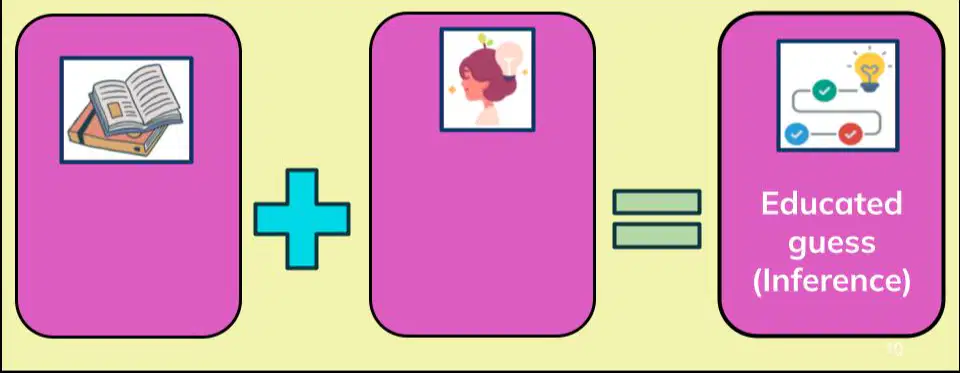
What do I need as a reader
to make an inference when reading a text?
Background knowledge and experiences
Plot and Text Evidence
Text Evidence and Background Knowledge
Multiple Answer choices
7

10
The Science of Smiling
1 Quick! Think of something you do at least 100 times a day. Maybe you are playing with a friend or reading a book. Maybe you are planning or
daydreaming. Then, all of a sudden, something makes you smile.
2 Have you ever thought about your smile? It seems simple. The corners of your mouth turn up and there is a twinkle in your eye. Maybe you flash your teeth, too. But hold on. Smiles may not be so simple, after all.
3 Scientists believe that humans display dozens of different smiles for dozens of different purposes. There are grins and smirks, broad smiles and sad smiles, and fake smiles, too. Each smile is made by using slightly different muscles in the face. Many have nothing to do with being happy.
Smile Studies
4 As it turns out, we know a lot about smiling. That is because there are
scientists studying how and why we do it. Yet the more we know about
smiling, the more we realize how much we do not know. Scientists still cannot agree whether smiling developed as a way to show emotion or as a way to communicate. Do we smile to say "I am happy"? Or do we smile to say "I want to be friendly"?
5 Who knew that such a simple look could be so difficult to figure out?
Vocabulary
daydream
(verb)
to have a series of
pleasant thoughts or
fantasies that distract
someone from reality
dozens (noun)
groups or sets of
twelve or a large
number.
smirk (noun)
a silly smile
8

11
Bared Teeth
6 One way that scientists study smiles and other expressions is by looking at the behavior of primates. This group of animals includes humans and our closest relatives, the apes and monkeys.
7 Some experts believe the human smile evolved from the "silent bared-teeth display." This display is often called a grimace. It is the face certain monkeys make when they feel as if they might be in danger. Their lips pull back to reveal all their monkey teeth. It may look a little scary to us. But this "smile" might actually mean "I am afraid of you. Please do not attack me."
8 If you think about it, it makes sense. You can see how the monkey's grimace of fear eventually could evolve over time into a signal of friendship among humans. Do you ever smile when you are nervous? The message you are sending is "I am not sure about this, but I am willing to work it out. Let's be friends."
grimace (noun)
twisted facial
expression showing
pain, disgust, or
disapproval
9

10
Poll
Based on the information in paragraphs 1 through 3, what can the reader infer about the significance of a smile in human communication?
Smiles have no impact on human communication.
Human communication relies solely on verbal expressions.
People smile primarily to show happiness
Different smiles convey various messages.
11
Multiple Choice

Which detail from paragraph 4 suggests that scientists find the origin of the smile is complex?
As it turns out, we know a lot about smiling.
That is because there are scientists studying how and why we do it.
Scientists still cannot agree whether smiling developed as a way to show emotion or as a way to communicate.
Do we smile to say "I am happy"?
12
Multiple Choice
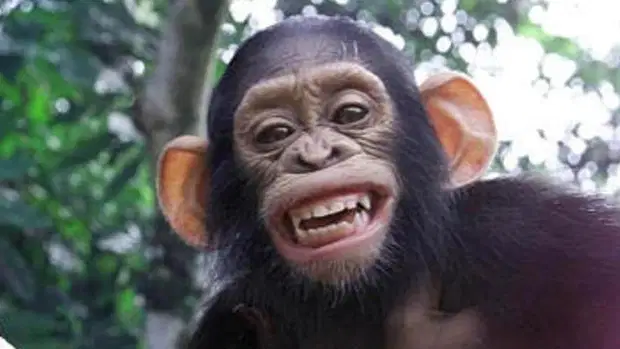
What is the connection between human smiles and monkey expressions?
Human smiles likely evolved from the monkey's grimace of fear.
Monkey expressions and human smiles are identical.
Monkeys smile only when they are happy, just like humans.
Human smiles and monkey grimaces have no connection
13
Multiple Choice

This question has two parts. First, answer Part A. This question has two parts. First, answer Part A. Then answer Part B.
Part A
What can the reader about the evolution of the human smile based on the text?
What can the reader about the evolution of the human smile based on the text?
The human smile evolved solely as a means of expressing happiness
The human smile originated from a gesture of aggression in primates.
The human smile developed as a response to danger and fear.
The human smile is unrelated to the expressions of other primates.
14
Multiple Choice

Part B
Which sentence from the selection best supports your answer to Part A?
Yet the more we know about smiling, the more we realize how much we do not know. (paragraph 4)
Who knew that such a simple look could be so difficult to figure out? (paragraph 5)
One way that scientists study smiles and other expressions is by looking at the behavior of primates. (paragraph 6)
But this "smile" might actually mean "I am afraid of you. Please do not attack me." (paragraph 7)
15



17
Play Time
9 Another idea about smiling is that it has to do with the desire to play.
When monkeys and some other animals want to play, they display what scientists call the "relaxed open-mouth face." It is also called the
"play-face." This expression is very different from the silent bared-teeth display. The lips are relaxed. The mouth is open, but the teeth usually do not show. Wrestling chimps show the play-face. Even kids chasing each other put on the play-face.
10 Could the play-face be related to the human smile? Maybe. The same muscles are used in play-face and smiling. Also, the play-face signals that it is time for fun. That can certainly make a human smile.
11 But smiling is not just for fun. It is also a matter of survival
12 Scientists have discovered that all newborn infants know how to smile. When a baby smiles, Mom coos and smiles back. The baby smiles even more. That is exactly what nature intended. A baby's smile is designed to attract and hold its mother's attention and encourage her care.
survival (noun):
continuing to live or
exist, often despite
difficult conditions.
infants (noun)
very young child,
usually under one
year old.
16


18
Is Your Smile True?
13
The most recognizable of all smiles is the true smile. It is brought on by true
pleasure and takes only two sets of muscles to create. One set of muscles
pulls up the corners of the mouth. Another causes the eyes to narrow and
crinkle.
14
Most people cannot control those eye muscles, so it is very hard to fake a true smile. People all over the world recognize it. Even among people who do not speak the same language, the true smile stands for peace and friendship.
crinkle (noun):
18
to make small,
tight wrinkles or
folds
17
Multiple Choice

What can the reader infer about why the play-face and the human smile use the same muscles?
Both expressions are used to signal aggression.
Both expressions are associated with positive social interactions.
Both expressions are used to show dominance.
Both expressions are meant to scare off predators
18
Multiple Choice

Based on the information in the section “Is Your Smile True?”, what can the reader infer about a true smile?
A true smile is easy to fake because it only involves the mouth muscles.
A true smile is recognized worldwide as it reflects genuine happiness.
A true smile is only recognized by people who speak the same language.
A true smile is difficult to recognize because it involves subtle facial movements.
19
Open Ended

R.A.C.E. (What can the reader infer about the significance of a baby’s smile?)
3rd Grade Read/Write
Extended LSAE
Student Facing
January 31, 2025
Show answer
Auto Play
Slide 1 / 19
SLIDE
Similar Resources on Wayground

13 questions
Similes and Metaphors
Presentation
•
3rd Grade
15 questions
Possessive Nouns
Presentation
•
3rd Grade
15 questions
main idea review
Presentation
•
3rd Grade
15 questions
Reading Comprehension 4_Grade 2
Presentation
•
3rd Grade
14 questions
Abstract Nouns
Presentation
•
3rd Grade
14 questions
Contractions
Presentation
•
3rd Grade
14 questions
Subjects & Predicates
Presentation
•
3rd Grade
14 questions
Author's Purpose PIEED Review
Presentation
•
3rd Grade
Popular Resources on Wayground
10 questions
Safety Day 2026 – Student Review

Quiz
•
9th Grade
21 questions
Continents and Oceans
Quiz
•
6th Grade
20 questions
Parts of Speech
Quiz
•
5th Grade
16 questions
Subject & Predicate
Quiz
•
5th Grade
25 questions
Multiplication Facts
Quiz
•
5th Grade
12 questions
Map Skills
Quiz
•
3rd Grade
22 questions
Continents and Oceans
Quiz
•
5th Grade
15 questions
Rounding Decimals
Quiz
•
5th Grade
Discover more resources for English
13 questions
Subjects & Predicate
Quiz
•
3rd Grade
10 questions
Main Idea and Supporting Details
Quiz
•
3rd - 6th Grade
20 questions
Main Idea
Quiz
•
3rd Grade
20 questions
Find the Main Idea and Supporting Details
Quiz
•
3rd Grade
20 questions
Similes & Metaphors
Quiz
•
3rd - 5th Grade
19 questions
Irregular Plural Nouns
Quiz
•
3rd Grade
20 questions
Inferences
Quiz
•
3rd Grade
20 questions
Cause and Effect
Quiz
•
3rd Grade