

5.3.5 Earth's History

Presentation
•
Science
•
8th Grade
•
Practice Problem
•
Easy
+2
Standards-aligned

Megan Horvat
Used 2+ times
FREE Resource
20 Slides • 6 Questions
1
Earth's History

5.3.5
2
Objectives
Learners can:
describe the different geological processes that have shaped the Earth's surface and contributed to changes in its environments
apply scientific inquiry skills to develop hypotheses and conduct investigations to better understand the Earth's history and the processes that have shaped it
3
Vocabulary
Prerequisite Vocab
erosion
plate tectonics
theory
weathering
4
Categorize
when soil is moved from one location to another by wind or water
the physical and chemical breakdown of rocks
the evidence that Earth's crust is made up of plates that move in relation to each other
Match the vocabulary word to its definition.
5
Open Ended
The isotope Rubidium-87 has a half-life of 500 years. If scientist find that the isotope has undergone 4 half-lifes, how many years have passed since the isotope began to decay?
6
Open Ended
The isotope Rubidium-87 has a half-life of 500 years. If scientists find that the isotope is 50% of its original size, how many years have passed since the isotope started to decay?
7
8

Radioactive isotopes are unstable elements that undergo decay over time. They transform into different elements through the emission of particles and energy. Each radioactive isotope has a characteristic rate of decay, known as its half-life.
Radioactive Decay
9
How Scientists Use Radioactive Isotopes to Date Rocks
10

Scientists analyze rocks and minerals found on Earth's surface and obtained from deep within the Earth to understand the Earth's formation. They look for certain isotopes with long half-lives, such as uranium-238, potassium-40, and rubidium-87, which are present in these materials.
Analyzing Rocks and Minerals
11

Scientists use a device called a mass spectrometer to measure the ratios of radioactive isotopes to stable elements in a sample. They can use this data to determine the amount of decay that has occurred since the rock or mineral formed. This allows them to calculate the age of the sample.
Radioactive Decay
12

The oldest rocks on Earth are found in Western Australia, in a formation known as the Jack Hills Conglomerate. Radiometric dating evidence shows that the minerals in this formation are at least 4.5 billion years old. This is the oldest known evidence of Earth's geologic history.
Formation of the Earth
13
Multiple Choice
How does radiometric dating help scientists estimate the age of the Earth?
Radiometric dating counts the number of years since the Earth's formation.
Radiometric dating measures the decay of certain elements in rocks to estimate how long ago the rocks formed.
Radiometric dating analyzes the composition of ancient fossils to determine the Earth's age.
14

One way radiometric dating contributes to our understanding of surface evolution is by determining the ages of rocks and minerals found on the Earth's crust. By analyzing the isotopic ratios in these samples, scientists can calculate their ages and establish the sequence of geological events.
Evolution of Earth's Surface
15
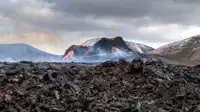
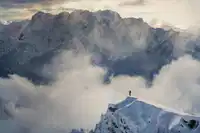
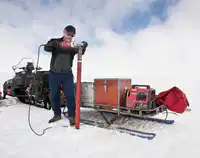
provides information about past volcanic activity
scientists understand the behavior of volcanic eruptions and their impact on Earth's landscape
Volcanic Rocks
provides information involved in mountain-building processes
scientists can reconstruct the history of mountain formation
Age of Rocks
ice cores determine ages of different ice layers
scientists study past climate conditions by studying the gas trapped in ice
Ice Cores
16
By combining radiometric dating with other geological and geophysical techniques, scientists can develop an understanding of the evolution of the Earth's surface. This includes understanding the processes of erosion, weathering, and the formation of landforms like valleys, canyons, and coastal features over vast time scales.
17
History of Life
One of the key applications of radiometric dating in studying the history of life is the dating of fossils. Fossils are the preserved remains or traces of ancient organisms in sedimentary rock layers. Scientists can estimate their ages by using radiometric dating on the rocks surrounding the fossils or the minerals within the fossils themselves.
18
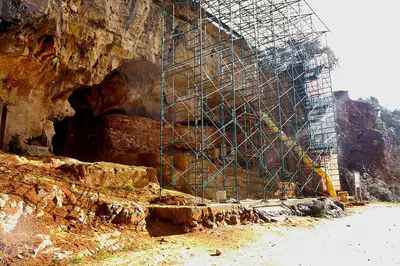
In northern Spain, scientists are excavating a cliff that is dated to be over one million years old. Using radiometric dating of the rocks, these scientists have identified early hominid fossils dated around 800,000 years old.
Determining the Age of Fossils
19
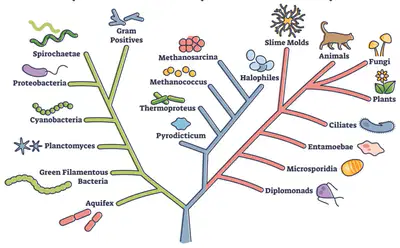
By comparing the ages of fossils from different geological layers, scientists can establish the order of appearance and disappearance of species, track evolutionary changes, and identify transitional forms.
Reconstructing Evolutionary Timelines
20

Scientists can date rocks and minerals to determine the timing and duration of significant events, like the extinction of dinosaurs.
Studying Mass Extinctions and Major Events
21
Multiple Choice
How do scientists use radiometric dating to study the history of life on Earth?
Radiometric dating measures the age of rock formations that contain fossils, providing insights into when an organism was alive.
Radiometric dating directly counts the number of years that have passed since the origin of life on Earth.
Radiometric dating examines the DNA of ancient organisms to determine their evolutionary relationships.
Radiometric dating analyzes the composition of sediment layers to infer the geological events that shaped life on Earth.
22
Scientific Inquiry
Through systematic investigation, observation, experimentation, and analysis, scientists have been able to piece together a comprehensive understanding of the Earth's geological evolution.
When asking questions about Earth's geologic history, scientists need to consider several important factors to ensure their inquiries are meaningful and scientifically rigorous.
23
Relevance and Significance
Scientists consider the relevance and significance of their questions in the context of Earth's geologic history, with a focus on helping to solve current problems. They aim to address significant gaps in knowledge, challenge existing theories, or uncover new insights that can have practical applications in tackling pressing issues. The questions should contribute to a deeper understanding of geological processes, environmental changes, or the evolution of life on Earth.
24
Testability and Falsifiability
Scientists ensure that they can test and investigate their questions using evidence. They formulate hypotheses that can be supported or refuted through data collection and analysis. Testability allows for the rigorous evaluation of competing explanations. At the same time, falsifiability ensures that other scientists can prove the explanation wrong if the evidence contradicts the proposed hypotheses.
25
Feasibility of Data Collection
Scientists assess whether something is possible by collecting pertinent data to address their research questions. They evaluate the availability of suitable samples, access to research sites, and the practicality of employing proper techniques and technologies. Scientists consider sufficient resources, logistical factors, and ethical considerations to ensure that data collection within the research's limitations is viable.
26
Multiple Choice
A group of paleontology students has discovered a set of fossilized dinosaur bones in a remote area. They are eager to determine the age of the fossils to gain insights into the Earth's ancient past. To accomplish this, they decide to employ radiometric dating. Which of the following statements best describes how they will use radiometric dating in this scenario?
Radiometric dating will estimate the approximate age of the dinosaur fossils by analyzing the decay of radioactive isotopes within them.
Radiometric dating will help determine the structural features of the dinosaur species based on the fossilized bones.
Radiometric dating will reveal the location of the dinosaur fossils, indicating the ancient climate conditions.
Earth's History
5.3.5
Show answer
Auto Play
Slide 1 / 26
SLIDE
Similar Resources on Wayground

19 questions
Periodic Table
Presentation
•
8th Grade
22 questions
Earth/Space Review 2-Stars & Sun
Presentation
•
8th Grade
22 questions
Exploring Earth's Surface
Presentation
•
8th Grade
18 questions
Temperature
Presentation
•
8th Grade
20 questions
Earth's Layers
Presentation
•
7th - 8th Grade
20 questions
Weathering Erosion Deposition
Presentation
•
8th Grade
21 questions
Graphing Motion
Presentation
•
8th Grade
19 questions
Eclipses
Presentation
•
8th Grade
Popular Resources on Wayground
10 questions
HCS SCI 03 Summer School Assessment 1

Quiz
•
3rd Grade
15 questions
HCS SCI 05 Summer School Assessment 1 Review
Quiz
•
5th Grade
22 questions
Day 9 Equations and Inequalities Review
Quiz
•
9th Grade
10 questions
Writing and Identifying Ratios Practice
Quiz
•
5th - 6th Grade
7 questions
PYRAMID PERSPECTIVES part 1
Presentation
•
9th - 12th Grade
12 questions
Understanding the Fourth of July
Quiz
•
9th Grade
15 questions
Soccer World Cup Quiz Questions
Quiz
•
7th Grade