

TEST quizzizz 1

Presentation
•
English
•
KG
•
Practice Problem
•
Easy

Elizabeth Saunders
Used 1+ times
FREE Resource
35 Slides • 1 Question
1

2
Open Ended
test: whos the best WNBA player
3

4

5

6

7

8

9

10
11

12

13

14

15

16

17

18

19

20


A rigorous and extensive
review process that ensures
scholarly work is credible and
high-quality.
Manuscripts undergo a series
of assessments by multiple
reviewers until they are
accepted, rejected, or sent
back to the author for
revisions.
What is Peer
Review?
21


22

Primary vs. secondary resource
Secondary sources are a
“secondhand account” of
information, adding an
additional layer of
interpretation and analysis.
Immediate, first-hand
accounts of a topic
provided by individuals
with direct experience or
involvement.
Does this source come from
someone directly involved in
the events I’m studying
(primary) or from another
researcher (secondary)?
______________________
Does the source provide
original information (primary)
or does it comment upon
information from other
sources (secondary)?
What’s The
Difference
Secondary Resource
Primary Resource
Examples:
Original research
Data sets
Surveys
Texts of law
Speeches, diaries, and
interviews
Examples:
Biographies
Books (many, not all)
Secondary analysis or
interpretation of data
Commentary articles
Documentaries
23

Primary vs. secondary resource
Immediate, first-hand
accounts of a topic
provided by individuals
with direct experience or
involvement.
Primary sources are the
foundation of original
research and enhance the
credibility of your
postulations.
They allow you to:
Provide credible evidence
to support your arguments
Give authoritative
information about your
topic
How to Use
PRIMARY SOURCES
Primary Resource
Examples:
Original research
Data sets
Surveys
Texts of law
Speeches, diaries, and
interviews
24

Primary vs. secondary resource
Secondary sources provide a
well-rounded, concise
overview of a topic and
understand how others
interpret the findings.
They allow you to:
Gain valuable background
information on a topic
Compare and contrast
your arguments with
other’s ideas
How to Use
SECONDARY SOURCES
Secondary sources are a
“secondhand account” of
information, adding an
additional layer of
interpretation and analysis.
Secondary Resource
Examples:
Biographies
Books (many, not all)
Secondary analysis or
interpretation of data
Commentary articles
Documentaries
25

Develop a
Research
Question
Plan the
Scholarly
Search
Start
Exploring
Modify your search
strategy based on
the database you’re
using
Keep track of your
search methods to
ensure
reproducibility
finding scientific articles
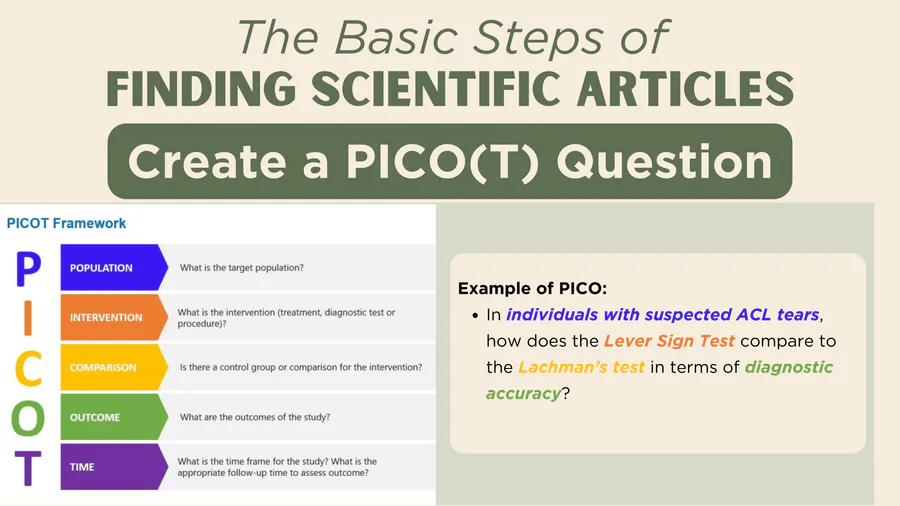
Create a PICO(T) Question
P: Patient/Problem/Population
I: Intervention
C: Comparison
O: Outcome
T: Time
Determine what databases
are appropriate for your
search
Establish your keywords
and Boolean terms
Define inclusion and
exclusion criteria
The Basic Steps of
26


finding scientific articles
The Basic Steps of
Create a PICO(T) Question
Example of PICOT:
In adult patients with total hip
replacements, how effective is pain
medication compared to aerobic stretching
in controlling post-operative pain during
the perioperative and recovery time?
27


finding scientific articles
The Basic Steps of
Create a PICO(T) Question
Example of PICO:
In individuals with suspected ACL tears,
how does the Lever Sign Test compare to
the Lachman’s test in terms of diagnostic
accuracy?
28

Keywords are the main points
of your topic or research
question.
Typically nouns because
they represent subjects
(rather than verbs,
adjectives, and adverbs)
Boolean Terms tell the
databases how to search with
the keywords you provide.
AND, OR, or NOT
finding scientific articles
The Basic Steps of
Plan the Scholarly Search
Determine the
Appropriate Database:
Keywords and Boolean
Terms:
Inclusion and Exclusion
Criteria:
There are numerous search engines
and databases.
PubMed
EBSCOHost
Google Scholar
Any others?
Select search engines and
databases that provide high-
quality, targeted results.
Adjust filters based on date
ranges, type of manuscript,
and study design.
Helpful Tip:
Recent studies (< 5 years)
provide modern insights
into topics.
Older literature (>5 years)
provides context, history,
and scientific progression
of a field or topic.
29

Keywords are the main points
of your topic or research
question.
Typically nouns because
they represent subjects
(rather than verbs,
adjectives, and adverbs)
Boolean Terms tell the
databases how to search with
the keywords you provide.
AND, OR, or NOT
finding scientific articles
The Basic Steps of
Plan the Scholarly Search
Keywords and Boolean
Terms:
How might dogs influence the mental
health of college students?
What are the keywords of this question?
30

Keywords are the main points
of your topic or research
question.
Typically nouns because
they represent subjects
(rather than verbs,
adjectives, and adverbs)
Boolean Terms tell the
databases how to search with
the keywords you provide.
AND, OR, or NOT
finding scientific articles
The Basic Steps of
Plan the Scholarly Search
Keywords and Boolean
Terms:
How might dogs influence the mental
health of college students?
What are the keywords of this question?
These keywords may not capture all
relevant articles...
How can we expand this search using synonyms?
31

Keywords are the main points
of your topic or research
question.
Typically nouns because
they represent subjects
(rather than verbs,
adjectives, and adverbs)
Boolean Terms tell the
databases how to search with
the keywords you provide.
AND, OR, or NOT
finding scientific articles
The Basic Steps of
Plan the Scholarly Search
Keywords and Boolean
Terms:
How might dogs influence the mental
health of college students?
How can we adjust our search using Boolean Terms?
32


How might dogs influence the mental
health of college students?
How can we adjust our search using Boolean Terms?
Narrow our results by instructing the databases to include only results
where all the keywords you combine with AND are present
Example: dogs AND mental health AND college students
33


How can we adjust our search using Boolean Terms?
Expand our search by linking 2 + similar terms. This tells the database that ANY of
our keywords combined with OR can appear in the search results.
Example: vegetarian OR vegan OR plant-based
34


How can we adjust our search using Boolean Terms?
Exclude certain words by instructing the database to ignore keywords that may be
implied by your search terms, helping to narrow your results.
Example: media AND bias NOT internet
35

finding scientific articles
The Basic Steps of
Start Exploring
Modify Your Search Strategy
Based on the Database
Each database has a
unique structure and
filters
Modify search terms to
match the features of
each database
Keep Track of Search
Methods
Track the databases
searched, inclusion and/or
exclusion criteria, and the
search terms used.
Spreadsheets are useful
in keeping search
methods organized and
accessible
36


wRITING
eXERCISE
Navigate to Blackboard
Click “Learning Central”
Find “Week 2 - Finding and
Understanding Scientific Writing”
Let’s Flex Our Knowledge
For this exercise:
Create a PICO(T)
Question
based on your unique
scholarly interest
Plan Your Literature
Search
Explore the
Literature
Reflect and
Compare
using targeted search
terms across 2+ databases
find and download 4
related RECENT articles
write a 300 - 500 word
reflection
Show answer
Auto Play
Slide 1 / 36
SLIDE
Similar Resources on Wayground

30 questions
Sources of Information
Presentation
•
8th Grade
32 questions
The Horror Genre Textlet
Presentation
•
8th Grade
29 questions
Resolving Conflict
Presentation
•
10th Grade
30 questions
Adjetivos & género
Presentation
•
9th - 12th Grade
32 questions
Flow of Energy
Presentation
•
9th Grade
32 questions
History of Medical Terminology
Presentation
•
9th Grade
31 questions
Inferencing, Main Ideas, Author's Purpose & Context Clues
Presentation
•
6th Grade
27 questions
Parts of Speech 9th Grade
Presentation
•
9th Grade
Popular Resources on Wayground
11 questions
Hallway & Bathroom Expectations

Quiz
•
6th - 8th Grade
10 questions
HCS SCI 03 Summer School Assessment 2
Quiz
•
3rd Grade
11 questions
Home Scope
Quiz
•
7th - 8th Grade
12 questions
2026 TAP Technology in the Classroom
Presentation
•
Professional Development
15 questions
HCS SCI 05 Summer School Assessment 2 Review
Quiz
•
5th Grade
15 questions
HCS SCI 04 Summer School Review 2
Quiz
•
4th Grade
59 questions
Geometry Unit 3 Review
Quiz
•
9th - 12th Grade
14 questions
FAST ELA READING SMAPLE TEST MATERIALS

Passage
•
3rd Grade