
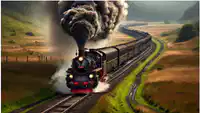
Lesson 2: The Railroad

Presentation
•
History
•
11th Grade
•
Practice Problem
•
Medium

Emmanuel Njoya
Used 3+ times
FREE Resource
16 Slides • 6 Questions
1

Lesson 2: The Railroads
2
Open Ended

Imagine yourself as a 19th-century traveler embarking on a transformative journey across the American West by train. Consider the sights, sounds, and experiences you might encounter - from the rhythmic clatter of wheels on rails to vast prairies and towering mountains passing by your window. Think about the challenges, excitement, and wonder of being part of this revolutionary form of transportation.
TASK
a. Describe two sights you might see from your train window as you travel across the American West.
b. What sounds would you likely hear during your journey on a 19th-century train?
c. Name one challenge and one exciting aspect of traveling by train in the 19th century.
3

Lesson Objectives
At the end of this lesson;
●I will be able to explain key factors driving
railroad expansion across the United States
during 1800s
●I will be able to analyze how railroads
transformed American economy, society, and
politics and evaluate government policies and
private business roles in railroad development
Main Idea: The railroad
was a transformative
invention that
revolutionized travel,
trade, and society in the
19th and 20th centuries,
connecting nations and
fostering economic and
social change.
4


The Railroads in American History
The railroad system revolutionized 19th-century America,
fundamentally changing how people lived, worked, and traveled.
This network of iron rails connected distant regions, accelerated
westward expansion, and drove unprecedented economic
growth. From humble beginnings to a vast transportation
network, railroads became the backbone of American industrial
development, reshaping both the physical and social landscape of
the nation.
Transforming America's Landscape and
Society
5


Linking the Nation
Railroad Expansion
●35,000 miles of track by 1865
●Most tracks east of
Mississippi River
●Dramatic post-Civil War
construction growth
Pacific Railway Act
1862
●Authorized Union Pacific
and Central Pacific
railroads
●Launched transcontinental
railroad construction
project
Diverse Workforce
●Union Pacific employed 10,000
Civil War veterans
●Central Pacific hired 10,000
Chinese workers
●Workers included miners,
farmers, and laborers
6


Discussion Activity
Stagecoach
"Imagine a world without cars, without planes, where traveling even a hundred miles could take days or
even weeks. How would goods be transported? How would people connect with distant family and
friends? How would nations interact with each other?"
Above is a picture of a stagecoach and a high-speed train in the 1900s. Estimate and analyze how long
it would take to travel from your present address to a major city a few hundred miles away.
Train
7

Two companies laid 1,774 miles of track in just four
years of construction
Central Pacific built 688 miles westward, Union
Pacific constructed 1,086 miles eastward
Project Scale
Company
Achievements
Historic
Completion
Hundreds gathered at Promontory Summit, Utah to
witness golden spike ceremony May 10, 1869
The Transcontinental Achievement
8


Economic Impact of Railroads
Market Expansion
and Industrial
Growth
Technological
Advancements
●Connected national markets after Civil War
●Stimulated economy through material
purchases
●Created large integrated railroad systems
●New locomotive technology improved
efficiency
●Air brakes enabled longer, heavier trains
●Enhanced railway infrastructure and safety
9
Open Ended
In what ways do railroads impact the American economy economically? (Write down TWO positive impacts)
10

120+ Million Acres
Federal land grants given to railroad
companies during 1850s-1860s
Low-Cost Land
Railroads offered affordable prices
and credit to attract settlers
Train Access
Settlers could easily reach and
develop their purchased land. This
helped people move West into the
Great Plains and close the American
frontier
Settlement and Land Development
11

Robber Barons
➢
In the late 1800srailroad entrepreneurs acquired wealth which led to accusations
that they had built their fortunes by swindling investors ( use deception to deprive
investors of money) and taxpayers, bribing officials and cheating on their contracts
and debts
➢
Corrupt railroad owner like Jay Gould practiced ‘‘ insider trading’’ and
manipulated stock prices
➢
Bribing occurred because the government was funding the railroad and Railroad
investors knew they could make money by selling free government land grants
than by operating a railroad
➢
Some bribe political representatives to vote for more grants
Next slide will illustrate a political cartoon of Jay Gould
➢
Jay Gould bowls on Wall street with balls labeled ‘‘ Trickery’’ and ‘‘ False report’’.
The pins are labeled ‘‘Banker’’, ‘‘inexperienced investor’’, ‘‘small operator’’ and
‘‘stock Broker’’
12
Multiple Choice
What practice did corrupt railroad owners like Jay Gould engage in to build their fortunes?
Honest business practices
Charitable donations
Insider trading and stock price manipulation
Public transparency
13
Open Ended
Explain how railroad entrepreneurs in the late 1800s were accused of building their fortunes unethically.
14


➢
Railroad owners became condemned as robber barons as the American public suspected them of bribery and cheating
15
Open Ended

Describe the political cartoon of Jay Gould bowling on Wall Street. What does it symbolize?
16

Cartoon Explanation
The cartoon focuses on Jay Gould and the negative perception of railroad owners during the late 19th century, specifically addressing the following:
Attitudes Towards Jay Gould: The public viewed railroad owners like Jay Gould as "robber
barons," suspecting them of engaging in unethical practices such as bribery and cheating to
gain wealth and power. This perception stemmed from the belief that they exploited the
system and the public for personal gain.
Outcome of Robber Barons' Actions: The cartoon suggests that the actions of these "robber
barons" would have detrimental consequences for the common people, represented by the
bowling pins. The pins being knocked down signifies the potential ruin and harm faced by
ordinary individuals due to the unchecked power and self-serving actions of these wealthy
industrialists.
The cartoon explains the negative image of industrialists like Jay Gould as manipulative figures who prioritized personal enrichment over ethical conduct and the well-being of the public.
17

The Credit Mobilier Scandal
Corruption in the railroad industry became public in 1872 with the
Credit Mobilier scandal. It was a construction company set up by
several stockholders of the Union Pacific Railroad, including Oakes
Ames a member of Congress
To convince Congress to give the railroad more grants, Ames sold
other members of Congress shares at a price well below their
market value
During the election campaign of 1872 a letter appeared in the New
York Sun listing members of Congress who had bought shares
The Credit Mobilier Scandal produced widespread anger and gave
an impression that railroad entrepreneurs were ‘‘ robber barons’’
(people who loot an industry and become rich unethically)
18

The Great Northern Railroad
Not all railroad men were robber barons. James J.Hill built the Great Northern Railroad from Wisconsin and Minnesota to Washington State without any federal land grants or subsidies
He also identified products that were in demand in China including cotton, textiles and flour and hauled those goods to Washington to ship to Asia
And not simply sending goods east and coming back empty like other railroads
It became the most successful transcontinental railroad that was not eventually forced into bankruptcy
19
Open Ended
Compare and contrast Jay Gould and James J.Hill as railroad men and entrepreneurs.
20

●
Credit Mobilier Scandal exposed corruption in 1872
●
Congress members received discounted shares for
favors
●
Oakes Ames led questionable stock manipulation
scheme
●
Public outrage led to 'Robber Baron' label
●
Widespread criticism of unethical business
practices
Railroad Industry
Achievements
Ethical Concerns and
Scandals
+
×
Challenges and Controversies
●
Rapid expansion of national rail network
●
Creation of efficient transportation
system
●
Development of new railroad
technologies
●
Facilitation of westward settlement
●
Stimulation of economic growth
nationwide
21

Questions
●How did the transcontinental railroad transform American society,
economy, and culture?
●Evaluate both benefits and drawbacks of federal land grants to
railroad companies.
●What made James J. Hill's business practices more ethical than other
railroad tycoons?
●How did railroad expansion affect Native American communities
and their territories?
●Analyze how railroads contributed to America's rapid
industrialization and urbanization
●Examine the role of immigrant workers in building the
transcontinental railroad.
22


Conclusion and Reflection
The railroad revolution fundamentally transformed 19th-century
America through unprecedented connectivity and economic
growth. Government support through land grants and legislation
partnered with private enterprise to create a nationwide rail
network. This partnership sparked industrial innovation, enabled
mass settlement of the West, and revolutionized commerce,
though it also brought challenges like monopolistic practices and
social inequities. The legacy of this era continues to influence
American transportation and economic systems today.
Railroads: A Catalyst for American
Progress
Lesson 2: The Railroads
Show answer
Auto Play
Slide 1 / 22
SLIDE
Similar Resources on Wayground

17 questions
American History World War II
Presentation
•
10th Grade
18 questions
Subject Orientation
Presentation
•
11th Grade
18 questions
Roles of African Americans and Indigenous people in Revolut
Presentation
•
11th Grade
18 questions
WWII Government Structures & Mapping 2022-2023
Presentation
•
11th Grade
19 questions
Diction and Syntax
Presentation
•
11th Grade
19 questions
osmosis
Presentation
•
11th Grade
20 questions
1920s - Day 2: The Harlem Renaissance and Black Nationalism TP
Presentation
•
11th Grade
13 questions
Holocaust
Presentation
•
11th Grade
Popular Resources on Wayground
24 questions
PBIS-HGMS Day 10

Quiz
•
6th - 8th Grade
10 questions
HCS SCI 03 Summer School Review 3
Quiz
•
3rd Grade
11 questions
Home Scope
Quiz
•
7th - 8th Grade
15 questions
HCS SCI 05 Summer School Assessment 3 Review
Quiz
•
5th Grade
35 questions
Lufkin Road Middle School Student Handbook & Policies Assessment
Quiz
•
7th Grade
18 questions
Geo 11.3 Area of Circles and Sectors
Quiz
•
9th - 11th Grade