
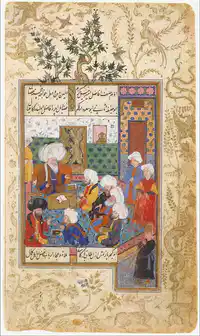
The Rise of the Ottoman Empire

Presentation
•
Social Studies
•
7th Grade
•
Practice Problem
•
Hard

Carlos Trinidad
Used 6+ times
FREE Resource
12 Slides • 0 Questions
1
After the early spread of Islam, the Ottoman Empire controlled large parts of Europe, Asia, and Africa.
Why is it important?
How did the Ottomans gain land for their empire?
Essential Question:
The Ottoman Empire
2
CORNELL WORDS
Using your student notebook, provided in Google Classroom, attempt to define at least three highlighted words and names in the reading in no less than one complete sentence.
3
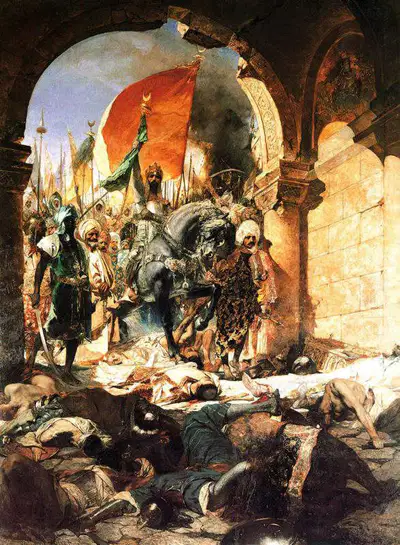
Centuries after the early Arab Muslim conquests, Muslims ruled several powerful empires containing various peoples. Rulers and military leaders in Persia empires, spoke Persian, Turkish leaders spoke Turkish, while Arabic continued as a language of religion and scholarship. One of these empires was the Ottoman Empire, which controlled much of Europe, Asia, and Africa. Built through conquest, the Ottoman Empire was a political and cultural force.
The Rise of the Ottoman Empire
4
In the mid-1200s, Muslim Turkish warriors known as Ottomans began to take land from the Christian Byzantine Empire. They eventually ruled lands from eastern Europe to North Africa and Arabia.
The key to the empire’s expansion was the Ottoman army. The Ottomans trained Christian boys from conquered towns to be soldiers. These slave soldiers, called Janissaries, converted to Islam and became fierce fighters. Besides these slave troops, the Ottomans were aided by new gunpowder weapons—especially cannons.
5
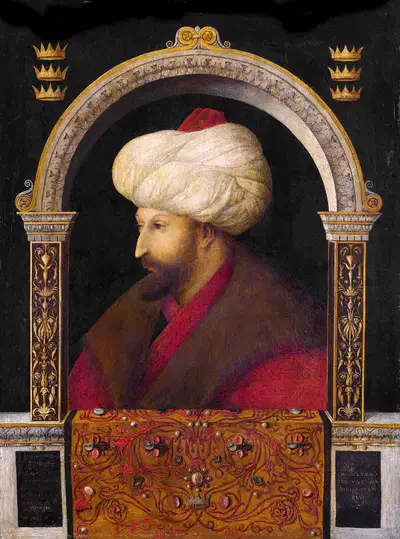
In 1453, Ottomans led by Mehmed II used huge cannons to conquer Constantinople. With the city’s capture, Mehmed defeated the Byzantine Empire. He became known as “the Conqueror.” Mehmed made Constantinople, which the Ottomans called Istanbul, his new capital. He also turned the Byzantines’ great church, Hagia Sophia, into a mosque.
6
Istanbul continued to grow as a commercial and cultural center. Mehmed II lowered taxes to attract merchants and artisans to the city. This encouraged industry and trade. The Ottoman Empire as a whole flourished along trade routes throughout the Mediterranean region. The Ottomans controlled much of the Mediterranean coast as well as ports along major inland rivers such as the Danube.
A later sultan continued Mehmed’s conquests. He expanded the empire to the east through the rest of Anatolia, another name for Asia Minor. His armies also conquered Syria and Egypt. Soon afterward the holy cities of Mecca and Medina accepted Ottoman rule as well. These triumphs made the Ottoman Empire a major world power.
7
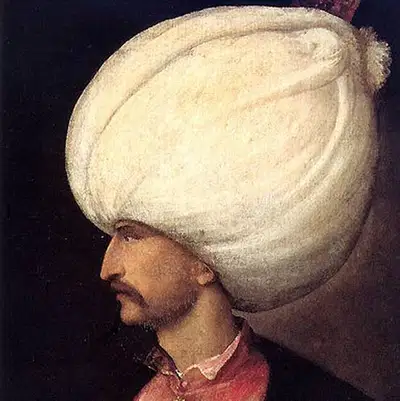
The Ottoman Empire reached its height under Suleyman I (soo-lay-MAHN), “the Magnificent.” During Suleyman’s rule, from 1520 to 1566, the Ottomans took control of the eastern Mediterranean and pushed farther into Europe, areas they would control until the early 1900s.
Also during Suleyman’s rule, the Ottoman Empire reached its cultural peak. Muslim poets wrote beautiful works, and architects worked to turn Istanbul from a Byzantine city into a Muslim one.
8
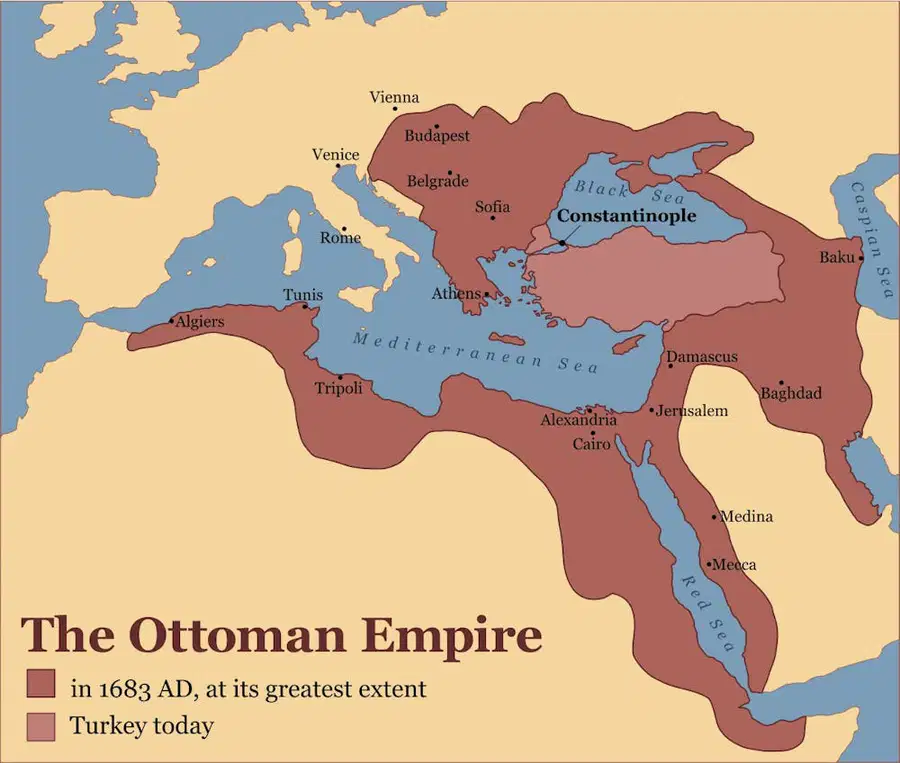
The Ottoman Empire spanned much of Eastern Europe, the Middle East, and coastal Africa.
The Ottoman Empire
9
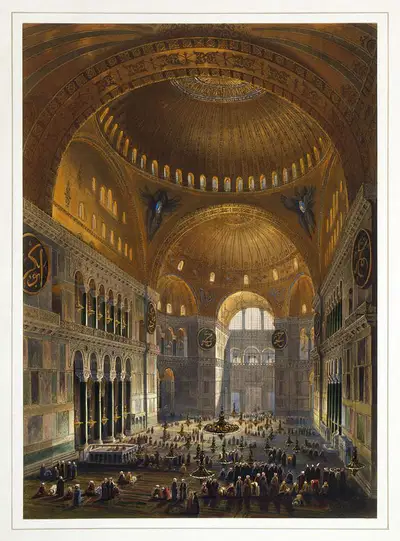
The sultan issued laws and made all major decisions in the empire. Most Ottoman law was based on Shariah, or Islamic law, but sultans also made laws of their own.
Ottoman Government & Society
10
Ottoman society was divided into two classes. Judges and other people who advised the sultan on legal and military matters were part of the ruling class. Members of the ruling class had to be loyal to the sultan, practice Islam, and understand Ottoman customs.
People who didn’t fit these requirements made up the other class, known as Raya. Many of them were Christians or Jews from lands the Ottomans had conquered. Christians and Jews formed religious communities, or millets, within the empire. Each millet had its own leaders and religious laws.
Ottoman society limited the freedom that women enjoyed, especially women in the ruling class. These women usually had to live apart from men in an area of a household called a harem. By separating women from men, harems kept women out of public life. However, wealthy women could still own property or businesses. Some women used their money to build schools, mosques, and hospitals.
11
CORNELL QUESTIONS
Using your student notebook, provided in Google Classroom, answer at least one of the major short answer questions in no less than 2-3 sentences.
12
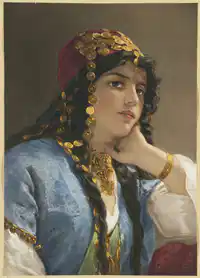
Who were the Janissaires?
Question One
In what ways was the Ottoman society tolerant and in what ways was it not?
Question Two
What was life like for women in Ottoman society?
Question Three
After the early spread of Islam, the Ottoman Empire controlled large parts of Europe, Asia, and Africa.
Why is it important?
How did the Ottomans gain land for their empire?
Essential Question:
The Ottoman Empire
Show answer
Auto Play
Slide 1 / 12
SLIDE
Similar Resources on Wayground

10 questions
Integers and number line
Presentation
•
7th Grade
10 questions
Texas Geography
Presentation
•
7th Grade
10 questions
S&E Asia Belief Systems: Shintoism DT #8 Re-Performance Lesson
Presentation
•
7th Grade
12 questions
SW Asia History DT#5: Continuing Conflicts and Change
Presentation
•
7th Grade
11 questions
Southern Africa History and Culture
Presentation
•
7th Grade
10 questions
Cotton, Cattle, and Railroads
Presentation
•
7th Grade
10 questions
Civil Rights Intro
Presentation
•
7th Grade
9 questions
Comma Rule: Interrupters
Presentation
•
7th Grade
Popular Resources on Wayground
6 questions
PRIDE Always and Everywhere
Presentation
•
12th Grade
20 questions
Lab Safety Quiz

Quiz
•
6th Grade
26 questions
KOR Review Kahoot Questions
Quiz
•
8th Grade
21 questions
Continents and Oceans
Quiz
•
6th Grade
12 questions
Unit Zero lesson 2 cafeteria
Presentation
•
9th - 12th Grade
20 questions
Parts of Speech
Quiz
•
5th Grade
10 questions
Riddles Riddles fun Riddles
Quiz
•
6th - 12th Grade
16 questions
Subject & Predicate
Quiz
•
5th Grade
Discover more resources for Social Studies
10 questions
Exploring the Age of Exploration: Key Events and Figures

Interactive video
•
6th - 10th Grade
20 questions
Primary and Secondary Sources
Quiz
•
7th Grade
21 questions
ss.7.cg.1.1- Ancient Influences
Quiz
•
7th Grade
13 questions
The French and Indian War
Interactive video
•
6th - 8th Grade
27 questions
SW Asia Geography Test Review
Quiz
•
7th Grade
25 questions
SS7G1 Africa Geography
Quiz
•
7th Grade
21 questions
Unit 2 Age of Contact 7th gr
Quiz
•
7th Grade
11 questions
Top 10 - B Cultural Diversity ME
Quiz
•
7th Grade