
Lesson 1.3 From June 7, 1776 to December 15, 1791

Presentation
•
Social Studies
•
10th Grade
•
Medium

Shelly Tinsley
Used 1+ times
FREE Resource
10 Slides • 17 Questions
1
Lesson 1.3 June 7, 1776 - December 15, 1791
Monday, February 24

2
Lee's Resolution
On June 7, 1776, Richard Henry Lee introduced a resolution "that these united colonies are and of right ought to be free and independent states," acting under the instruction of the Virginia Convention. The Lee Resolution contained three parts: a declaration of independence, a call to form foreign alliances, and "a plan for confederation."
3
Multiple Choice
Lee's Resolution proposed three things. Identify one item not included in Lee's Resolution.
Independence
Foreign alliances
Plan for confederation
Strong central government
4
Multiple Choice
Who presented a resolution to the 2nd Continental Congress to declare independence from England?
5
Declaration of Independence
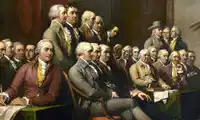
The Declaration of Independence was adopted on July 4, 1776, by the Continental Congress. It announced the separation of 13 North American colonies from Great Britain. The Declaration of Independence established the United States as a nation.
6
Multiple Choice
Who was the main author of the Declaration of Independence?
Roger Sherman
John Adams
Benjamin Franklin
Thomas Jefferson
7
Multiple Choice
What was the date the 2nd Continental Congress adopted the Declaration of Independence?
July 4,1776
August 2, 1775
April 18, 1776
July 2, 1776
8
Multiple Choice
9
Articles of Confederation
After considerable debate and revision, the Second Continental Congress adopted the Articles of Confederation on November 15, 1777. This "first constitution of the United States" established a "league of friendship" for the 13 sovereign and independent states. Each state retained "every Power...which is not by this confederation expressly delegated to the United States.
10
Multiple Choice
To change (amend) the Articles of Confederation, how many states had to agree?
11
Multiple Choice
The states
The central government
Parliament
King George III
12
Treaty of Paris
This treaty, signed on September 3, 1783, between the American colonies and Great Britain, ended the American Revolution and formally recognized the United States as an independent nation.
13
Multiple Choice
The primary goal of the Treaty of Paris was to...
reward the French for their efforts in the war.
punish the British.
help the colonies and Britain become rich.
maintain peace between Britain and the United States.
14
Multiple Select
When was the Treaty of Paris signed?
July 4, 1776
September 3, 1783
January 14, 1784
October 19, 1781
15
Mount Vernon Compact
On March 28, 1785, at George Washington’s request, representatives from Virginia and Maryland met at Mount Vernon to discuss navigational rights on the Potomac River. This meeting is now known as the Mount Vernon Compact. The commissioners in attendance agreed on a 13-point document that would become known as the Mount Vernon Compact, which set a precedent for interstate cooperation on navigation, toll duties, commerce regulations, debt collection, and fishing rights.
16
Reorder
Arrange these founding documents in order.
Lee's Resolution
Declaration of Independence
Articles of Confederation
Treaty of Paris
Mount Vernon Compact
17
Annapolis Convention
Meeting at the suggestion of James Madison in Annapolis, Maryland beginning on September 11, 1786, the Annapolis Convention was held to discuss some issues of interstate trade. Attendance was low, with only 12 delegates total representing just five states (New York, New Jersey, Pennsylvania, Delaware, and Virginia).
18
Multiple Choice
In what year did the Annapolis Convention take place?
1776
1786
1796
1806
19
Multiple Choice
What was the main purpose of the Annapolis Convention?
To discuss improving commercial relations between the states
To declare independence from Britain
To draft the Constitution
To elect a new president
20
The Constitutional Convention
The Convention (also known as the Philadelphia Convention, the Federal Convention, or the Grand Convention at Philadelphia) met in Philadelphia, Pennsylvania from May 14 to September 17, 1787. Delegates gathered to correct the various problems that had arisen while the newly-independent nation was operating under the Articles of Confederation following independence from Great Britain. The historic result of the Convention was the crafting of the United States Constitution.
21
Multiple Choice
This plan for government was favored by large states because representation in Congress was based on population.
22
Multiple Choice
the central government was too weak to manage state relations
23
Multiple Choice
24
Bill of Rights
The Bill of Rights, ratified December 15, 1791, is the first 10 Amendments to the Constitution. It spells out Americans’ rights in relation to their government. It guarantees civil rights and liberties to the individual—like freedom of speech, press, and religion. It sets rules for due process of law and reserves all powers not delegated to the Federal Government to the people or the States.
25
Multiple Choice
This group wanted a Bill of Rights added to protect the rights of the people
Federalists
Anti-Federalists
26
Reorder
Place the events in order from earliest to most recent:
US declares independence
Articles of Confederation government
The Constitution is written
Debate over ratification
The Constitution takes effect
27

Lesson 1.3 June 7, 1776 - December 15, 1791
Monday, February 24
Show answer
Auto Play
Slide 1 / 27
SLIDE
Similar Resources on Wayground

20 questions
Causative Form
Presentation
•
10th Grade
20 questions
Plant Nutrition
Presentation
•
10th Grade
19 questions
Middle Ages
Presentation
•
9th Grade
22 questions
Early Exploration & Colonization PT 1
Presentation
•
10th Grade
22 questions
French Revolution of 1789
Presentation
•
9th Grade
22 questions
World War One Beginnings
Presentation
•
9th Grade
22 questions
German/Italian Unification
Presentation
•
10th Grade
Popular Resources on Wayground
19 questions
Naming Polygons

Quiz
•
3rd Grade
10 questions
Prime Factorization
Quiz
•
6th Grade
20 questions
Math Review
Quiz
•
3rd Grade
15 questions
Fast food
Quiz
•
7th Grade
20 questions
Main Idea and Details
Quiz
•
5th Grade
20 questions
Context Clues
Quiz
•
6th Grade
20 questions
Inferences
Quiz
•
4th Grade
19 questions
Classifying Quadrilaterals
Quiz
•
3rd Grade
Discover more resources for Social Studies
10 questions
Exploring the 50 States and Capitals of the USA

Interactive video
•
6th - 10th Grade
28 questions
Semester Review Part 1
Quiz
•
9th - 12th Grade
10 questions
Exploring the Basics of Economics
Interactive video
•
6th - 10th Grade
20 questions
Texas High School — World History End-of-Course Final Exam<br>Un
Quiz
•
10th Grade
24 questions
Spring Semester Exam Part 2 Review
Quiz
•
9th - 12th Grade
10 questions
Exploring Financial Literacy and Personal Growth
Interactive video
•
9th - 12th Grade