Search Header Logo
  1. Resource Library
  2. Science
  3. Chemistry
  4. Bonding
  5. Properties, Changes, & Bonding Review
Properties, Changes, & Bonding Review

Properties, Changes, & Bonding Review

Assessment

Presentation

•

Science

•

11th Grade

•

Practice Problem

•

Easy

•
NGSS
MS-PS1-2

Standards-aligned

Created by

Katherine Petersen

Used 2+ times

FREE Resource

38 Slides • 30 Questions

1

media

2

media

3

media

4

media

5

media

6

media

7

media

8

media

9

media

10

media

11

media
media

12

media

13

Dropdown

Does smelling something change the substance chemically? ​​


Is odor a physical or chemical property? ​

14

Categorize

Options (8)

Odor

Melting Point (temp at which a solid turns to liquid)

Brittleness (ability to break/shatter)

Luster (shininess)

Reactivity (tendency to react with other substances)

Flammability

Acidity/pH

Conductivity (Ability to conduct heat)

Categorize the following as chemical or physical properties. Remember: Physical properties can be observed without chemically changing a substance and chemical properties require a chemical reaction in order to be observed

Physical Property
Chemical Property

15

Match

Match the following definitions with the most appropriate term

A modification to the appearance, state of matter, or overall energy of a substance that does not change the chemical make up of the substance

A characteristic of a substance that can be observed or measured without changing the chemical make-up of a substance

A modification of the combination of atoms and bonds that make up a substance, resulting in a completely different chemical substance with a unique set of properties

A characteristic of a substance that requires some type of chemical reaction to observe or measure

Physical Change

Physical Property

Chemical Change

Chemical Property

16

Multiple Select

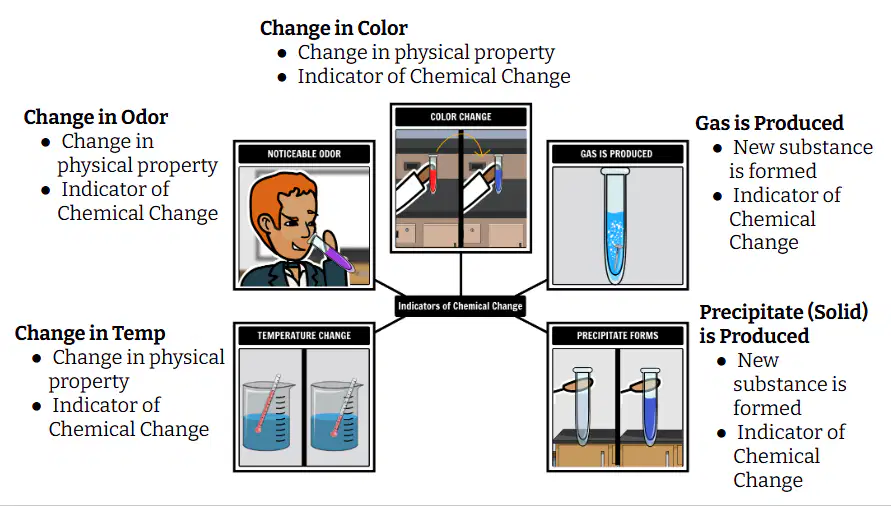
Which of the following is evidence that a chemical change has occurred?

1

A change in phase

2

A change in odor

3

A new substance is formed.

4

A change in density

17

Multiple Choice

Question image

Baking soda and vinegar chemically change. What evidence supports a chemical change?

1

The baking soda dissolves

2

A gas is produced

3

A mixture is formed

4

airColor change

18

Multiple Choice

Which of the following is an example of a chemical property of sulfur?

1

Brittleness

2

Yellow

3

Odorless

4

Combustible

5

Non-conductive

19

media

20

media

21

media

22

media

23

media

24

media

25

media

26

Multiple Choice

Which of the following elements will form a cation?

1

Na

2

Si

3

Br

27

media

28

media

29

media

30

media

31

media

32

media

33

media

34

media

35

Dropdown

​
lose electrons to form ​
charged ions.

​
gain electrons to form ​
charged ions

These opposite charges can be used to for a(n) ​
bond

36

Multiple Choice

What type of bond is formed when atoms share electrons?

1

Covalent Bond

2

Ionic Bond

3

Both Ionic and Covalent Bonds

37

Multiple Choice

What type of bond forms between two nonmetals

1

Covalent Bond

2

Ionic Bond

3

Both Ionic and Covalent Bonds

38

Multiple Choice

What type of bond forms in order for the two elements to obtain a full valence shell of electrons?

1

Covalent Bond

2

Ionic Bond

3

Both Ionic and Covalent Bonds

39

Fill in the Blanks

An element has 6 valence electrons and will form covalent bonds with other atoms. How many single covalent bonds does it need to form to get a full 8 valence electrons?

Type answer...

40

Fill in the Blanks

An element has 4 valence electrons and will form covalent bonds with other atoms. How many single covalent bonds does it need to form to get a full 8 valence electrons?

Type answer...

41

Fill in the Blanks

An element has 5 valence electrons and will form covalent bonds with other atoms. How many single covalent bonds does it need to form to get a full 8 valence electrons?

Type answer...

42

Fill in the Blanks

An element has 7 valence electrons and will form covalent bonds with other atoms. How many single covalent bonds does it need to form to get a full 8 valence electrons?

Type answer...

43

media

44

media

45

media

46

media

47

media

48

media

49

media

50

media

51

media

52

media

53

Dropdown

CaBr2


Ionic or Covalent? ​


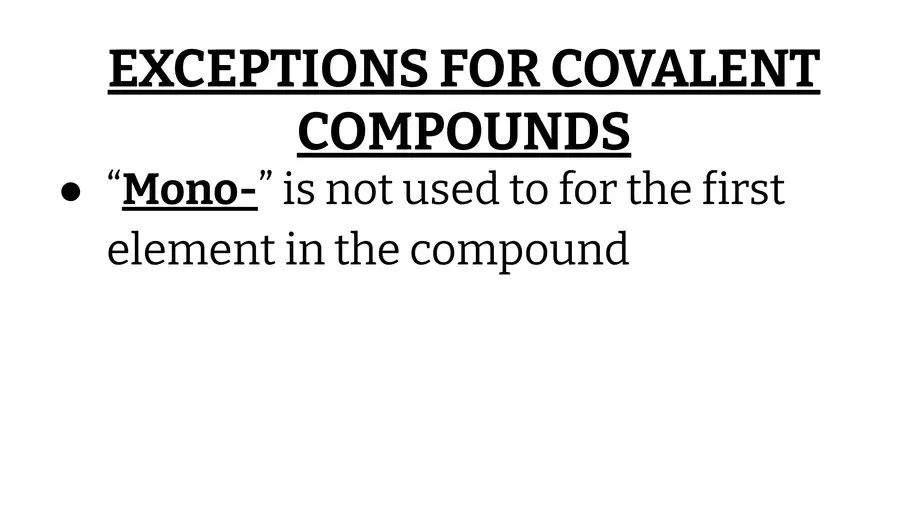
Does this compound need prefixes when being named? ​


Name the compound: ​

54

Dropdown

N2O5


Ionic or Covalent? ​


Does this compound need prefixes when being named? ​


Name the compound: ​

55

Dropdown

Li3N


Ionic or Covalent? ​


Does this compound need prefixes when being named? ​


Name the compound: ​

56

Dropdown

MgO


Ionic or Covalent? ​


Does this compound need prefixes when being named? ​


Name the compound: ​

57

Dropdown

CCl4


Ionic or Covalent? ​


Does this compound need prefixes when being named? ​


Name the compound: ​

58

media
GAS LAW REVIEW

59

Multiple Choice

Which graph shows the pressure-temperature relationship expected for an ideal gas?

1
2
3
4

60

Fill in the Blanks

A sample of a gas occupies 6.00 liters at a temperature of 200. K. It the pressure remains constant and the temperature is raised to 600 K, the volume of the gas sample would be

Include 3 sig figs in your answer

Type answer...

61

Multiple Choice

A sample of gas confined in a cylinder with a movable piston is kept at constant pressure. What change in temperature will cause the volume of the gas to double?

1

400. K to 200.K

2

200. K to 400K

3

200K to 800K

4

800 K to 200 K

62

Fill in the Blanks

Determine the temperature, in Kelvin required for 0.0475 mol of gas to fill a balloon to 1.20 L under 0.998 atm pressure. 

Include 3 sig figs in your answer.

Type answer...

63

Fill in the Blanks

Calculate the volume that a 0.323-mol sample of a gas will occupy at 265 K and a pressure of 0.900 atm.

Include 3 sig figs in your answer

Type answer...

64

Multiple Choice

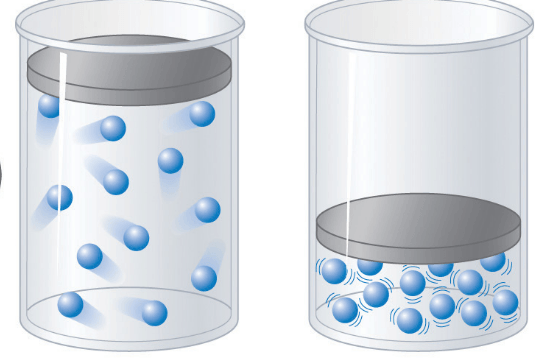
When the temperature of matter increases the particles...
1
speed up and move closer
2
speed up and move farther apart
3
slow down and move closer together
4
slow down and move farther apart

65

Multiple Choice

When Pressure increases then the Volume must...
1
Increase
2
decrease

66

Multiple Choice

When Volume increases then Pressure must...
1
Increase
2
Decrease

67

Multiple Choice

Question image
Which container will have a lower pressure?
1
left
2
right
3
they both have the same pressure
4
I don't know

68

Multiple Choice

Question image
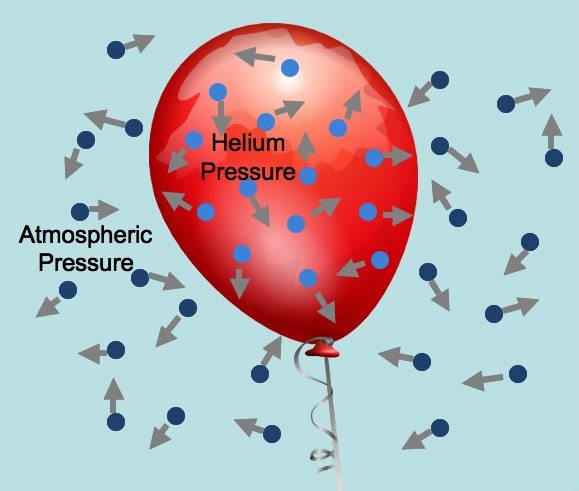
What causes pressure?
1
The walls of the container
2
The vacuum in the container
3
The collisions of the particles
4
Atmospheric pressure acting on the outside walls
pattern-tertiary
media

Show answer

Auto Play

Slide 1 / 68

SLIDE