

Minerals

Presentation
•
Science
•
9th - 12th Grade
•
Hard

James Gonzalez
FREE Resource
33 Slides • 20 Questions
1
A mineral is any naturally-occurring, inorganic solid that has a definite chemical composition and an orderly crystalline structure.

2
3
We will follow the mnemonic device "D.I.N.O.S." to help you remember them.

4
A mineral must have a specific chemical make-up.
5
Multiple Choice
Which of the following is an example of a mineral having a definite chemical composition?
Quartz may display a variety of colors but always has the basic building block silicon dioxide (SiO2).
Pyrite forms cube-shaped crystals.
Concrete always has limestone crushed into its mixture.
6
A mineral may not came from anything living or once-living.
7
Multiple Choice
Which of the following is inorganic?
Calcite
Petrified wood
Coal
Fossil-bearing shale
8
A mineral must be formed by a natural process, it cannot be man-made.
9
Multiple Choice
Which of the following is a naturally occurring mineral?
Concrete
Glass
Ice from your freezer
Ice in a glacier
10
A mineral's atoms must be arranged in an orderly pattern.
11
The arrangement of sodium and chlorine atoms in the crystal structure of halite...

12
...is evident is the shape of its crystals.

13
Multiple Select
Check each of the following that is an example of a mineral's orderly crystal structure?
Iron and sulfur form an ionic bond and crystallize into cube-shaped crystals called pyrite.
Sodium and Chorine form an ionic bond and crystallize into cube-shaped crystals called halite (salt).
Copper is often found as irregularly-shaped "nuggets".
The mineral sulfur smells like rotten eggs.
14
A mineral must be a solid substance, it may not be a liquid or gas.
15
Multiple Select
Under which of the following conditions would water (H2O) be classified as a mineral? (Check all that apply)
Snowflakes falling from the sky.
A stream flowing over rocks.
Ice cubes in your freezer.
Ice in a glacier
Ice in a comet
16
...it is NOT a mineral.

17
Multiple Choice
Which of the following is NOT one of the "D.I.N.O.S." criteria?
Definite origin
Inorganic
Naturally occurring
Solid
18
19
Minerals can be identified through a series of tests of their various properties.

20
Hardness
Cleavage/Fracture
Luster/Color
Streak
Density
Crystal Form
*Other Tests

21
A mineral's hardness is a measure of its resistance to being scratched by another mineral or other object.
The Mohs Hardness Scale is used as a baseline for mineral hardness.
22

23
Multiple Choice
Which of the following minerals tops the Mohs Hardness Scale at a 10?
Diamond
Calcite
Corundum
Talc
24
Multiple Choice
Which of the following minerals would be scratched by all of the others on the Mohs Hardness Scale?
Talc
Diamond
Gypsum
Apatite
25
Cleavage is a mineral's tendency to break along flat, even surfaces due to a plane of weak chemical bonds.
Fracture is a mineral's tendency to break into uneven, irregular surfaces.
26
Multiple Select
Check all of the minerals pictured that display cleavage.
27
Multiple Select
Check all of the minerals pictured that display fracture.
28
Luster is a test of how light is reflected from the reflected from the surface of the mineral.
Color is a noticeable quality that can indicate the presence of different elements within the mineral.
29
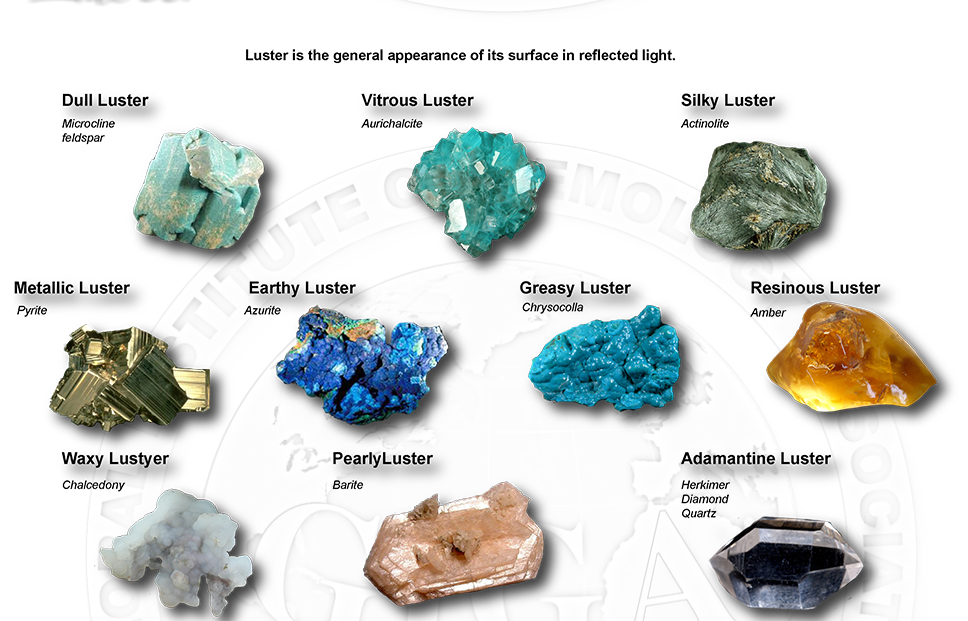
30
Multiple Choice

What type of luster does this mineral display?
Earthy
Pearly
Vitreous (glassy)
Metallic
31
Multiple Choice

Which type of luster does this mineral display?
Metallic
Earthy
Waxy
Silky
32
A mineral's streak is its color in powdered form.
33

34
Fill in the Blanks
To perform a streak test, we rub a mineral across a
Type answer...
35
A mineral's density is determined by dividing its mass by its volume.
36

37
Multiple Choice

A mineral sample has a mass of 35g and a volume of 10cm3. Which of the following is the correct way to calculate it's density?
35g/10cm3 = 3.5 g/cm3
35g X 10cm3 = 3.5 g/cm3
10cm3/35g = 3.5 g/cm3
10cm3 X 350g = 3.5 g/cm3
38
Multiple Choice

Since our sample in the last problem was determined to have a density of 3.5 g/cm3, if the sample is pure, then it is most likely to be which mineral?
Fluorite
Topaz
Chalcopyrite
Quartz
39
When visible, a mineral's crystal form is an expression of a mineral's internal arrangement of atoms.
40

41
Effervescence
Fluorescence
Magnetism
42
43
Crystallization
Precipitation
Metamorphic processes
Hydrothermal processes

44
As magma cools different substances solidify from the magma more quickly than others, creating a mix of different minerals.
The longer a magma takes to cool the more different minerals are produced, and larger mineral crystals are able to grow.
- null

45
Multiple Select
Check all of the following that would result from a slow cooling magma.
An igneous rock with many large mineral crystals
An igneous rock with mostly small mineral crystals
An igneous rock with a variety of different minerals
An igneous rock with a uniform composition
46
(not to be confused with precipitation of water from clouds)
Dissolved elements or ions carried by water will be left behind and crystallize together as water evaporates.

47
Multiple Choice
Which of the following is an example of a mineral forming by precipitation?
Dissolved calcium, sulfate, and water molecules bond together as a lake evaporates, leaving behind deposits of gypsum.
Superheated water cools and leaves copper deposits behind as it flows through cracks and fissures in rock.
Tectonic activity buries a bed of rock deeper beneath the earth, increasing temperature and pressure on the rock, and causing micas in the rock to recrystallize.
A body of magma cools slowly over time, allowing large feldspar crystals to form as it crystallizes into rock.
48
Metamorphic processes involve changing the temperature and/or pressure of existing rock.
Increasing temperature and/or pressure on a mineral causes its atoms to become unstable and rearrange into a structure more suited to the new conditions they are in.

49
Multiple Choice
Which of the following is an example of a mineral forming by metamorphic processes?
Dissolved calcium, sulfate, and water molecules bond together as a lake evaporates, leaving behind deposits of gypsum.
Superheated water cools and leaves copper deposits behind as it flows through cracks and fissures in rock.
Tectonic activity buries a bed of rock deeper beneath the earth, increasing temperature and pressure on the rock, and causing micas in the rock to recrystallize.
A body of magma cools slowly over time, allowing large feldspar crystals to form as it crystallizes into rock.
50
Hydrothermal activity causes super-heated water to move through cracks and pores deep underground.
As it dissolves minerals and carries them through the rock until they cool and recrystallize.

51
Multiple Choice
Which of the following is an example of a mineral forming by hydrothermal processes?
Dissolved calcium, sulfate, and water molecules bond together as a lake evaporates, leaving behind deposits of gypsum.
Superheated water cools and leaves copper deposits behind as it flows through cracks and fissures in rock.
Tectonic activity buries a bed of rock deeper beneath the earth, increasing temperature and pressure on the rock, and causing micas in the rock to recrystallize.
A body of magma cools slowly over time, allowing large feldspar crystals to form as it crystallizes into rock.
52
Open Ended
What question(s) do you have after participating in this lesson? Is there anything else you would like to know about minerals?
53
Remember that you have UNLIMITED attempts to earn a 100%! So review and try again as needed!
A mineral is any naturally-occurring, inorganic solid that has a definite chemical composition and an orderly crystalline structure.
Show answer
Auto Play
Slide 1 / 53
SLIDE
Similar Resources on Wayground

50 questions
Family Members
Presentation
•
9th - 12th Grade
51 questions
AgApps Obj. 4.03 - Breeds
Presentation
•
9th - 12th Grade
50 questions
Climate Change Review
Presentation
•
9th - 12th Grade
50 questions
Electric Circuits
Presentation
•
8th - 11th Grade
45 questions
Evolution PreTest
Presentation
•
9th - 12th Grade
Popular Resources on Wayground
10 questions
How much do you know about our Portrait of an Eagle?

Quiz
•
10th Grade
10 questions
Fast Food Slogans
Quiz
•
6th - 8th Grade
21 questions
Continents and Oceans
Quiz
•
6th Grade
20 questions
Parts of Speech
Quiz
•
5th Grade
16 questions
Subject & Predicate
Quiz
•
5th Grade
25 questions
Multiplication Facts
Quiz
•
5th Grade
12 questions
Map Skills
Quiz
•
3rd Grade
22 questions
Continents and Oceans
Quiz
•
5th Grade
Discover more resources for Science
10 questions
Exploring Chemical and Physical Changes

Interactive video
•
6th - 10th Grade
20 questions
Atomic Structure
Quiz
•
9th Grade
10 questions
Decoding the Periodic Table of Elements
Interactive video
•
6th - 10th Grade
10 questions
Exploring the Periodic Table
Interactive video
•
6th - 10th Grade
14 questions
Physical and Chemical Changes
Quiz
•
10th Grade
22 questions
Periodic Table Review
Quiz
•
9th - 12th Grade
20 questions
Observation vs. Inference
Quiz
•
7th - 9th Grade
14 questions
Periodic Trends
Interactive video
•
11th Grade