

Unit 5 Section 2: Plant Structures

Presentation
•
Science
•
9th - 12th Grade
•
Medium
+2
Standards-aligned

Abby Fancsali
Used 36+ times
FREE Resource
28 Slides • 17 Questions
1
DO NOW: Write what you think the example words mean in your lab manual.
Extra Credit: Find three additional words that use this root and write them and their definition in your lab manual (6 Points Max)

2

The Aroid plant has the largest leaves on Earth, at three meters long. This is comporable to the height of a basketball hoop from the ground These large leaves help the plant to grow and produce flowers and fruit.
3
Multiple Choice
What is the sharpness (clearness) of an image?
revolution
resolution
revelation
solution
4
Dropdown
5
Multiple Choice
To find the total magnification power of a microscope, you need to
add the power of the eyepiece (ocular) by the power of the objective lens
divide the power of the eyepiece (ocular) by the power of the objective lens
subtract the power of the eyepiece (ocular) by the power of the objective lens
multiply the power of the eyepiece (ocular) by the power of the objective lens
6
Labeling
Label each part correctly. Be careful!!
light source
base
eyepiece or ocular lens
coarse adjustment knob
fine adjustment knob
low power objective
arm
diaphragm
7

Describe the functions of roots, and stems
Describe the parts that make up a root
Describe the parts that make up a stem
Describe the functions of leaves, seeds, and flowers
Understand how seeds become new plants
Describe the structure of a flower
8
Parts of a Plant
There are many different structures of a plant, each one plays an important role
The three main structures we will look at are:
Roots
Stems
Leaves

9
Roots
Roots have three functions in a plant
Anchor a plant in the ground
Absorb water and minerals from the soil
The more roots a plant has, the more it can absorb
Store food
Roots are sorted into two different types

10
Fibrous Roots
Fibrous Roots: made up of many similarly sized roots that form a dense, tangled mass
Can pick up a lot of soil when pulled from the ground
Examples: grass, corn, onions

11
Taproots
Taproots: made up of one thick main root, with smaller roots branching off the main roots
Hard to pull out of the ground
Examples: Carrots, dandelions, and cacti

12
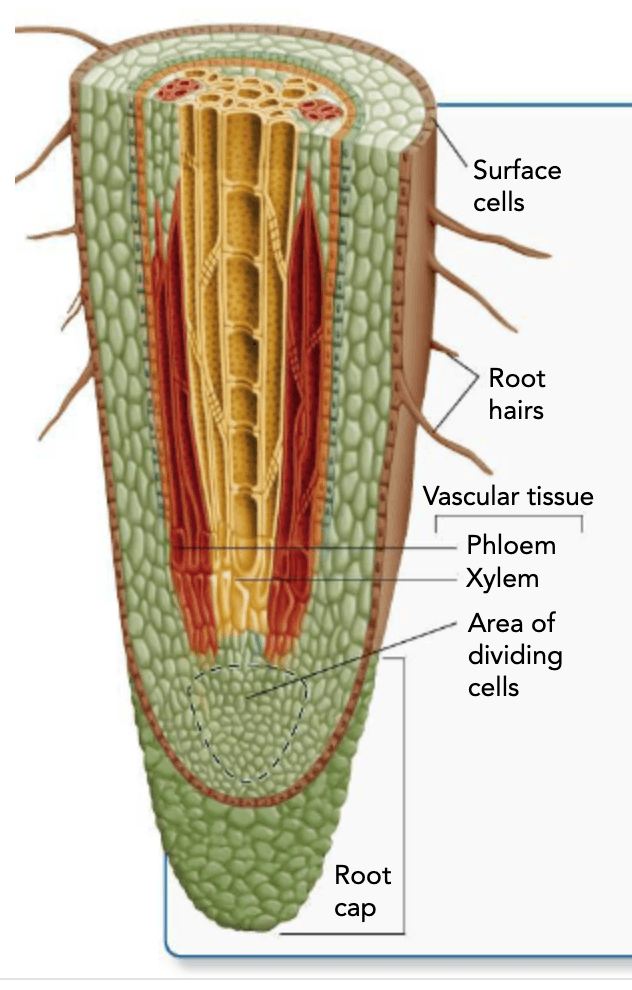
Root Structure
Root Cap: protects the root from injury as the root grows through the soil
Cells directly behind the root cap divide to form new cells
Root Hairs: grow out of the surface of the root
Can enter tight spaces in the soil
absorb water and minerals
Provide extra support
13
Root Tissue
The inside of the root contains vascular tissue, which carries materials throughout the plant
Xylem: Carries water and nutrients up from the roots to the leaves/stem/other parts of the plant
Phloem: Carries food produced by leaves to the roots for storage or growth
14
Multiple Choice
What is the primary function of the root cap?
To protect the root as it grows
To Aachor the plant in the ground
To transport nutrients from the soil to the upper parts of the plants
To transport materials from the leave to the root
15
Multiple Choice
What is the function of the xylem?
To protect the root as it grows
To reach into the soil for nutrients and water
To transport nutrients from the soil to the upper parts of the plants
To transport materials from the leave to the root
16
Multiple Choice
What is the function of the root hairs?
To protect the root as it grows
To reach into the soil for nutrients and water
To transport nutrients from the soil to the upper parts of the plants
To transport materials from the leave to the root
17
Multiple Choice
What is the function of the Phloem?
To protect the root as it grows
To reach into the soil for nutrients and water
To transport nutrients from the soil to the upper parts of the plants
To transport materials from the leave to the root
18
Stem Functions
All stems have two main functions:
Carry materials between the plant's roots and leaves
Provide support for the plant and hold leaves up to the sun
Some stems also store extra food for the plant
Example: Asparagus

19
Stem Types
Two types of stem:
Woody: hard and rigid
Herbaceous: soft and somewhat flexible
Both Contain phloem and xylem tissues


20
Outer Layers of Woody Stems
Woody Stems have many different layers of supporting cells
Bark: The outermost layer of a woody stem
Cork: a hard protective layer of bark
Phloem: The inner layer of bark

21
Inner Layers of Woody Stems
Cambium: The second layer of a woody stem
divides up to make new phloem and xylem
makes up the "wood" of the tree
Sapwood: active xylem that transports water and minerals through the stem
Hardwood: older inactive xylem that gives a tree support

22
Annual Rings
Annual Rings: The rings you see inside a tree that show the yearly growth
Both light and dark rings are made up of xylem
Xylem that forms in the spring grows rapidly
are large with thin walls
Have a lighter color
Xylem that forms in the summer grows more slowly
are smaller and have thicker walls
Have a darker color
One pair of light and dark rings represent one year of growth
Can indicate how conditions were each year
23
Multiple Choice
A tree has 24 light rings and 24 dark rings. How many years old is the tree?
24
48
12
576
24
Multiple Choice
This is the hard outer layer of bark that protects the inside of the tree
Cork
Sapwood
Hardwood
Cambium
25
Multiple Select
Select all of the possible functions of a stem
To carry substances between the roots and leaves
To anchor a plant in the ground
To store food
To provide support for a plant
To break apart soil
26
Multiple Choice
True or false: The stem of a plant is a single solid structure with no layers
True
False
27
Multiple Choice
Which part of the plant is responsible for the absorption of nutrients
Stem
Flowers
Roots
Leaves
28
Leaves
Leaves can vary greatly in size and shape
Can be long and broad like a maple leaf, or thin and skinny like a pine tree needle
Leaves Capture the sun's energy and carry out photosynthesis

29
The Structure of Leaves
The outer surface is the cuticle and has a waxy coating
Helps keep water in the plant
Stomata: small pores on a leaf that open and close to control the flow of gases in and out of the leaf
When open, Carbon dioxide enters while oxygen and water vapor exit

30
Leaves & Photosynthesis
Chloroplasts: specialized cells in a leaf where photosynthesis takes place
Are located close to the leaf's surface, and trap energy from sunlight
Carbon dioxide enters the stomata
Water travels through the xylem from the roots

31
Controlling Water Loss
Transpiration: The process by which water evaporates from a plant's leaves into the air
If a plant starts to become too dry, the stomata will close up to prevent too much water loss

32
Multiple Choice
If you forget to water a houseplant for a few days, would the stomata be open or closed?
Open
Closed
33
Multiple Choice
What is the primary function of leaves
To shade the roots of a plant
To control water loss
To capture the sun's energy for photosynthesis
To protect the plant
34
Seeds
Many plants begin their lives as seeds
Every seed contains a partially developed plant
If a seed lands in an area where conditions are favorable, the plant sprouts out of the seed and begins to grow
There are three main parts to a seed
35
Seed Structure
Embryo: the young plant that develops from the fertilized plant
Already has the beginning of roots, stems, and leaves
Usually stops growing until conditions are good
Cotyledon: Stored food for the embryo to use for growth
Seed Coat: The outer covering of a seed that protects the embryo and keeps it from drying out

36
Seed Dispersal
After seeds form, they are usually scattered
The farther away a seed lands, the better chance it has at survival
Dispersal: The Scattering of seeds
Occurs in many different ways
Animals eat fruit and pass the seeds through the digestive system
Hooking onto the fur of animals
Falling into the water and being carried to new places
Wind carries seeds
Ballistic Scattering: The plant explodes and sends the seeds flying
37
38
Germination
After a seed is dispersed, it may remain inactive for a while
Germination: the moment a plant begins to grow and pushes out of the seed
Is started when a seed absorbs water
Uses the food stored in the cotyledon to grow
Roots grow first, then the stem

39
Flowers
Flower: The reproductive structure of an angiosperm
Flowers have all different shapes, sizes, and colors, but the same function: Reproduction
Pollination: The transfer of pollen from male reproductive structures to female reproductive structures

40
Flower Structures
A typical flower contains the following parts
Sepals
Petals
Reproductive structures
Stamens
Pistils
Some plants have both structures in a single flower, while others have only one

41
Sepals and Petals
Sepals: leaflike structures that protect a developing bud
are often green
Petals: The most colorful part of the flower
Are designed to attract specific pollinators to come to the flower

42
Stamens
Stamens: The male Reproductive structure in plants
Has two parts
Filament: a thin stalk that holds the anther
Anther: the part of the plant that produces pollen

43
Pistils
Pistils: The female reproductive structure in plants
Generally in the center of most flowers
Some plants have multiple pistils
Parts:
Stigma: sticky top part of the pistil
Style: Long tube that connects the stigma to the ovary
Ovary: the base of the Pistil that protects the seeds as they develop

44
Dropdown
45
Dropdown
DO NOW: Write what you think the example words mean in your lab manual.
Extra Credit: Find three additional words that use this root and write them and their definition in your lab manual (6 Points Max)
Show answer
Auto Play
Slide 1 / 45
SLIDE
Similar Resources on Wayground

38 questions
2/3 Intro to Forensics FBISD Austin HS
Presentation
•
9th - 12th Grade
37 questions
Passive and Active Transport
Presentation
•
9th - 12th Grade
37 questions
Periodic Table Review
Presentation
•
9th - 12th Grade
39 questions
Earth Materials: Minerals
Presentation
•
9th - 12th Grade
39 questions
Historical Skills & Evaluating Sources
Presentation
•
9th - 12th Grade
35 questions
Color (light Waves)
Presentation
•
9th - 12th Grade
Popular Resources on Wayground
10 questions
How much do you know about our Portrait of an Eagle?

Quiz
•
10th Grade
10 questions
Fast Food Slogans
Quiz
•
6th - 8th Grade
21 questions
Continents and Oceans
Quiz
•
6th Grade
20 questions
Parts of Speech
Quiz
•
5th Grade
16 questions
Subject & Predicate
Quiz
•
5th Grade
25 questions
Multiplication Facts
Quiz
•
5th Grade
12 questions
Map Skills
Quiz
•
3rd Grade
22 questions
Continents and Oceans
Quiz
•
5th Grade
Discover more resources for Science
10 questions
Exploring Chemical and Physical Changes

Interactive video
•
6th - 10th Grade
20 questions
Atomic Structure
Quiz
•
9th Grade
10 questions
Decoding the Periodic Table of Elements
Interactive video
•
6th - 10th Grade
10 questions
Exploring the Periodic Table
Interactive video
•
6th - 10th Grade
14 questions
Physical and Chemical Changes
Quiz
•
10th Grade
22 questions
Periodic Table Review
Quiz
•
9th - 12th Grade
20 questions
Observation vs. Inference
Quiz
•
7th - 9th Grade
14 questions
Periodic Trends
Interactive video
•
11th Grade