Search Header Logo
Parts of a Chemical Equations

Parts of a Chemical Equations

Assessment

Presentation

Science

7th Grade

Hard

Created by

James Gonzalez

FREE Resource

2 Slides • 19 Questions

1

media

2

Multiple Choice

Question image

Students make pizzas to model different atoms. They use pepperoni slices to represent protons, mushrooms to represent electrons, and pieces of onion to represent neutrons. Which pizza

most accurately models an atom containing 3 protons, 3 electrons, and 3 neutrons?

1
2
3
4

3

Multiple Choice

Question image

Desalination is a method of making fresh water from salt water. A student makes a model desalination factory. The student heats salt water in container 1 and collects fresh water in container 2. The diagram shows the model desalination factory, and the table contains the boiling points of water and salt.

How does the process of desalination demonstrate that salt water is a mixture?

1

The salt water's temperature can increase when placed above a burner.

2

The volume of fresh water in container 2 is less than the salt water in container 1.

3

Two diff erent types of pure substances are collected in container 2.

4

Water can be separated from salt because water has a lower boiling point.

4

To Do:

Today we will look at different word problems and work some of them out with our skittles.

Once done, you may eat your skittles.

Now think back to what we have been working on with chemical equations: Coefficients, Subscripts, Parenthesis, Balanced or Unbalanced

5

Fill in the Blanks

6

Fill in the Blanks

7

Fill in the Blanks

8

Fill in the Blanks

9

Draw

Take 3 different colored skittles and lay out 1 color for each element. Ex: Na, you choose red skittles. How many red skittles do you need for 2Na?

10

Multiple Choice

Question image

Does the following equation support the Law of Conservation of Mass? Show with your skittles.

1

Yes

2

No

11

Multiple Choice

Question image

Does the following equation support the Law of Conservation of Mass? Show your work with your skittles.

1

Yes

2

No

12

Multiple Choice

Question image

Which side is the reactant?

1
2

13

Multiple Choice

Question image

Which side is the product?

1
2

14

Multiple Choice

 If 153 g of iron reacted with 22 g of oxygen gas to form iron oxide, how much iron oxide would be produced if no reactants were left over?

1

153 g - 22 g = 131 g

2

153 g + 22 g = 175 g

15

Multiple Choice

In an experiment, students started with 176.3 grams of reactants.  In a totally closed system, what will be the mass of the products?

1

0 g

2

176.3 g

16

Draw

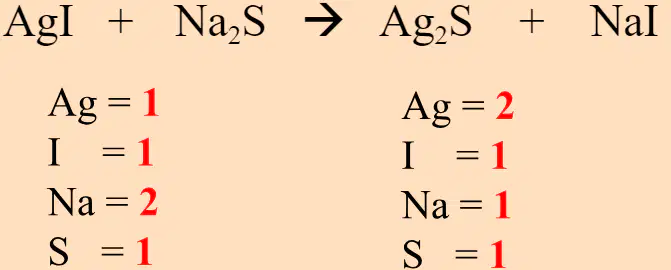
Count the atoms in the equation pictured. Once done, show your work with your skittles.

17

Multiple Choice

Question image

 What is wrong with the previous equation?

1

There is an extra silver (Ag) atom on the reactant side and a missing sulfur (S) atom on the product side.

2

There is an extra silver (Ag) atom on the reactant side and an extra sodium (Na) atom on the product side.

3

There is a missing silver (Ag) atom on the reactant side and a missing sodium (Na) atom on the product side.

4

There is an extra iodine (I) atom on the reactant side and a missing sodium (Na) atom on the product side.

18

Multiple Choice

Question image

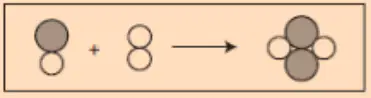
Does the image follow LOCOM? Model with your skittles.

1
The image is unclear about LOCOM.
2
No, the image does not follow LOCOM.
3
Yes, the image follows LOCOM.
4
LOCOM is not applicable to this image.

19

Multiple Choice

Question image

Does this image follow LOCOM? Model with your skittles.

1

Yes

2

No

20

Multiple Choice

Question image

Evaluate the equation attached.  Which model demonstrates the Law of Conservation of Mass according to the equation? Use your skittles.

1
2
3
4

21

Poll

How are you feeling about LOCOM so far?

Great!

Good!

Okay!

Need more help!

media

Show answer

Auto Play

Slide 1 / 21

SLIDE