Geologic Time Lesson
Presentation
•
Science
•
7th Grade
•
Hard

James Gonzalez
FREE Resource
21 Slides • 16 Questions
1
Unit 1: Earth and Space Science
Lesson 5: Geologic Time Scale
2
Multiple Choice
Someone took the last cookie in the cookie jar last night. The last person to leave the scene is the culprit. Who was it?
Clues:
Person A walks to work.
Person B rides a bike.
Person C rides a motorcycle.
Person D drives a car.
Person E travels with a guide dog.
Person A
Person B
Person C
Person D
Person E
3
Let's talk about it!
Who is the culprit?
What evidence did you see that led you to your answer?
4
Answer
Person E is the culprit.
We know that Person E and the dog left most recently because their footprints were on top of all the others.
5
That brings us to... The Law of Superposition!
6
Uniformitarianism
Geological processes that occur today are similar to those that have occurred in the past.
The same processes that we see today have been occurring in Earth's past.
7
Multiple Select
Which geological processes occurring today also occurred in Earth's past?
Weathering
Erosion
Volcanic Eruptions
Extinction of trilobites
8
Fossils
A fossil is the preserved remains or impressions of an organism such as a plant, animal, or insect.
Almost all fossils are preserved in sedimentary rock.
Studying fossils helps scientists to learn about the past history of life on Earth.
9
Index Fossil
Species that existed on Earth for a short length of time, were abundant, and inhabited many locations.
10
Multiple Choice
An index fossil needs to...
...exist in only one spot on the planet.
...be difficult to find.
...have lived for a short period of time.
11
Multiple Choice
The brachiopod would make a good index fossil.
True
False
12
Multiple Choice
The horseshoe crab would make a good index fossil.
True
False
13
Principles of Relative Age Dating
Superposition
Original Horizontality
Lateral Continuity
Erosional Unconformities
Inclusions
Cross-cutting Relationships
14
Law of Superposition
Recall that fossils are present in layers of sedimentary rock.
The Law of Superposition tells us that in a series of undisturbed rock layers, the oldest layer is at the bottom, and the youngest layer is at the top.
15
Multiple Choice
Which layer is oldest?
A
B
C
D
E
16
Multiple Select
Which layer is the youngest?
A
B
C
D
E
17
Open Ended
According to the Law of Superposition, layer 1 was the first layer deposited, so it is the oldest layer. The last layer deposited was layer 12, so it is the youngest layer.
What can this tell us about the age of the fossils that we find in these layers?
18
Answer
The Law of Superposition gives us information about the relative age of different fossils.
Relative age does not tell the exact age of something, but it tells us which object is oldest and which is youngest.
19
Multiple Choice
Which of the following is an example of relative age?
You are older than your sibling
You are 14 and your sibling is 12
20
Original Horizontality
Most rock-forming materials are deposited in horizontal layers.
21
Lateral Continuity
Sediments are deposited in large, continuous sheets in all lateral directions.
22
Erosional Unconformities
Breaks or gaps in the rock record.
Angular unconformity can also be called a "folded rock strata"
23
Multiple Choice
Which of the following is not an unconformity?
Disconformity
Angular unconformity
Inconformity
Nonconformity
24
Multiple Choice
What type of unconformity is shown in the picture?
Disconformity
Angular Unconformity
Nonconformity
25
Inclusions
If one rock contains pieces of another rock, the rock containing the pieces is younger than the pieces.
26
Multiple Choice
Which picture shows an inclusion?
27
Cross-cutting Relationships
If one geologic feature cuts across another feature, the feature that cuts across is older.
28
Faults and Intrusions
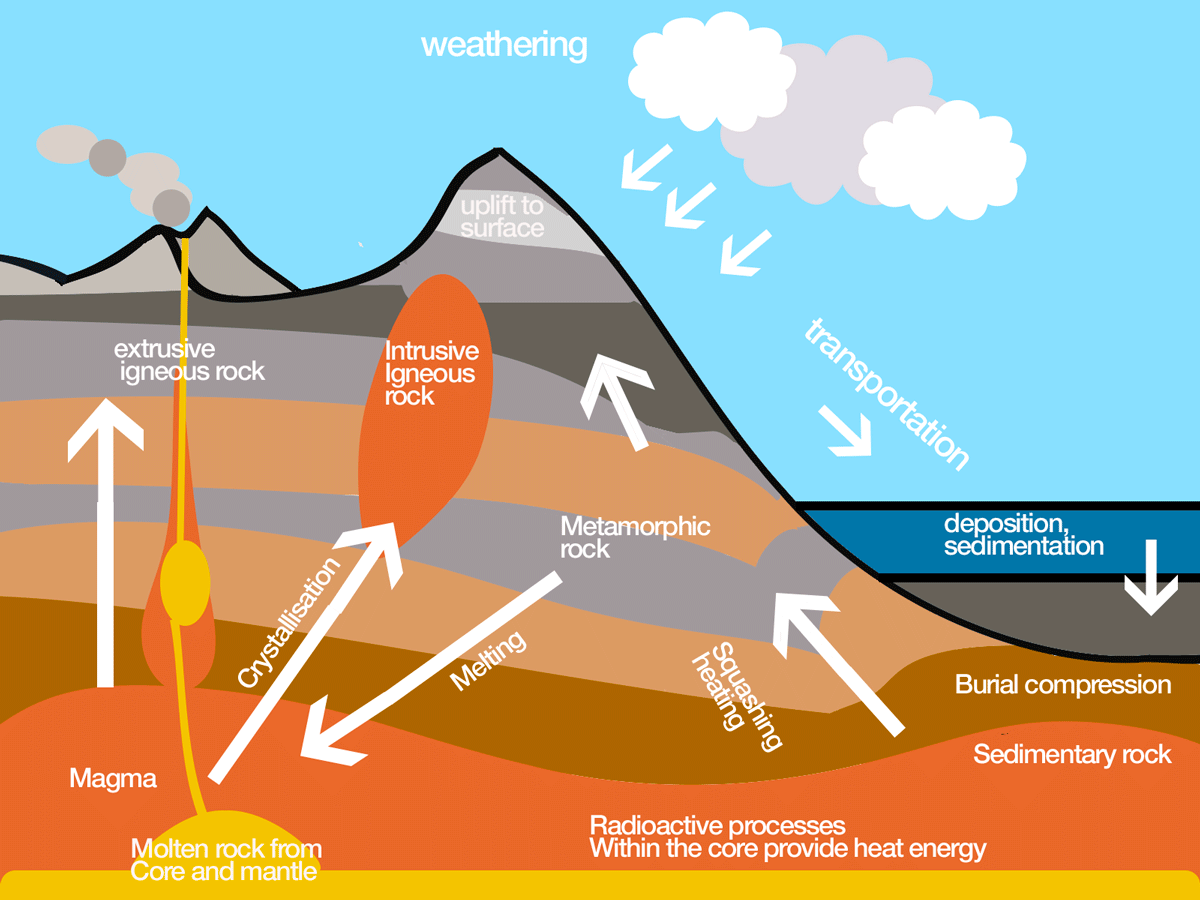
Sometimes, rock layers are disturbed by natural events, creating faults or intrusions.
In these cases, determining relative age can be more difficult.
The Law of Crosscutting Relationships tells us that a fault or intrusion is always younger than all the rocks it cuts through.
29
Faults
Faults occur when rocks break due to the forces acting on them
There are 3 basic types of faults
Normal Fault
Found at divergent plate boundaries
Caused from extension stress; aka "thinning"
Thrust Fault
Found at convergent plat boundaries
Caused from compression stress; aka "folding"
Slip Fault
Found at transform plate boundaries
Caused from shear stress; aka "
30
31
Multiple Choice
Which letter represents the fault?
A
B
C
D
E
32
Intrusions
Intrusions: when magma (lava) penetrates existing rock, crystallizes, and solidifies, forming igneous rock.
Also known as "volcanic dike"
33
Multiple Choice
Which letter represents the intrusion?
A
B
C
D
E
34
Multiple Choice
Fault lines are younger than the rock they cut through.
True
False
35
Open Ended
Let's pull it all together! Based on what we just discussed, put the layers in the correct order, starting with the oldest layer.
36
Let's talk about it!
What order did you put the layers in?
What evidence did you use to put the layers in this order?
37
Answer
K youngest
J
I
H
P
L
M
N
O
Q oldest
Unit 1: Earth and Space Science
Lesson 5: Geologic Time Scale
Show answer
Auto Play
Slide 1 / 37
SLIDE

Similar Resources on Wayground
30 questions
Punnett Squares
Presentation
•
7th Grade
33 questions
Calculating Speed using a Graph
Presentation
•
7th Grade
28 questions
Characteristics of Life - Earth
Presentation
•
7th Grade
32 questions
Light Waves
Presentation
•
6th - 8th Grade
33 questions
Tropic levels
Presentation
•
7th Grade
31 questions
Space Unit Notes
Presentation
•
7th Grade
31 questions
Factors Affecting Climate
Presentation
•
6th Grade
28 questions
Magnetic Forces and Electrictromagnetism
Presentation
•
7th Grade
Popular Resources on Wayground
10 questions
5.P.1.3 Distance/Time Graphs
Quiz
•
5th Grade
10 questions
Fire Drill
Quiz
•
2nd - 5th Grade
20 questions
Equivalent Fractions
Quiz
•
3rd Grade
22 questions
School Wide Vocab Group 1 Master
Quiz
•
6th - 8th Grade
20 questions
Main Idea and Details
Quiz
•
5th Grade
20 questions
Context Clues
Quiz
•
6th Grade
20 questions
Inferences
Quiz
•
4th Grade
12 questions
What makes Nebraska's government unique?
Quiz
•
4th - 5th Grade
Discover more resources for Science
19 questions
Introduction to Properties of Waves
Presentation
•
6th - 8th Grade
16 questions
Interactions within Ecosystems
Presentation
•
6th - 8th Grade
10 questions
Exploring the Layers of the Earth
Interactive video
•
6th - 10th Grade
16 questions
Photosynthesis and Cellular Respiration Review
Quiz
•
7th Grade
20 questions
Abiotic & Biotic Factors
Quiz
•
7th Grade
10 questions
Exploring the Evolution of Cell Theory
Interactive video
•
7th Grade
17 questions
Human body systems
Quiz
•
7th Grade
20 questions
Energy Transformations
Quiz
•
6th - 8th Grade