

Structure and Function of Cells

Presentation
•
Science
•
7th Grade
•
Practice Problem
•
Medium
+3
Standards-aligned

Barbara White
Used 98+ times
FREE Resource
13 Slides • 22 Questions
1

Middle School

2
Describe Cell Theory and differentiate between prokaryotic and eukaryotic cells.
Explain how the structure of organelles relates to their functions.
Explain how the form of specialized cells fits their function.
Explain how cell size is limited and how cells maintain homeostasis.


3
Key Vocabulary

Cell Theory
The fundamental principle that all life is made of cells, which are the basic unit of life.

Prokaryote
A simple cell type that lacks a true nucleus and other membrane-bound organelles inside it.

Eukaryote
A complex cell type that contains a distinct nucleus and many membrane-bound organelles inside.

Selective Permeability
The cell membrane's property of allowing only certain substances to pass, controlling the cell's internal environment.

Specialized Cell
A cell whose unique structure, such as its shape, allows it to perform a specific function.

Homeostasis
The essential process by which a cell actively maintains a stable and constant internal environment.
4
Key Vocabulary

Mitochondrion
This organelle converts chemical energy from food into ATP, the main energy source for the cell.

Ribosome
A small particle of RNA and protein that builds new proteins using instructions from the DNA.
5
Prokaryotic Cells
These cells are usually much smaller and simpler in their overall structural organization.
They do not have a nucleus; the DNA is located in a region called the nucleoid.
Organisms like bacteria and archaea are examples of prokaryotes.

Eukaryotic Cells

These cells are typically larger in size and are significantly more complex.
Their defining feature is a nucleus, which contains and protects the cell's DNA.
Plants, animals, fungi, and protists are all composed of eukaryotic cells.
6
Multiple Choice
What is the main structural difference between a eukaryotic cell and a prokaryotic cell?
The presence of a nucleus in eukaryotic cells.
The size of the DNA in prokaryotic cells.
The types of organisms they are found in.
The overall color and shape of the cells.
7
Multiple Choice
How do prokaryotic and eukaryotic cells compare in terms of their overall structural organization?
Prokaryotic cells are simpler and smaller, while eukaryotic cells are more complex and larger.
Prokaryotic cells are always found in animals, while eukaryotic cells are found in bacteria.
Prokaryotic cells contain a nucleus, while eukaryotic cells have a nucleoid.
Prokaryotic cells are more complex, while eukaryotic cells are much simpler in structure.
8
Multiple Choice
A scientist discovers a new organism. Its cells are small and simple, and they lack a nucleus. Based on this evidence, what is the most likely classification for this organism?
A type of bacterium
A type of plant
A type of fungus
A type of animal
9
The Cell Membrane: A Protective Barrier
The cell membrane has two layers of phospholipids, called a phospholipid bilayer.
Hydrophilic heads face outwards, while hydrophobic tails face inwards, creating a barrier.
Its structure makes the membrane selectively permeable, controlling what enters and exits.
Proteins within the membrane act as channels and receptors for the cell.


10
Multiple Choice
What is the main purpose of the cell membrane?
To control what enters and exits the cell.
To produce energy for the cell's activities.
To store the cell's genetic material.
To provide the cell with a rigid structure.
11
Multiple Choice
How does the structure of phospholipids cause the cell membrane to form a bilayer?
Hydrophilic heads face water, and hydrophobic tails face away from water.
Protein channels push the two layers of phospholipids apart.
Both layers are made entirely of water-loving hydrophilic heads.
The membrane is a single, solid layer rather than two.
12
Multiple Choice
If a large molecule like glucose cannot pass directly through the phospholipid bilayer, what is the most probable way it can enter the cell?
It would likely pass through a protein channel.
It would be unable to enter the cell.
It would dissolve a hole in the phospholipid layer.
It would be broken down outside the cell.
13
The Protein Pathway: From DNA to Delivery
The protein production process starts in the nucleus, protecting the cell's DNA.
Ribosomes create proteins, which the rough ER helps fold and modify.
The Golgi apparatus then tags and packages proteins into small vesicles.
Vesicles carry these finished proteins to their final destinations in the cell.

14
Multiple Choice
What is the primary role of the nucleus in the journey of a protein?
It sends out instructions for building them.
It assembles the proteins piece by piece.
It packages proteins into vesicles for transport.
It modifies proteins and makes lipids.
15
Multiple Choice
What is the relationship between a ribosome and the Rough ER during protein production?
The ribosome assembles the protein, and the Rough ER modifies it.
The Rough ER makes lipids, and the ribosome transports them.
The ribosome protects the DNA, and the Rough ER sends instructions.
The Rough ER assembles the protein, and the ribosome packages it.
16
Multiple Choice
A cell is creating fully modified proteins, but they are not being delivered to their final destinations. Which organelle is most likely malfunctioning and why?
The Golgi apparatus, because it is responsible for packaging proteins for transport.
The nucleus, because it has stopped sending the correct instructions.
The ribosomes, because they are no longer assembling the proteins correctly.
The Smooth ER, because it is not making the required lipids for the cell.
17
Energy Production
Mitochondria are the powerhouses of the cell, converting food energy into ATP.
The inner membrane has folds called cristae that increase the surface area for these reactions.
Chloroplasts capture light energy for photosynthesis using membranes called thylakoids.

Storage and Recycling

Vacuoles are membrane sacs that are used for storage inside the cell.
Plant cells have a large central vacuole that stores water to keep the cell firm.
Lysosomes contain digestive enzymes to break down and recycle cellular waste and old organelles.

18
Multiple Choice
What is the main purpose of the cell's mitochondria?
To convert food energy into usable ATP.
To store water and keep the cell firm.
To break down and recycle cellular waste.
To capture light energy for photosynthesis.
19
Multiple Choice
What is the key difference between how a central vacuole and a lysosome function within a cell?
The vacuole is primarily for storage, while the lysosome is for recycling.
The vacuole produces energy, while the lysosome helps with photosynthesis.
Both organelles work together to convert food into ATP.
Both organelles are responsible for giving the plant cell its firm shape.
20
Multiple Choice
A scientist notes that a cell's energy production has decreased. They determine the problem is not with capturing light energy, but with the efficiency of the conversion process itself. Which explanation best fits these observations?
The folds, or cristae, in the mitochondria have been damaged, reducing the surface area for reactions.
The thylakoid membranes in the chloroplasts are not capturing enough light.
The central vacuole has lost too much water, causing the cell to wilt.
The lysosomes have released their digestive enzymes into the cell.
21
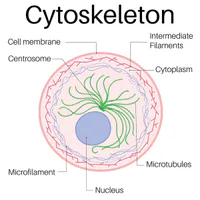
The Cytoskeleton
This is an internal network of protein fibers that gives the cell its shape and helps it move.
This network provides support and acts like a system of tracks for moving things around inside the cell.
It includes microtubules that form cilia and microfilaments that are responsible for the shape and movement of the cell.
The Cell Wall

This is a rigid layer found outside the cell membrane in plants, fungi, and many prokaryotes.
In plant cells, the cell wall is made of a strong, fibrous material called cellulose.
Its main job is to provide the cell with structural support, protection, and a fixed shape.
22
Multiple Choice
What is the main purpose of a cell's structural components like the cytoskeleton and cell wall?
To help the cell create energy from sunlight.
To control all of the cell's activities and store DNA.
To provide the cell with shape, support, and protection.
To regulate what enters and leaves the cell.
23
Multiple Choice
How do the roles of the cytoskeleton and the cell wall differ in a plant cell?
The cytoskeleton is an internal network for movement, while the cell wall is a rigid external layer for protection.
The cytoskeleton is only found in plant cells, while the cell wall is found in all cells.
The cytoskeleton is made of cellulose, while the cell wall is made of protein fibers.
The cytoskeleton stores water, while the cell wall helps the cell make food.
24
Multiple Choice
If the microtubules within a cell's cytoskeleton were damaged, what would be the most likely consequence?
The cell would lose its rigid, fixed shape.
The movement of materials inside the cell would be disrupted.
The cell membrane would be unable to let anything pass through.
The cell would be unable to produce protein fibers.
25
Specialized Cells
Neurons have long axons to transmit signals over long distances throughout the body.
Red blood cells lack a nucleus, leaving more room for hemoglobin to carry oxygen.
Root hair cells in plants have long extensions to absorb more water from soil.

Levels of Organization

Similar cells with a shared function group together to form a single tissue.
Different tissues are arranged into an organ to perform a much larger, complex task.
Multiple organs link to create an organ system that completes a major body function.
26
Multiple Choice
What is formed when a group of similar cells with a shared function work together?
A specialized cell
A tissue
An organ
An organ system
27
Multiple Choice
Why do neurons, red blood cells, and root hair cells all have very different shapes and features?
They are all part of the same organ system.
Their structures are adapted to perform a specific, different job.
One type of cell is more important to the body than the others.
They are located in different parts of an organism.
28
Multiple Choice
The stomach is an organ that uses muscle tissue to churn food and glandular tissue to release digestive acids. Which statement best explains how this arrangement achieves a major body function?
A single type of specialized cell groups together to form a complete organ system.
An organ is made of one type of tissue that performs all the body's major functions.
Different tissues are arranged into an organ that is part of an organ system to carry out a major function.
An organ system is the simplest level of organization, which then forms tissues and organs.
29
Surface Area to Volume
Cells exchange materials like nutrients and waste through their surface, the cell membrane.
As a cell grows, its volume increases much faster than its surface area.
A high surface-area-to-volume ratio is more efficient for moving materials in and out.

Keeping a Balance

Cells must keep their internal environment stable, a process known as homeostasis.
The cell membrane is selective, controlling what substances can pass in and out.
Sensors on the cell’s surface detect changes and trigger responses to maintain balance.
30
Multiple Choice
What is the process by which a cell maintains a stable internal environment?
Homeostasis
Surface tension
Cellular growth
Material exchange
31
Multiple Choice
Why is a high surface-area-to-volume ratio important for a cell's survival?
It allows for faster movement of nutrients and waste across the cell membrane.
It helps the cell store a larger volume of water.
It makes the cell membrane thicker and stronger.
It reduces the number of sensors on the cell's surface.
32
Multiple Choice
What would most likely happen if a cell grew to a very large size?
The cell would not be able to move enough nutrients in and waste out to survive.
The cell's membrane would become too selective and let nothing pass through.
The cell would be able to respond more quickly to changes in its environment.
The cell's volume would decrease to match its surface area.
33
Misconception | Correction |
|---|---|
Plant cells have a cell wall instead of a cell membrane. | Plant cells have both a cell wall and a cell membrane. |
Bigger cells are more efficient than smaller cells. | Smaller cells are more efficient at transporting materials. |
All cells are simple and have a round shape. | Cells have specialized shapes and sizes to perform specific jobs. |
34
All life is made of prokaryotic or eukaryotic cells with membranes and walls.
The nucleus, ribosomes, ER, and Golgi work together to produce and ship proteins.
Mitochondria create energy from food, while chloroplasts create food from light.
Specialized cells form tissues and organs, and their small size helps with transport.
35
Poll
On a scale of 1-4, how confident are you about the concepts covered in today's review?
1
2
3
4
Middle School
Show answer
Auto Play
Slide 1 / 35
SLIDE
Similar Resources on Wayground

25 questions
7th Science- Energy Transfer in Ecosystems
Presentation
•
7th Grade
27 questions
Atoms, Elements, Molecules, & Compounds
Presentation
•
7th - 8th Grade
29 questions
Limiting Factors and Carrying Capacity
Presentation
•
7th Grade
27 questions
Describing Phase Change at Two Scales
Presentation
•
7th Grade
27 questions
Chemical and Physical Change
Presentation
•
7th Grade
30 questions
Organisms and their Environment Review
Presentation
•
7th Grade
32 questions
Digestive System
Presentation
•
7th Grade
29 questions
Air Pollution
Presentation
•
7th Grade
Popular Resources on Wayground
21 questions
Continents and Oceans

Quiz
•
6th Grade
20 questions
Parts of Speech
Quiz
•
5th Grade
16 questions
Subject & Predicate
Quiz
•
5th Grade
25 questions
Multiplication Facts
Quiz
•
5th Grade
12 questions
Map Skills
Quiz
•
3rd Grade
22 questions
Continents and Oceans
Quiz
•
5th Grade
15 questions
Rounding Decimals
Quiz
•
5th Grade
20 questions
Brand Labels
Quiz
•
5th - 12th Grade
Discover more resources for Science
17 questions
7.6D Aqueous Solutions
Quiz
•
7th Grade
20 questions
Claim, Evidence and Reasoning (CER)
Quiz
•
6th - 8th Grade
10 questions
Exploring Chemical and Physical Changes

Interactive video
•
6th - 10th Grade
16 questions
Photosynthesis and Cellular Respiration Review
Quiz
•
7th Grade
20 questions
Food Webs + Energy Pyramids
Quiz
•
7th Grade
24 questions
Cell Organelles
Quiz
•
7th Grade
20 questions
Human Body Systems
Quiz
•
7th Grade
10 questions
Exploring the Periodic Table
Interactive video
•
6th - 10th Grade